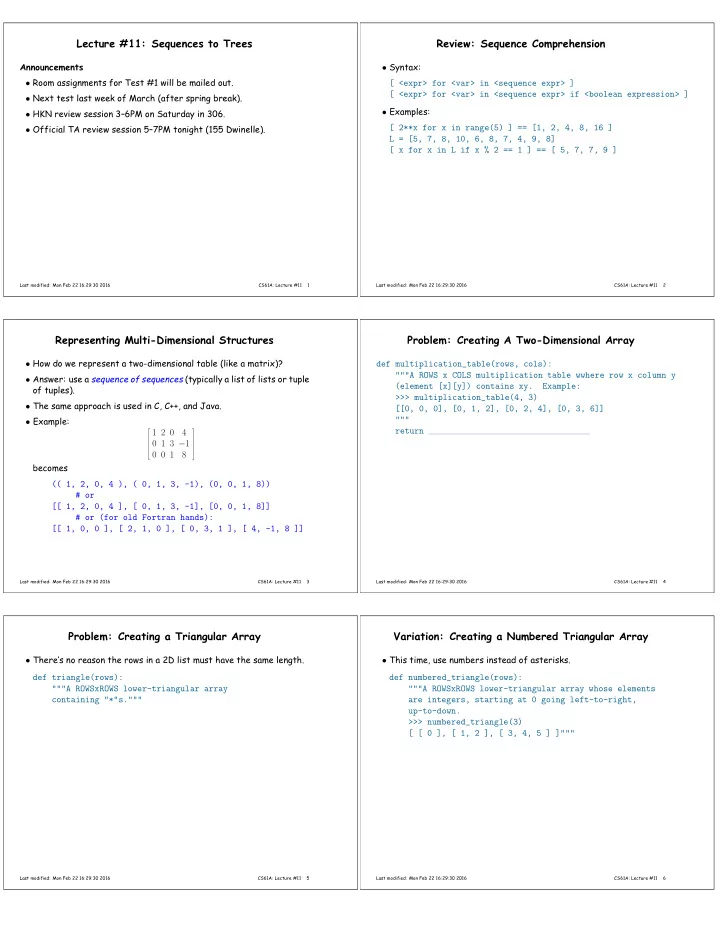

Lecture #11: Sequences to Trees
Announcements
- Room assignments for Test #1 will be mailed out.
- Next test last week of March (after spring break).
- HKN review session 3–6PM on Saturday in 306.
- Official TA review session 5–7PM tonight (155 Dwinelle).
Review: Sequence Comprehension
- Syntax:
[ <expr> for <var> in <sequence expr> ] [ <expr> for <var> in <sequence expr> if <boolean expression> ]
- Examples:
[ 2**x for x in range(5) ] == [1, 2, 4, 8, 16 ] L = [5, 7, 8, 10, 6, 8, 7, 4, 9, 8] [ x for x in L if x % 2 == 1 ] == [ 5, 7, 7, 9 ]
Last modified: Mon Feb 22 16:29:30 2016 CS61A: Lecture #11 2Representing Multi-Dimensional Structures
- How do we represent a two-dimensional table (like a matrix)?
- Answer: use a sequence of sequences (typically a list of lists or tuple
- f tuples).
- The same approach is used in C, C++, and Java.
- Example:
1 2 0 4 0 1 3 −1 0 0 1 8
becomes (( 1, 2, 0, 4 ), ( 0, 1, 3, -1), (0, 0, 1, 8)) # or [[ 1, 2, 0, 4 ], [ 0, 1, 3, -1], [0, 0, 1, 8]] # or (for old Fortran hands): [[ 1, 0, 0 ], [ 2, 1, 0 ], [ 0, 3, 1 ], [ 4, -1, 8 ]]
Last modified: Mon Feb 22 16:29:30 2016 CS61A: Lecture #11 3Problem: Creating A Two-Dimensional Array
def multiplication_table(rows, cols): """A ROWS x COLS multiplication table wwhere row x column y (element [x][y]) contains xy. Example: >>> multiplication_table(4, 3) [[0, 0, 0], [0, 1, 2], [0, 2, 4], [0, 3, 6]] """ return
Last modified: Mon Feb 22 16:29:30 2016 CS61A: Lecture #11 4Problem: Creating a Triangular Array
- There’s no reason the rows in a 2D list must have the same length.
def triangle(rows): """A ROWSxROWS lower-triangular array containing "*"s."""
Last modified: Mon Feb 22 16:29:30 2016 CS61A: Lecture #11 5Variation: Creating a Numbered Triangular Array
- This time, use numbers instead of asterisks.
def numbered_triangle(rows): """A ROWSxROWS lower-triangular array whose elements are integers, starting at 0 going left-to-right, up-to-down. >>> numbered_triangle(3) [ [ 0 ], [ 1, 2 ], [ 3, 4, 5 ] ]"""
Last modified: Mon Feb 22 16:29:30 2016 CS61A: Lecture #11 6