Queues (First In First Out: FIFO) A queue is usually depicted - - PowerPoint PPT Presentation

queues first in first out fifo
SMART_READER_LITE
LIVE PREVIEW

Queues (First In First Out: FIFO) A queue is usually depicted - - PowerPoint PPT Presentation

CS206 CS206 Queues (First In First Out: FIFO) A queue is usually depicted horizontally. One end of the queue is the rear (or tail), where elements A queue is a collection whose elements are added on one are added (enqueued). end and


slide-1
SLIDE 1

CS206

Queues (First In First Out: FIFO)

  • A queue is a collection whose elements are added on one

end and removed from the other.

  • Therefore a queue is processed in a FIFO fashion: first in,

first out.

  • Elements are removed in the same order they arrive.
  • Any waiting line is a queue:

– the check out line at a grocery store, – the cars at a stop light, – an assembly line.

  • Queue = FIFO, Stack = LIFO

CS206

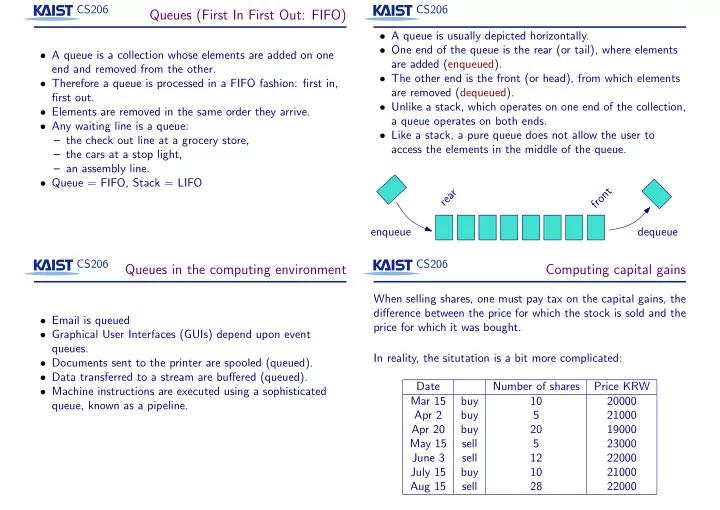
  • A queue is usually depicted horizontally.
  • One end of the queue is the rear (or tail), where elements

are added (enqueued).

  • The other end is the front (or head), from which elements

are removed (dequeued).

  • Unlike a stack, which operates on one end of the collection,

a queue operates on both ends.

  • Like a stack, a pure queue does not allow the user to

access the elements in the middle of the queue. enqueue dequeue front rear CS206

Queues in the computing environment

  • Email is queued
  • Graphical User Interfaces (GUIs) depend upon event

queues.

  • Documents sent to the printer are spooled (queued).
  • Data transferred to a stream are buffered (queued).
  • Machine instructions are executed using a sophisticated

queue, known as a pipeline. CS206

Computing capital gains

When selling shares, one must pay tax on the capital gains, the difference between the price for which the stock is sold and the price for which it was bought. In reality, the situtation is a bit more complicated: Date Number of shares Price KRW Mar 15 buy 10 20000 Apr 2 buy 5 21000 Apr 20 buy 20 19000 May 15 sell 5 23000 June 3 sell 12 22000 July 15 buy 10 21000 Aug 15 sell 28 22000

slide-2
SLIDE 2

CS206

Computing capital gains

The standard accounting principe for capital gains valuation is first-in-first-out (FIFO). Algorithm:

  • When buying shares, enqueue number of shares and cost.
  • When selling n shares:

– Look at oldest shares (front of the queue). Let their number be m. – If n < m, then compute profit for n shares based on price difference. Decrease number of oldest shares. – Otherwise, compute profit for m shares based on price

  • difference. Dequeue oldest shares. Let n ← n − m, and

repeat. CS206

Implementing a Queue

  • As a Python list:

is_empty and front constant time. enqueue constant time on average. But dequeue takes time linear in the size of the queue!

  • Can we make a “linked queue” with constant time per
  • peration, similar to our linkedstack?

The problem is that we need to modify the linked structure

  • n both ends. We’ll look at this later!
  • Using two Python lists: All operations take constant time
  • n average.
  • Can we guarantee constant time per operation if the

maximum queue size is known in advance? CS206

Circular buffers

Implementing a stack using an array is easy—just keep an index to remember the top of the stack inside the array. Implementing a queue is harder, because we insert and remove elements at two different places. The normal way to do this is using a circular buffer. front rear Since we do not have circular memory, we have to simulate that using a linear array, and two index pointers. When the index reaches the end, it “wraps around” to the beginning. dequeue enqueue empty full CS206

Circular buffers

rear front Empty buffer Enqueue one front rear Enqueue four front rear Dequeue one front rear front rear Enqueue one

slide-3
SLIDE 3

CS206

Circular buffers

front rear Enqueue three front rear Dequeue two front rear Enqueue three front rear Enqueue one more? What does front == rear mean? Full buffer or empty buffer? Typical solution: Forbid filling buffer completely, always keep

  • ne slot free.

(See Circular Buffers on Wikipedia for other solutions.)