Question 1-no right answer Assuming you have living relatives, if - - PowerPoint PPT Presentation

question 1 no right answer
SMART_READER_LITE
LIVE PREVIEW

Question 1-no right answer Assuming you have living relatives, if - - PowerPoint PPT Presentation

3/8/2019 Question 1-no right answer Assuming you have living relatives, if you were diagnosed Genetics of pulmonary hypertension after this meeting with idiopathic PAH, would you seek genetic testing of all known PAH genes? Wendy Chung, MD PhD


slide-1
SLIDE 1

3/8/2019 1

Genetics of pulmonary hypertension

Wendy Chung, MD PhD Kennedy Family Professor of Pediatrics and Medicine Columbia University Assuming you have living relatives, if you were diagnosed after this meeting with idiopathic PAH, would you seek genetic testing of all known PAH genes? a) Yes b) No c) Don’t know d) Don’t care

Question 1-no right answer Question 2-answer C

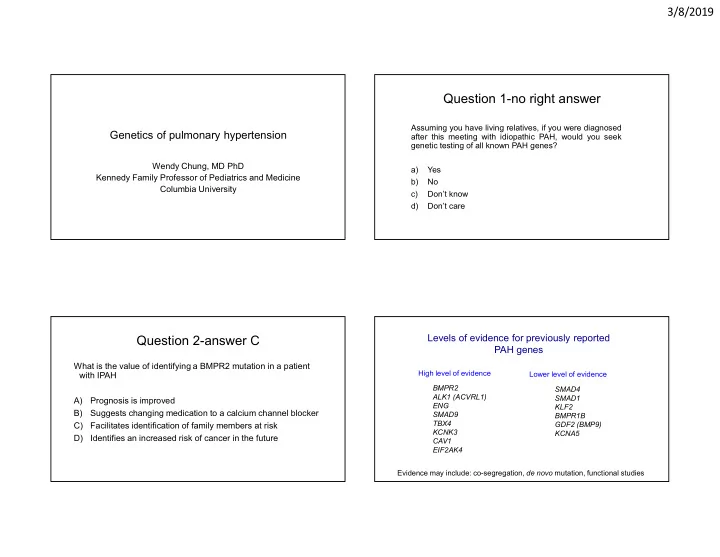
What is the value of identifying a BMPR2 mutation in a patient with IPAH A) Prognosis is improved B) Suggests changing medication to a calcium channel blocker C) Facilitates identification of family members at risk D) Identifies an increased risk of cancer in the future

Levels of evidence for previously reported PAH genes

BMPR2 ALK1 (ACVRL1) ENG SMAD9 TBX4 KCNK3 CAV1 EIF2AK4 SMAD4 SMAD1 KLF2 BMPR1B GDF2 (BMP9) KCNA5 High level of evidence Lower level of evidence Evidence may include: co-segregation, de novo mutation, functional studies

slide-2
SLIDE 2

3/8/2019 2

Smad 4

BMP9/10

BRE Targets (including ID1-4) TF

P P

Smad5

P P

Cav1 Smad8

P P

Smad1

P P

Endoglin BMPRII ALK1

Mutations identified to date in HPAH and PVOD

KCNK3 EIF2AK4

HPAH PVOD/PCH

TBX4 SOX17 ATP13A3

?AQP1

BMPR2 mutations increase the risk of pulmonary hypertension but do not guarantee the person will ever develop pulmonary hypertension

  • Individuals who have a BMPR2 gene mutation are at risk to develop

PH but may never develop the disease.

  • Currently there is NO way to determine if a person with a BMPR2

gene mutation will or will not develop PH

Determinants of penetrance * *

* *

Worse survival in BMPR2 mutation carriers

Evans et al. Lancet Respir Med 2016

p=0.002 Total population p<0.0001 Age<50 At diagnosis No mutation Mutation

Death or transplantation

No mutation Mutation

slide-3
SLIDE 3

3/8/2019 3

Earlier disease onset, poor response to therapy and high rates of transplantation in biallelic EIF2AK4 mutation carriers

Montani et al. Lancet Respir Med 2017

Drug induced pulmonary edema in 23%

  • f mutation carriers

94 PVOD/PCH patients 28% carried biallelic EIF2AK4 mutations

Reasons to Perform Genetic Testing

  • Confirm the diagnosis
  • Avoid additional diagnostic testing (lung biopsy)
  • Refine prognosis
  • Preparation for future molecularly based treatments
  • Inform risk stratification for family members
  • Duty to inform
  • Facilitate early diagnosis of family members
  • Inform reproductive options
  • Preimplantation genetic diagnosis
  • Address patient concerns about etiology: why me?

Resources to Assist With Genetic Testing

  • Family history tools
  • Paper screening tools
  • https://familyhistory.hhs.gov/
  • Educational materials
  • Videos https://www.youtube.com/watch?v=36rlvtj_Qrs
  • https://www.genomicseducation.hee.nhs.uk
  • Genetic Home Reference (https://ghr.nlm.nih.gov/)
  • Genetic Testing Registry (https://www.ncbi.nlm.nih.gov/gtr/)
  • Easier biological samples (saliva, buccal swabs, as well as blood)
  • Telemedicine/video conference options for pre-test and post-test

education and genetic counseling

  • Genetic counseling is critical for unaffected family members

Who Should Have Genetic Testing?

Group I PAH

  • Familial PAH
  • IPAH (greatest number of BMPR2 mutation carriers are in this group)
  • PVOD/PCH
  • Children
slide-4
SLIDE 4

3/8/2019 4 Comparison of Genetic Test Results in Adults and Children

Adult Pediatric (age < 18) FPAH IPAH

N=178 N=79 N=130 N=25

Zhu et al, Circ CV Genetics 2018

What Test to Order?

  • Familial mutation when known
  • BMPR2 including deletion analysis
  • Panels of PAH genes
  • Exomes (after a negative panel)
  • Familial cases
  • Pediatric/early onset cases (with parents to identify de novo mutations)

Management of Mutation Positive/Untested Family Members

  • Monitoring suggestions are not evidence based
  • Annual echocardiogram
  • Immediately evaluate respiratory symptoms/syncope
  • For EIF2AK4 measure diffusion coefficient on pulmonary

function tests