Quarterly Breakfast of Champions February 08, 2019, 7:30am-9:00am - - PowerPoint PPT Presentation

quarterly breakfast of champions
SMART_READER_LITE
LIVE PREVIEW

Quarterly Breakfast of Champions February 08, 2019, 7:30am-9:00am - - PowerPoint PPT Presentation

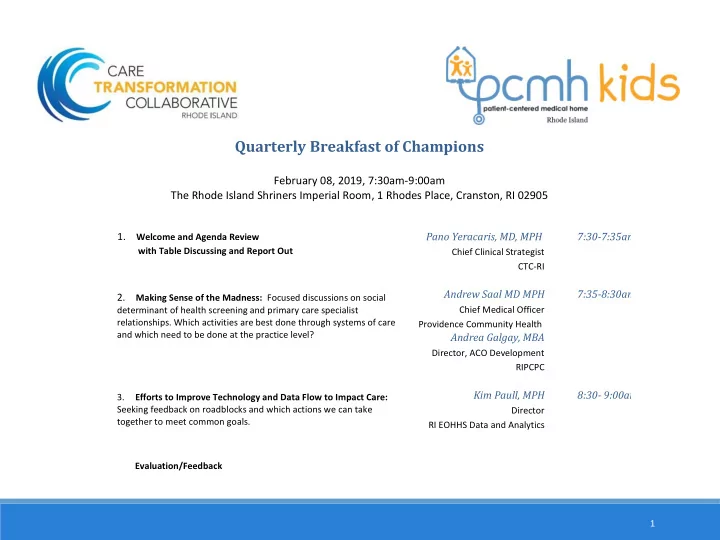
Quarterly Breakfast of Champions February 08, 2019, 7:30am-9:00am The Rhode Island Shriners Imperial Room, 1 Rhodes Place, Cranston, RI 02905 Pano Yeracaris, MD, MPH 7:30-7:35am 1. Welcome and Agenda Review with Table Discussing and Report Out


slide-1
SLIDE 1

1

Quarterly Breakfast of Champions

February 08, 2019, 7:30am-9:00am The Rhode Island Shriners Imperial Room, 1 Rhodes Place, Cranston, RI 02905

  • 1. Welcome and Agenda Review

Pano Yeracaris, MD, MPH 7:30-7:35am

with Table Discussing and Report Out Chief Clinical Strategist CTC-RI

  • 2. Making Sense of the Madness: Focused discussions on social

determinant of health screening and primary care specialist

  • relationships. Which activities are best done through systems of care

and which need to be done at the practice level?

Andrew Saal MD MPH 7:35-8:30am

Chief Medical Officer Providence Community Health

Andrea Galgay, MBA

Director, ACO Development RIPCPC

  • 3. Efforts to Improve Technology and Data Flow to Impact Care:

Seeking feedback on roadblocks and which actions we can take together to meet common goals.

Kim Paull, MPH 8:30- 9:00am

Director RI EOHHS Data and Analytics Evaluation/Feedback

slide-2
SLIDE 2

Making Sense of the Madness …while maintaining your sanity

Care Transformation Collaborative of R.I.

A n d re a G a l ga y, M B A , R h o d e I s l a n d P r i m a r y C a r e P h y s i c i a n s C o r p o ra t i o n A n d re w S a a l , M D M P H , P ro v i d e n c e C o m m u n i t y H e a l t h C e n t e rs P a n o Ye ra c a r i s , M D M P H , C a r e Tra n s f o r m a t i o n C o l l a b o ra t i ve - R I

QUARTERLY BREAKFAST OF CHAMPIONS FRIDAY, FEBRUARY 8, 2019

slide-3
SLIDE 3

The Challenge of Transformation

slide-4
SLIDE 4

Transformation Strategies

Interagency Relationships

Specialist Compacts Continuity of Care Documents Transitions of Care Referrals Management

Population Management

Historical – Top 5% Total Cost Predictive – Who Might Need Help? Health Risk Assessments

Care Team Redesign

Nurse Care Management Community Health Workers Integrated Behavioral Health

Improved Data

EHR-derived data Panel-level data HIE / CurrentCare All-Payer Claims Database

slide-5
SLIDE 5

Population Management

Getting the right resources to the right patient – before they get into trouble But how can you predict who is more likely to have trouble?

slide-6
SLIDE 6

What if someone had a simple tool that could accurately predict a patient’s risk before they decompensated?

slide-7
SLIDE 7

Health Risk Assessments

Which common conditions predict poor health outcomes?

slide-8
SLIDE 8

HRA as a Population Health Strategy If you knew who was more likely to have bad

  • utcomes, then you could steer additional

resources to them to mitigate the problem The Social Determinants of Health are potentially modifiable risk factors!

slide-9
SLIDE 9

SDOH – Everybody Wants to Know

EOHHS Medicaid AE Core Quality Slate

slide-10
SLIDE 10

COLLABORATION WITH SPECIALISTS AND REFERRAL MANAGEMENT

slide-11
SLIDE 11

Reasons for Collaboration

Enhanced management of patient population Standardization of care Aligned incentives ACO/Group ‘preferred’ networks MACRA Product design

slide-12
SLIDE 12

Stakeholders

PCPs Specialists Insurers Hospitals Patient

slide-13
SLIDE 13

Common Issues

Access and Communication – Specialist AND PCP One time consult versus ‘annuity’ Managing patient expectations Fear of offending peers Red tape

slide-14
SLIDE 14

Social Determinants of Health

1) How is your practice screening and capturing that information? 2) What problems have you had with the screening process? What types of problems are patients facing? 3) How are you responding to patient needs that have been identified?

slide-15
SLIDE 15

Referrals Management

1) What drives your referral network / patterns? 2) Who decides which specialist gets the referral? (e.g. front desk based on next available appt, other)? 3) Are there clear expectations with specialists about the clinical question being asked and how to coordinate care (expected number of visits, etc.)?