Quantitative Reasoning + Skills Reasoning (QR): what + why - - PowerPoint PPT Presentation

quantitative reasoning skills
SMART_READER_LITE
LIVE PREVIEW

Quantitative Reasoning + Skills Reasoning (QR): what + why - - PowerPoint PPT Presentation

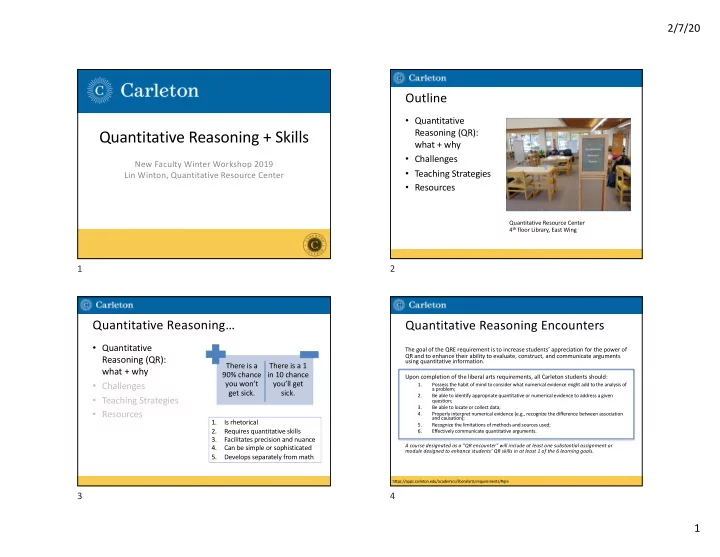
2/7/20 Outline Quantitative Quantitative Reasoning + Skills Reasoning (QR): what + why Challenges New Faculty Winter Workshop 2019 Teaching Strategies Lin Winton, Quantitative Resource Center Resources Quantitative Resource


slide-1
SLIDE 1

2/7/20 1

Quantitative Reasoning + Skills

New Faculty Winter Workshop 2019 Lin Winton, Quantitative Resource Center

1

Outline

  • Quantitative

Reasoning (QR): what + why

  • Challenges
  • Teaching Strategies
  • Resources

Quantitative Resource Center 4th floor Library, East Wing

2

Quantitative Reasoning…

  • Quantitative

Reasoning (QR): what + why

  • Challenges
  • Teaching Strategies
  • Resources

There is a 90% chance you won’t get sick. There is a 1 in 10 chance you’ll get sick.

1. Is rhetorical 2. Requires quantitative skills 3. Facilitates precision and nuance 4. Can be simple or sophisticated 5. Develops separately from math

3

Quantitative Reasoning Encounters

The goal of the QRE requirement is to increase students’ appreciation for the power of QR and to enhance their ability to evaluate, construct, and communicate arguments using quantitative information. Upon completion of the liberal arts requirements, all Carleton students should:

1. Possess the habit of mind to consider what numerical evidence might add to the analysis of a problem; 2. Be able to identify appropriate quantitative or numerical evidence to address a given question; 3. Be able to locate or collect data; 4. Properly interpret numerical evidence (e.g., recognize the difference between association and causation); 5. Recognize the limitations of methods and sources used; 6. Effectively communicate quantitative arguments. A course designated as a "QR encounter" will include at least one substantial assignment or module designed to enhance students’ QR skills in at least 1 of the 6 learning goals.

https://apps.carleton.edu/academics/liberalarts/requirements/#qre

4

slide-2
SLIDE 2

2/7/20 2

Quantitative Reasoning Example

https://www.wunderground.com/forecast/us/mn/Minneapolis, accessed 2019.11.26

5

QR challenges

  • 1. Is rhetorical
  • 2. Requires quantitative

skills

  • 3. Facilitates precision

and nuance

  • 4. Can be simple or

sophisticated

  • 5. Develops separately

from math

Quantitative Reasoning Quantitative Skills Problem-Solving Strategies Mathematics Content Communication Reading Writing

6

QS challenges

  • K-12 coursework varies
  • Challenges common to QS
  • Growth mindset + equity

What students say What students mean “When am I ever going to use this?” I am not making any connections to prior knowledge. “I’m not a math person.” You can’t get better at this with practice. “That’s not what my teacher wants.” This is arbitrary, and I need to memorize it.

Dweck, C. (2006). Mindset : the new psychology of success (1st edition.). New York: Random House.

7

Quantitative Skills

  • When a student is struggling with a QR task, it

can be difficult to tell where the issue lies

  • 1. What is the unknown?
  • 2. What are the knowns?
  • 3. What is the connection?

Example:

Pólya, G. (1957). How to solve it : a new aspect of mathematical

  • method. Princeton, N.J: Princeton University Press.

8

slide-3
SLIDE 3

2/7/20 3

Developing a “habit of mind”

  • 4 questions we can put on assignments, include

in discussions

  • Across disciplines, within disciplines
  • 1. How were the terms defined?
  • 2. Compared to what?
  • 3. Controlling for what?
  • 4. What is the impact?

QR questions adapted from Neil Lutsky’s Ten Foundational QR Questions https://apps.carleton.edu/quirk/curricular/10questions/

9

Developing a “habit of mind”

Eligon, J. (2019, Dec 3). ‘Who Owns Black Art?’: A Question Resounds at Art Basel Miami. The New York Times. Retrieved from https://www.nytimes.com

1. How were the terms defined? 2. Compared to what? 3. Controlling for what? 4. What is the impact?

10

Developing a “habit of mind”

Slide adapted from Nathan Grawe Levin, D. (2019, Dec 2). The Class of 2000 ‘Could Have Been Anything’. The New York Times. Retrieved from https://www.nytimes.com

1. How were the terms defined? 2. Compared to what? 3. Controlling for what? 4. What is the impact?

11

Developing a “habit of mind”

”Women are 68% more likely than men to experience depression in their lifetime.” 21.3% of women experienced depression in their lifetime 12.7% of men experienced depression in their lifetime

Wolfe, J. (2010). Rhetorical Numbers: A Case for Quantitative Writing in the Composition

  • Classroom. College Composition and Communication, 61(3), 452-475.

1. How were the terms defined? 2. Compared to what? 3. Controlling for what? 4. What is the impact?

12

slide-4
SLIDE 4

2/7/20 4

Outline

  • Quantitative

Reasoning (QR): what + why

  • Challenges
  • Teaching Strategies
  • Resources

Quantitative Resource Center 4th floor Library, East Wing

13

What can the QRC help with?

Creating Reading numbers Reading graphs Reading tables Quantitative skills

Peer QR/QS tutors Class visits Faculty workshops 1:1 collaboration Development grants

Posters, presentations, graphic design: Doug Foxgrover Finding data: Kristin Partlo, Sean Leahy, Audrey Gunn Data cleaning, wrangling, R, Tableau: Data Squad Writing: Writing Center tutors Mathematics, Statistics courses: Math Skills Center, CMC computer lab Course-specific help: Prefects, teaching assistants, problem-solving facilitators

Email @Lwinton, http://tinyurl.com/QRCappt

14