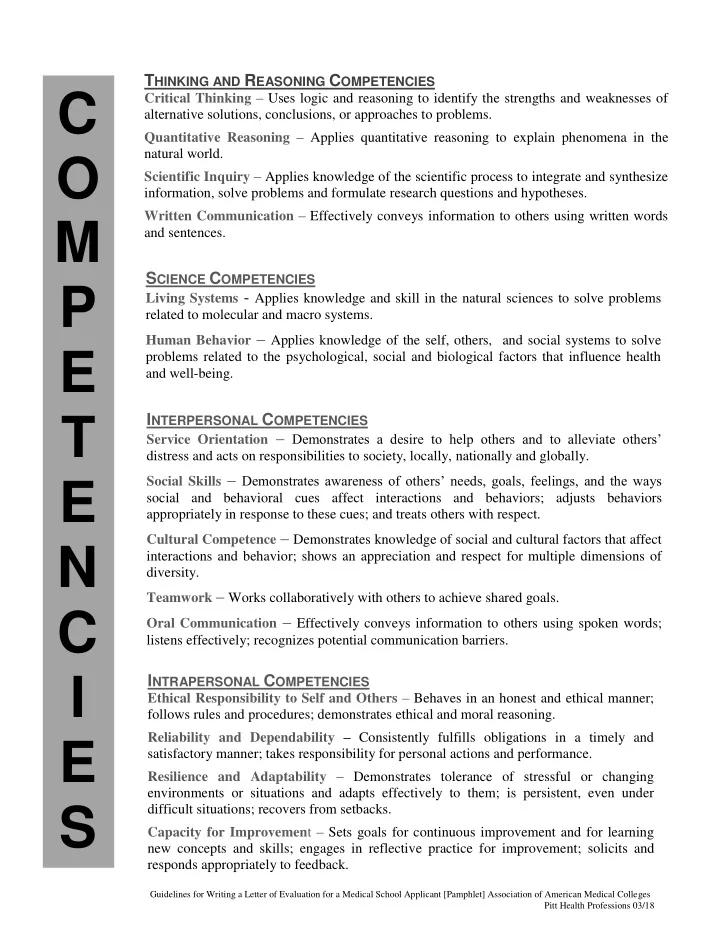

C O M P E T E N C I E S
INTERPERSONAL COMPETENCIES
Service Orientation – Demonstrates a desire to help others and to alleviate others’ distress and acts on responsibilities to society, locally, nationally and globally. Social Skills – Demonstrates awareness of others’ needs, goals, feelings, and the ways social and behavioral cues affect interactions and behaviors; adjusts behaviors appropriately in response to these cues; and treats others with respect. Cultural Competence – Demonstrates knowledge of social and cultural factors that affect interactions and behavior; shows an appreciation and respect for multiple dimensions of diversity. Teamwork – Works collaboratively with others to achieve shared goals. Oral Communication – Effectively conveys information to others using spoken words; listens effectively; recognizes potential communication barriers.
THINKING AND REASONING COMPETENCIES
Critical Thinking – Uses logic and reasoning to identify the strengths and weaknesses of alternative solutions, conclusions, or approaches to problems. Quantitative Reasoning – Applies quantitative reasoning to explain phenomena in the natural world. Scientific Inquiry – Applies knowledge of the scientific process to integrate and synthesize information, solve problems and formulate research questions and hypotheses. Written Communication – Effectively conveys information to others using written words and sentences.
SCIENCE COMPETENCIES
Living Systems - Applies knowledge and skill in the natural sciences to solve problems related to molecular and macro systems. Human Behavior – Applies knowledge of the self, others, and social systems to solve problems related to the psychological, social and biological factors that influence health and well-being.
INTRAPERSONAL COMPETENCIES
Ethical Responsibility to Self and Others – Behaves in an honest and ethical manner; follows rules and procedures; demonstrates ethical and moral reasoning. Reliability and Dependability – Consistently fulfills obligations in a timely and satisfactory manner; takes responsibility for personal actions and performance. Resilience and Adaptability – Demonstrates tolerance of stressful or changing environments or situations and adapts effectively to them; is persistent, even under difficult situations; recovers from setbacks. Capacity for Improvement – Sets goals for continuous improvement and for learning new concepts and skills; engages in reflective practice for improvement; solicits and responds appropriately to feedback.
Guidelines for Writing a Letter of Evaluation for a Medical School Applicant [Pamphlet] Association of American Medical Colleges Pitt Health Professions 03/18