Eyes Wide Open Artists Ikse Matre (France), Vincent - - PDF document

eyes wide open
SMART_READER_LITE
LIVE PREVIEW

Eyes Wide Open Artists Ikse Matre (France), Vincent - - PDF document

Eyes Wide Open Artists Ikse Matre (France), Vincent Breed (Holland) with the complicity of des Vues de lesprit Executive


slide-1
SLIDE 1

Eyes​ ​Wide​ ​Open

Artists Ikse​ ​Maître​ ​(France),​ ​Vincent​ ​Breed​ ​(Holland)

with​ ​the​ ​complicity​ ​of​ ​des​ ​Vues​ ​de​ ​l’esprit

Executive​ ​Director Curators Ricardo​ ​Fernandes Ricardo​ ​Fernandes,​ ​Thierry​ ​Renaudin-Viot La​ ​Nuit​ ​Blanche​ ​-​ ​7​ ​October 2017​ ​from​ ​7pm​ ​to​ ​5am Centre​ ​Culturel​ ​Cloître​ ​des​ ​Billettes,​ ​Marais

24,​ ​rue​ ​des​ ​Archives​ ​-​ ​75004​ ​Paris,​ ​France

slide-2
SLIDE 2

Curiosity​ ​is​ ​a​ ​fluid​ ​that​ ​penetrates​ ​places​ ​and​ ​crosses​ ​time.​ ​It​ ​flows​ ​through​ ​keyholes,​ ​spreads​ ​in

galleries​ ​and​ ​settles​ ​in​ ​museums.​ ​It​ ​drips​ ​and​ ​exposes.​ ​It​ ​lingers​ ​in​ ​the​ ​corners.​ ​Curiosity​ ​covers​ ​works in​ ​its​ ​path.​ ​It​ ​then​ ​discovers​ ​them.

What​ ​if​ ​artworks​ ​were​ ​curious​ ​about​ ​us?

7 October 2017​, curiosity will invade the Cultural Center Cloître des Billettes in Paris. Artworks

will keep their eyes wide open all night to undertake the night owls. Curious of the viewers, they will follow them with their eyes; they will seek their looks; they will change their point of view; they will exchange​ ​their​ ​eyes. Ikse​ ​Maître

1

slide-3
SLIDE 3

Summary

Summary 2 Concept 3 The​ ​Eyes 5 L’Œil​ ​de​ ​Mars​ ​Concept 5 L’Œil​ ​de​ ​Mars​ ​Dramaturgy 5 Concept​ ​of​ ​the​ ​Eyeballs 6 Martien​ ​Collective​ ​Imagination 6 Technical​ ​Developments 7 The​ ​Artists 8 Ikse​ ​Maître 8 Vincent​ ​Breed 9 The​ ​sas​ ​-​ ​des​ ​Vues​ ​de​ ​l’esprit 10 The​ ​Curators 11 Ricardo​ ​Fernandes 11 Thierry​ ​Renaudin-Viot 11 The​ ​Exhibition​ ​Venue 12 Partners 13 General​ ​Information 14 2

slide-4
SLIDE 4

Concept

Eyes Wide Open is a perambulation through the Cultural Center Cloître des Billettes under the

collective gaze of oversized eyeballs. It is a journey between works and public imagined by the French artist Ikse Maître in collaboration with the Dutch artist Vincent Breed. This is a series of winks to share and​ ​glances​ ​wishing​ ​to​ ​share.

3

slide-5
SLIDE 5

The central artwork, ​L’Œil de Mars​, ​in English Eyes Wide Open, by artist Ikse Maître “is a gigantic eye to realistic aesthetics that dialogues with us”. It follows us through the cloister, vaguely interested, incredibly​ ​greedy,​ ​terribly​ ​indiscreet,​ ​slightly​ ​inquisitive​ ​and​ ​fundamentally​ ​curious. To complete those dialogues, ​eyeballs in glass, forty centimeters in diameter were created by the artist Vincent Breed. Hanging from the pillars, emerging from the walls, they give us the impression, all along​ ​the​ ​gallery,​ ​of​ ​being​ ​also​ ​observed​ ​by​ ​the​ ​historical​ ​monument. “There are always two facets of the look: the look that one carries and the look that one reflects. In other words, I look at the other and the other looks at me. It is through the gaze of the other that I become aware​ ​that​ ​I​ ​am​ ​watching.​ ​It​ ​is​ ​the​ ​other​ ​who​ ​reveals​ ​in​ ​me​ ​my​ ​own​ ​point​ ​of​ ​view.”​ ​says​ ​Ikse​ ​Maître. From an artistic and historical point of view, art objects reflect what we create for ourselves and others, symbolizing​ ​our​ ​own​ ​trajectory​ ​and​ ​a​ ​reflection​ ​of​ ​what​ ​we​ ​have​ ​been​ ​or​ ​what​ ​we​ ​are​ ​today. This “double jeu” of gaze allows us to grasp the paths that we borrow. Contemporary art plays its role of writing​ ​our​ ​history​ ​and​ ​exposing​ ​it​ ​collectively. The work presented at the Cultural Center Cloître des Billettes is a realistic reflection of our vision. It draws us into a personal reflection on what we are building for ourselves through human relationships and​ ​artistic​ ​expressions​ ​we​ ​make​ ​ourselves​ ​and​ ​that​ ​make​ ​us​ ​every​ ​day. Ricardo​ ​Fernandes

4

slide-6
SLIDE 6

The​ ​Eyes

L’Œil​ ​de​ ​Mars​ ​Concept

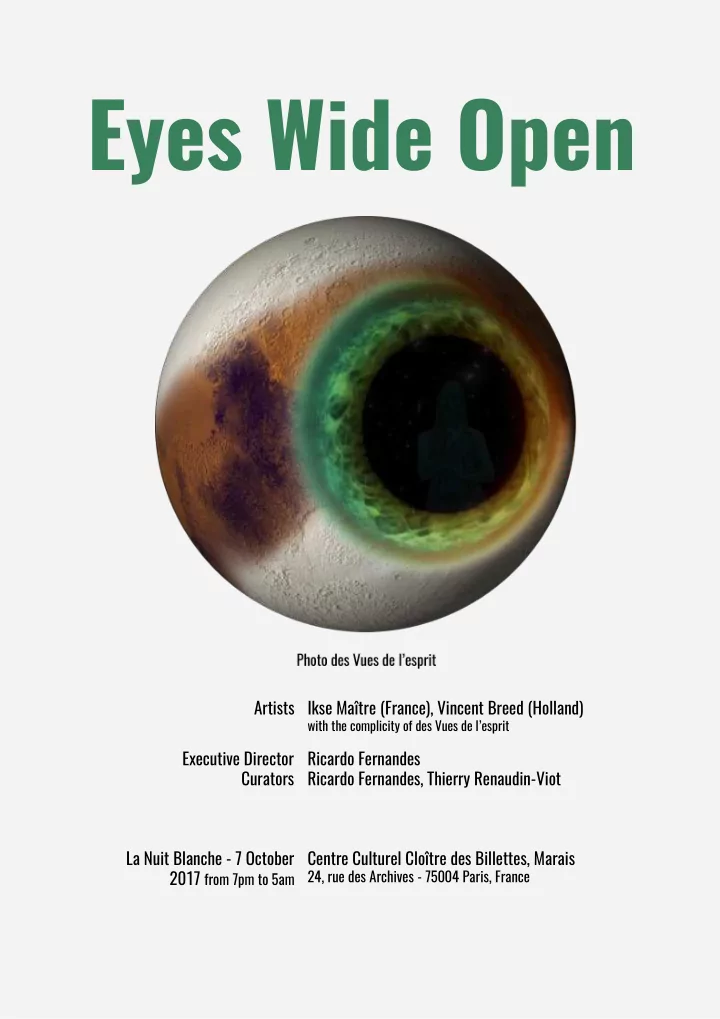
L’Œil de Mars, in English - The Eye of Mars, is a gigantic eye with aesthetic a priori realistic but of the size

  • f a human being, spherical, white and vascularized. It clings to the rest by the optic nerve. It behaves

in a manner similar to that of a human eye. In the darkness to see better, the eye dilates its pupil. In the light it retracts it. Sensitive to the luminous environment, it is animated by rapid eye movements that allow it to scan in a snap the whole space that surrounds it. It is not constrained by the bone cavity that contains the human eye and it can not close the eyelid. But it can wink and see elsewhere, behind, above, below. The eye can become wet, cry a little. It can be transformed, becoming fantastic. It changes colors, inflates the veins and lets the blood fill it, or simply slips away to reveal only the​ ​white​ ​of​ ​the​ ​eye.

L’Œil​ ​de​ ​Mars​ ​Dramaturgy

When a person arrives, L'Œil jumps and follows the gaze. The eye reflects the person’s image, interacts with and makes eye contact and sounds. It appeals to its curiosity. To the eye beat, beaten by a heart that it does not have, the eye makes us hear an inner world, teeming with life, a complex harmony constituted live by the established relationship - what​ ​L'Œil​ ​sees​ ​of​ ​the​ ​other,​ ​the​ ​others. On the arrival of other persons, it casts a discreet eye. It shares its attention. It probes around people, attracts one or the other. It gauges and judges their attention. The sound composition depends on it. It tries to lead them to share their attention. Function of this multiple interaction, the eye gives to see Mars.​ ​It​ ​gradually​ ​reveals​ ​the​ ​planet​ ​through​ ​the​ ​latest​ ​scientific​ ​results​ ​and​ ​the​ ​questions​ ​they​ ​raise. It is by following this behavioral framework that the visual and sound scenarios of L'Œil de Mars are

  • written. Composite dramaturgy combines different fields of art and science. It is experimental.

Different journeys between dream and reality are posed to the passage of the viewers. Different paths

  • f curiosity between positive and negative, between yin and yang, are explored. They will result from the

multi-user​ ​interaction​ ​with​ ​the​ ​public​ ​who​ ​will​ ​recompose​ ​ ​L'Œil​ ​de​ ​Mars​ ​each​ ​time. Ikse​ ​Maître

5

slide-7
SLIDE 7

Concept​ ​of​ ​the​ ​Eyeballs

One wonders what are all the intentions today to this flow of images available to all the screens and Internet users, whether they are Mars, a bathroom or a concert hall. This flow of images also comes from those detached eyes of the body which are the drones and other optics that extend our gaze to the inaccessible, the unpublished, the unimaginable and today the unacceptable. What do we see when we can see so much, since​ ​an​ ​image​ ​is​ ​not​ ​much​ ​without​ ​a​ ​brain? Vincent​ ​Breed

Martien​ ​Collective​ ​Imagination

Gullies that are growing through the seasons? Water on the Red Planet? Blood, anger, war, life on Mars? Humans dream as much today of setting foot there as they were afraid of the invasion of the Martians many years ago. At

  • ver 55 million kilometers, the fourth planet of

the solar system feeds an ambiguous imaginary, intertwining attraction and

  • rejection. It is on this imaginary and associated

ambivalence that the Eye of Mars, suspended in​ ​the​ ​midst​ ​of​ ​the​ ​ocular​ ​globes,​ ​is​ ​written.

6

slide-8
SLIDE 8

Technical​ ​Developments

The audible and visual experiences of the spectators will be composed and scripted before being programmed in Java and rendered in real time on graphic card with OpenGL 4.5.. The musical compositions​ ​will​ ​be​ ​worked​ ​to​ ​increase​ ​the​ ​curiosity​ ​of​ ​L'Œil​ ​and​ ​to​ ​play​ ​with​ ​that​ ​of​ ​the​ ​spectators. The RGB sensors for viewing in the Eye and infrared sensors (kinect PC) for viewing movements will be installed​ ​and​ ​calibrated​ ​to​ ​ensure​ ​360​ ​°​ ​tracking. An automatic recognition of the genre and primary emotions (joy, sadness, astonishment and anger) with Shore will be experienced granting the behavior of The Eye of Mars to the spectators with whom it

  • interacts. It is not a matter of determining the emotions, but rather of modulating the behavior of the

work with the apparent and detectable presence of the spectators. However, the conditions for the Nuit Blanche​ ​show​ ​do​ ​not​ ​allow​ ​this​ ​recognition​ ​at​ ​the​ ​Cultural​ ​Center​ ​Cloître​ ​des​ ​Billettes. The technique is necessary for the realization of L'Œil de Mars both for the capturing of the environment and the spectators who occupy it and for the visual and sound rendering. It determines the possibilities

  • f dramaturgy. But as much as possible, sensors, computers and video projectors will be absent for his

show: the technique will not appear to the spectators. Interactivity is about human-machine-human (and perhaps Martian!) Interaction. The Eye of Mars is not brought to react solely but, out of curiosity and​ ​curiosity,​ ​to​ ​act​ ​and​ ​interact.

____________________________________________________________ Christian Kueblbeck and Andreas Ernst, Detection and tracking in video sequences using the modified census transformation, Journal on Image​ ​and​ ​Vision​ ​Computing​ ​24​ ​(6),​ ​564-572,​ ​2006,​ ​ISSN​ ​0262-8856​ ​www.iis.fraunhofer.de/en/​ ​bf​ ​/​ ​bsy​ ​/​ ​fue​ ​/​ ​isyst

7

slide-9
SLIDE 9

The​ ​Artists

Ikse​ ​Maître

The interactions between us and our environment are first. Then we arrive. Ikse Master relies on the slips

  • f reality to question the relationships we have with the world around us. Capturing the outside world,

processing the acquired data, Ikse Master plays mainly in situ with the addition of video projections and sounds​ ​generated​ ​and​ ​controlled​ ​by​ ​computer. There is no particular support in his work since he has explored sand, stone, statues, threads, tissues, human bodies, or monitors to locally shift a living reality. He also has used medical imaging to reveal our inner depth and increase human reality. He worked to grossly extrapolate the general relativity on disrupted video projections in order to exacerbate the reciprocal effects between visitors​ ​and​ ​places​ ​visited. His collective or individual works have been set up and exhibited in France and abroad in places of a voluntarily diverse audience: Le Pass, Mons, Belgium - Museum of Arts and Crafts, Paris - Saint Merry Church, Paris - Sciences Essonne, Marolles - SXSW, Austin, TX, USA - PROTO204, Orsay - JDEV, Polytechnic School, Palaiseau - Future in the Seine, La Gaîté Lyrique, Paris - Paris - Science and You, Nancy - El Hormiguero 3.0, Antena 3,​ ​Saclay​ ​-​ ​Le​ ​Carreau​ ​du​ ​Temple,​ ​Paris​ ​-​ ​Theater​ ​Dunois,​ ​Paris​ ​-​ ​Madrid,​ ​Spain. Ikse Master collaborates within the Minds with scientists and developers, with actors and sound

  • designers. In 2014, he founded the sas, group science-art-society, at the Scientific Center of Orsay.

Since August 2015, he has been a resident at the Institut d'Astrophysique Spatiale, Paris-Sud University, Paris-Saclay University and since January 2016 in research residency at the Cité des Sciences et de l'Industrie, Paris. In January 2017, with the director Bruno Freyssinet, they open an airlock:​ ​Le​ ​sas>​ ​cité.

8

slide-10
SLIDE 10

Vincent​ ​Breed

As a perfectionist and a savvy technician, Vincent Breed approaches glass as a contemporary art material and a medium for expression. His taste for thoughtful and mastered forms led him to concentrate on the work of "hot" glass and in particular on the blowing with cane, the most demanding​ ​mode​ ​of​ ​expression​ ​in​ ​glass. His artistic grammar often leads him to the completion of an object, by the play of colors, reflection, even image, which he incorporates into it by

  • silvering. A factitious space, the furtive moment of a new perception,

always in flight, and which, always renewed, leaves traces only in the mind. So those who in Hong Kong, Paris or Monaco, cross its great Totems, precisely UNTITLED can offer themselves by looking at themselves, if they are attentive, the same journey​ ​of​ ​truth​ ​that​ ​Alice,​ ​in​ ​this​ ​mirror​ ​behind​ ​which​ ​he​ ​hides​ ​in​ ​his​ ​own​ ​way. It is this mental and technical mastery of the construction and realization of a creation that Vincent Breed proposes in his collaborations with JEAN NOUVEL, MATALI CRASSET, PATRICK JOUIN, HILTON MCCONNICO, YVES-SAINT-LAURENT, HUBERT LE GALL, PAUL BOCUSE, ALAIN DUCASSE, DIPTYQUE, whiskey​ ​BALLANTINE'S,​ ​BNP​ ​PARIBAS​ ​... His work has been exhibited at the Design Center New York, Hotel Phoenicia BEYROUTH, Millionar Fair MOSCOW, Hotel Murano PARIS, Mayan Bay MONTE-CARLO, Residence Bel-Air HONG KONG, One Pacific Heights HONG KONG, SHANGHAÏ Art 2010, HONG KONG Art Fair 2011, Art Beatus HONG KONG, Glass Museum​ ​of​ ​MURANO,​ ​Glass​ ​Museum​ ​of​ ​SARS-POTERIE,​ ​... The Musée des Arts Décoratifs in Paris, the Glass Museum in Sars-Poterie, and the MUDAC in Lausanne have​ ​each​ ​acquired​ ​a​ ​work​ ​in​ ​their​ ​permanent​ ​collections. Its new workshop of 600 m2 is the largest private research and development laboratory in France, which welcomes​ ​and​ ​brings​ ​together​ ​artists,​ ​architects,​ ​designers​ ​and​ ​glass​ ​professionals. Vincent​ ​Breed​ ​is​ ​supported​ ​by​ ​the​ ​FOUNDATION​ ​ERNST​ ​&​ ​YOUNG. Vincent Breed was the sole representative of French glassmaking at the Murano Glass Museum at the Biennale​ ​of​ ​Contemporary​ ​Art​ ​in​ ​Venice​ ​and​ ​at​ ​the​ ​Biennale​ ​of​ ​Contemporary​ ​Art​ ​in​ ​Lyon​ ​in​ ​2011. Jean-Pierre​ ​Evrard

9

slide-11
SLIDE 11

The​ ​sas​ ​-​ ​des​ ​Vues​ ​de​ ​l’esprit

Le sas, groupe science-art-société, reshapes a strong idea of art on science in society through the research, design, production and dissemination of cybernetic art-science facilities. The airlock is a place of research and exchange between artists and scientists open to everyone. At the Paris-Sud University, Paris-Saclay University is currently working with the collective of Vues de l'esprit, an artistic and scientific residency at the Institut d'Astrophysique Spatiale. Through its actions of diffusion

  • utside the walls of the university, it is also a mobile place art and science that goes to meet the public within the city. For The

Eye​ ​of​ ​Mars,​ ​Views​ ​of​ ​the​ ​Spirit​ ​are​ ​:

Tanguy​ ​Boucneau​ ​[​Construction​] PhD student in the Laboratory of Medical Magnetic Resonance Imaging and Multi-Modalities, he confronts in his works the inner exploration of the mechanical properties of human tissues and the

  • pening​ ​to​ ​the​ ​outside​ ​world​ ​that​ ​surrounds​ ​it.

Matthieu​ ​Courgeon​ ​[​Graphics​ ​and​ ​Emotional​ ​Computer​] Researcher at the Laboratory of Sciences and Techniques of Information, Communication and Knowledge (Lab-STICC), he works on real-time graphic rendering and interaction and human-machine

  • intercomprehension. It questions our conception of the world by increasing reality by dynamic and

interactive​ ​digital​ ​renderings. Michèle​ ​Gouiffès​ ​[​Image​ ​Processing​] Master of Conferences at the Laboratory of Computer Science for the Mechanics and the Sciences of the Engineer she is interested in the analysis of images and the artificial vision. It works on the representation of color, the photometric variations and the detection of relevant characteristics in images. ​ ​Vincent​ ​Hulot​ ​[​Sound​ ​Composition​] Vincent Hulot has worked as a stage manager and self-taught musician since 1994 as a stage manager with Gabriel Garran on the TILF, Laurent Terzieff, Tiina Kaartama (La métonymie), as technical director with Adrien de Van (Cie du Tamanoir) stage manager with Pauline Bureau. Since 2000, he has been creating​ ​soundtracks. Karen​ ​Perronet​ ​[​Optical​ ​Conception​] Karen Perronet, a researcher at the Charles Fabry Laboratory in the Biophotonics group, develops

  • ptical instruments to better understand certain fundamental biological processes such as the

synthesis​ ​of​ ​proteins​ ​at​ ​the​ ​level​ ​of​ ​a​ ​single​ ​molecule. François​ ​Poulet​ ​[​Astrophysics​] Astronomer at the Institute of Space Astrophysics (IAS), he mainly studies Mars but also Mercury and small satellites and rings of giant planets and asteroids. His works are part of the planetary sciences, the​ ​initial​ ​conditions​ ​and​ ​processes​ ​of​ ​formation​ ​and​ ​planetary​ ​evolution. Mathieu​ ​Vincendon​ ​[​Astrophysics​] He is a professor at the University of Paris-Sud and a researcher at the Institute of Space Astrophysics (IAS).​ ​He​ ​studies​ ​the​ ​seasonal​ ​processes​ ​of​ ​the​ ​planet​ ​Mars​ ​using​ ​satellite​ ​measurements.

10

slide-12
SLIDE 12

The​ ​Curators

Ricardo​ ​Fernandes

With more than 25 years of experience, Ricardo Fernandes has built a solid career as an international art expert and the organization of artistic events linked to contemporary​ ​art. He​ ​was​ ​able​ ​to​ ​multiply​ ​his​ ​activities​ ​by​ ​being​ ​also​ ​noted​ ​as​ ​curator,​ ​scenographer,​ ​art​ ​critic​ ​and​ ​lecturer. He is a member of the Association of Art Museum Curators (AAMC) of New York in the USA, the Association for Art History (AAH) of London in England and the International Association of Art Criticism (AICA)​ ​in​ ​Paris​ ​in​ ​France.

Thierry​ ​Renaudin-Viot

For over 25 years, Thierry Renaudin-Viot has been a volunteer director of the Cloître des Billettes for which he has launched an innovative cultural policy to

  • rganize exhibitions in order to promote artists and give access to historical

monuments in Paris during all year round. He has become a specialist in the notion of universal access in the cultural sector, an area in which he has worked for many years. He has worked as a curator in many art exhibitions, among them “Touch. The first exhibition​ ​for​ ​blind​ ​and​ ​disabled​ ​of​ ​Paris,​ ​in​ ​2011. He is an official at the Public Institution Paris Museums and holds the post of General Secretary of the House​ ​of​ ​Victor​ ​Hugo​ ​in​ ​Paris,​ ​France. He is a Presbyterian Counselor of the Cloître des Billettes and Regional Councilor of the United Protestant​ ​Church​ ​of​ ​France.​ ​He​ ​is​ ​also​ ​an​ ​Officer​ ​in​ ​the​ ​Order​ ​of​ ​Arts​ ​and​ ​Letters.

11

slide-13
SLIDE 13

The​ ​Exhibition​ ​Venue

Cultural​ ​Center​ ​Cloître​ ​des​ ​Billettes

La​ ​Chapelle,​ ​originally​ ​the​ ​Cloitre​ ​des​ ​Billettes,​ ​was​ ​built​ ​in​ ​1294. After several restorations punctuated by the History of the City of Paris, the Cloister is built as an annex to​ ​the​ ​religious​ ​complex​ ​in​ ​1427. Classified as a historical heritage of the City of Paris, Cloitre des Billettes is the only remaining medieval cloister in Paris. Its name comes from the former convent there, which welcomed the brothers of Charity​ ​of​ ​Notre-Dame,​ ​known​ ​as​ ​Billettes. Contrasting with the Rocaille style of the Chapel, the stripping of the Cloister evokes the recollection and serenity​ ​of​ ​the​ ​monks​ ​and​ ​Carmelites​ ​who​ ​inhabited​ ​it​ ​and​ ​paced​ ​the​ ​central​ ​garden​ ​framed​ ​by​ ​arcades. After surviving the vagaries of history, this ancient high place of spirituality is currently one of the rare vestiges of the Middle Ages still rooted in the Paris of the 21st century and has today become a cultural center. Now converted into a cave of art, the Cultural Center Cloitre de Billettes is emerging as a remarkable exhibition​ ​place.

Photo​ ​Bruno​ ​Macé

12

slide-14
SLIDE 14

Partners ​ ​ ​ ​ ​ ​ ​ ​ ​ ​ ​ ​ ​ ​ ​ ​ ​ ​ ​ ​ ​ ​ ​ ​ ​ ​ ​ ​ ​ ​ ​ ​ ​ ​ ​ ​ ​ ​ ​ ​ ​ ​ ​ ​ ​ ​ ​ ​ ​ ​ ​ ​ ​

Info​ ​:​ ​contact@ricardofernandes.biz

13

slide-15
SLIDE 15

General​ ​Information

Exhibition:​ ​La​ ​Nuit​ ​Blanche​ ​2017,​ ​Paris Exhibition​ ​Title:​ ​Les​ ​Yeux​ ​Grand​ ​Ouverts​ ​(in​ ​English,​ ​Eyes​ ​Wide​ ​Open) Artists:​ ​Ikse​ ​Maître​ ​and​ ​Vincent​ ​Breed​ ​with​ ​the​ ​complicity​ ​of​ ​des​ ​Vues​ ​de​ ​l’esprit Executive​ ​Director:​ ​Ricardo​ ​Fernandes Curators:​ ​Ricardo​ ​Fernandes,​ ​Thierry​ ​Renaudin-Viot Date:​ ​October​ ​7,​ ​2017 Time:​ ​from​ ​7pm​ ​to​ ​5am​ ​(October​ ​8) Venue:​ ​Centre​ ​Culturel​ ​Cloître​ ​des​ ​Billettes​ ​(Marais,​ ​Paris) Address:​ ​24​ ​rue​ ​des​ ​Archives​ ​-​ ​75004​ ​Paris​ ​France Metro:​ ​Hôtel​ ​de​ ​Ville Bus​ ​:​ ​69,​ ​74,​ ​75,​ ​96 Parking​ ​Hotel​ ​de​ ​Ville​ ​/​ ​3​ ​rue​ ​de​ ​la​ ​Tacherie,​ ​75004 Info:​ ​www.ricardofernandes.biz Phone:​ ​+​ ​33​ ​6​ ​81​ ​35​ ​12​ ​87

Press​ ​kit:​ ​Ricardo​ ​Fernandes French​ ​review:​ ​Any​ ​Collin English​ ​translation:​ ​Ricardo​ ​Fernandes English​ ​review:​ ​Tim​ ​Olsen Photos​ ​:​ ​ ​Bruno​ ​Macé,​ ​des​ ​Vues​ ​de​ ​l’esprit,​ ​Vincent​ ​Breed L’Œil de Mars is a creation of the artist Ikse Master with the complicity of ​des Vues de l`esprit​; a subsidiary of ​sas​, groupe science-art-sociétéy; a production of ​La métonymie​, in partnership with ​IR4M​, ​Lab-STICC​, ​IAS​, ​LIMSI​, ​CNRS and the University of Paris-Sud​, ​Paris-Saclay University​, with the support of the ​General Council of Essonne and the device Science and​ ​Society​ ​of​ ​La​ ​Diagonale​ ​Paris-Saclay​.

14