Drawbridge: History, the People, and its Future by Ceal Craig, - - PowerPoint PPT Presentation

drawbridge
SMART_READER_LITE
LIVE PREVIEW

Drawbridge: History, the People, and its Future by Ceal Craig, - - PowerPoint PPT Presentation

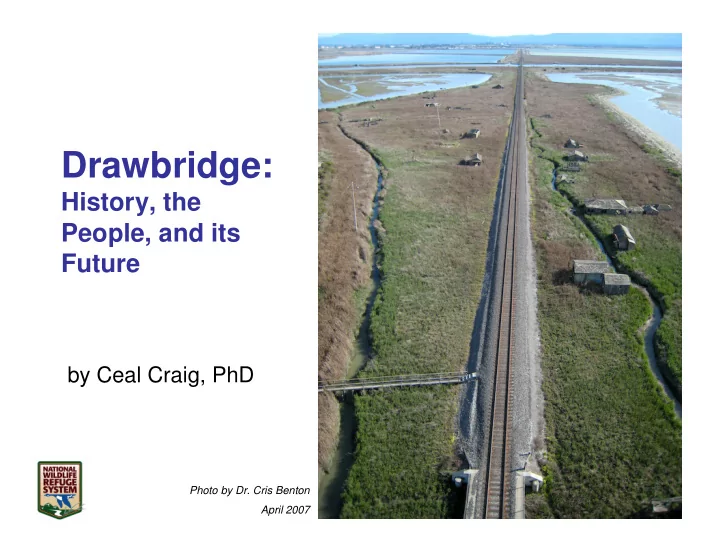
Drawbridge: History, the People, and its Future by Ceal Craig, PhD Photo by Dr. Cris Benton April 2007 Drawbridge: History, People, & its Future SUMMARY South Bay Life in the 1800s Trains & Bridges of Drawbridge Maps :

slide-1
SLIDE 1

Drawbridge:

History, the People, and its Future

by Ceal Craig, PhD

Photo by Dr. Cris Benton April 2007

slide-2
SLIDE 2

Drawbridge:

History, People, & its Future SUMMARY

  • South Bay Life in the 1800s
  • Trains & Bridges of

Drawbridge

  • Maps: then and now
  • Life at Drawbridge

– Winter – Summer – Culture

  • Drawbridge Characters
  • Its Future…

A mosaic of remarkable aerial photographs from the San Francisco Estuary Institute. These show the wetlands before the salt ponds were built. For the originals see www.southbayrestoration.org/

slide-3
SLIDE 3

Drawbridge : Statistics

  • Size

– 7/8 of a mile long, 80 acres in size

  • Demographics Timeline

– 1887: bridges completed. Two-room bridge tender’s cabin – 1906: 79 cabins, two hotels

  • Sprung’s Hotel, middle Drawbridge & Hunter’s Home in south Drawbridge

– 1926: 90 cabins, five passenger train stops a day – 1931: Electricity arrives – 1940: water levels dropping (begin in early 1930s) – 1976: one resident remained

Photo by Ceal Craig

View to south towards Alviso

Photo by Dr. Cris Benton May 24, 2010

slide-4
SLIDE 4

Life in 1800s in South Bay

  • South Bay was area breadbasket
  • Fruit trees dotted the landscape
  • Alviso was a working port

– 1838: “hundreds of hides loaded onto mission-built boats” [3] – Three sail & steam lines ran out of Alviso – Into 1920s: Passengers and freight moved north to San Francisco and beyond

  • Landings dotted the Bay
  • Hunters build duck hunting

blinds on Station Island (1850-1870)

  • Railroads entered the landscape…

Origin unknown Burrill & Rogers

slide-5
SLIDE 5

How the town began…

  • 1876 - 1880

– Two people—James Fair & Alfred Davis—had a vision: build a narrow gauge railroad between Newark (later Alameda) & Santa Cruz – Problem! Two waterways must remain open to boat traffic: Warm Springs (Mud Slough) Slough & Coyote Creek – Solution: Bridge tender living on “Station Island” managing two swing bridges – Drawbridge was born!

Historical Atlas of Santa Clara County – 1876 [2]

slide-6
SLIDE 6

San Francisco to the South Bay & Beyond

San Francisco to San Jose

1849 - 1864

  • Stagecoach:

– $32 or “two ounces of gold” – Trip was 9 hours

  • Boat:

– $35, 3-4 hours (?) – 50 steamers on Bay by 1850

  • Boat & Carriage:

– $8, taking 6.5 hours

1864 – 1870 and beyond

  • San Francisco & San Jose

Railroad >> Southern Pacific 1876 – 1906

  • Stagecoach:
  • To Santa Cruz: 2 days & cost ~ $40.00

through Drawbridge to San Jose then Santa Cruz

  • Steamboat & train: South Pacific Coast

Railroad

  • Took 3 hours and 55 minutes. Cost $3.50
  • 1897 Drawbridge station added & named

1906 – 1955

  • Went to standard gauge in 1906
  • Wood bridges replaced in 1904
  • Coyote Creek Bridge: truss in 1955

1955

  • No more regular stops at Drawbridge

Today

  • Amtrak & freight trains pass through daily
slide-7
SLIDE 7

Bridges of Drawbridge

  • 1876

– Swing bridge, central pier, iron truss span, hand-operated

  • 1904
  • Mechanical bridges built
  • 1944

– Trestle bridges built

  • Today

– Mud Slough Bridge rotates/swings – Coyote Creek bridge – 1955 trestle span

Second Bridge

Built in 1904, four-lever mechanical interlocking bridge. Retired in 1944 and replaced by trestle bridges

Swing Bridges Mud Slough Bridge Today, pivots in center Coyote Creek Bridge, 2011

Photo by Ceal Craig

slide-8
SLIDE 8

Bridge Tenders of Drawbridge

  • 1876 – WWI

– First Bridge Tender: George Mundershietz – Hand cranked movement – Motors installed ~1910

  • World War I – 1940

– William Carrera, chief tender, Lewis Holden & Jim Hardy

  • All lived in Drawbridge

– Engine-cranked movement

  • After 1940: Private
  • Cargill Salt (Leslie Salt: 1936 – late 20th century)

used Mud Slough Bridge

Circa 1903

Building is The Recreation (owned by Byrnes)

slide-9
SLIDE 9
  • Mud Slough

(Warm Springs Slough)

  • Station Island
  • Coyote Creek
  • ~100 Sq. Miles
  • f Wetlands

South Bay

Dixon Landing

slide-10
SLIDE 10

South Bay

  • >90% wetlands

gone

  • Mud Slough
  • Station Island
  • Coyote Creek
slide-11
SLIDE 11

Drawbridge, ~1928

  • Before the salt

ponds were built

  • n Station Island
  • ~90 houses
  • 5 trains stopped

each day

slide-12
SLIDE 12

South Bay

  • Compliments of

Google Earth & NASA

2008

slide-13
SLIDE 13

Drawbridge 2010, Visual Earth

slide-14
SLIDE 14

Drawbridge 2014, Google Earth

slide-15
SLIDE 15

Coyote Creek & Mud Slough Meet

Coyote Creek (south) surround Station Island Mud Slough (north)

View to west towards slough convergence

Photo by Dr. Cris Benton June 7, 2011

East facing view of sloughs converging

Photo by Ceal Craig July 2, 2012

slide-16
SLIDE 16

History of Drawbridge: 1880 - 1979

Earlier view of Drawbridge after it became part of NWR

Photo by Dr. Cris Benton September 10, 2006

Sinking building

Photo by Dr. Cris Benton September 3, 2006

East Bay hills over Mud Slough

Photo by Dr. Cris Benton May 24, 2010

slide-17
SLIDE 17

Life at Drawbridge: 1880 – 1950s

  • Independent Spirits!

– No police, no services – Rumors of interesting activities…

Gordon Gun Club built 1876, shape of a railroad car or ship cabin. Had ships bell in 1979. Rented for $5

slide-18
SLIDE 18

Life at Drawbridge: 1880 – 1950s

  • Perfect spot to hunt and fish

– Smelt & striped bass – Shrimping – Salt Marshes circled the Bay. Wildlife abounded. A simpler life

slide-19
SLIDE 19

Life at Drawbridge: Winter living

  • Duck Hunting!

– Most wild stories occurred in winter

  • Most women & children

stayed home

  • Non-residents arrived by

train to hunt & party

slide-20
SLIDE 20

Duck & Gun Clubs

Courtesy, California Historical Society, Albert E. Norman Coll. CHS2012.963.tif

slide-21
SLIDE 21

Duck Clubs

  • Precita Gun Club
slide-22
SLIDE 22

Life at Drawbridge: Summer Living

  • Mostly seasonal living

– Quickly cabins dotted Station Island – Cabins built on stilts above shifting tides – Wooden walkways as streets – Main Street: Railroad track!

Social center, North Summer Drawbridge–known for ice cream socials Large screened in porch.

1903

slide-23
SLIDE 23

Life at Drawbridge: Summer Living was Seasonal

  • Everyone had a boat
  • Great place to play!

OR “Nothing to do.”

  • “As children it was a treat to walk the

tracks to [Sprung hotel] to buy candy”

– Lucille & George Cervieres (1905 – 1928)

slide-24
SLIDE 24

Life at Drawbridge

  • Outdoor people having a good time
  • South Side: mostly permanent residents
  • North Side: more seasonal, duck clubs

and vacation cabins

  • People enjoying freedom

Courtesy, California Historical Society, Challis Gore Coll.. CHS2012.962.tif 1904, in front of Southern Pacific Station

slide-25
SLIDE 25

NORTH Drawbridge Then

  • Early days, looking

south from Mud Slough

  • After residents leave
slide-26
SLIDE 26

NORTH Drawbridge Now

Changes over time

View to south

Photo by Dr. Cris Benton September 6, 2009

View to north

Photo by Dr. Cris Benton May 26, 2010

View to north

Photo by Dr. Cris Benton June 7, 2011

slide-27
SLIDE 27

SOUTH Drawbridge

mid-1900s

1981

High Tide

  • Permanent residents walked

to Alviso for school or work

  • Two story house built by

Barney Panella, replaced Hunter’s Lodge that burned down

  • Bulkheads for confronting

rushing waters in Coyote Creek

(memories from Stuart Holden, son

  • f bridge tender Lewis Holden)

1974

slide-28
SLIDE 28

SOUTH Drawbridge Now

2011

Photos by Ceal Craig

Screen shot from Visual Earth

House & Boathouse originally

  • wned by Kenneth Witten
slide-29
SLIDE 29

Life at Drawbridge: 1880 – 1950s

  • North & South Drawbridge divisions did exist

– Catholics lived on South Side; Protestants on North – Italian, Irish, Portuguese on South; English on North – Distrust of people who were different? – Dinners several times a year for all residents

  • Narrow portion of island had few residents

– no boat access

  • Summary:

– Cliques…Small-town Attitudes – Residents & frequent visitors had common goals

People of Drawbridge: 1880 - 1979

slide-30
SLIDE 30

Drawbridge Characters

John and Ann Byrns

  • First “indoor toilet’: washed clean twice a day…
  • With friends at honeymoon cabin…The Recreation,

built in 1903

^^ Outhouse

slide-31
SLIDE 31

Boat & Decoy Builders

  • Billy Robinson, E. H. Adams,

Cornelius Reinhardt

  • Scull Boats:

a South Bay invention

~1915

slide-32
SLIDE 32

Sprung Hotel

  • Joe & Hedwig Sprung, opened hotel

~1905

– November 5, 1914 deeded to Hedwig – March 2, 1926 Hedwig to Ike Oswald (nephew)

  • Dining room served hunters for 35¢

– Small bedrooms on one side; dining room & kitchen on the other – One bathroom, porch around hotel

  • Kerosene lamps, wood stove
  • Water tower artesian well supplied

all residents for $3 a year!

Sprung Hotel (pictured above ~1967) collapsed New Year’s storm 1967-68 Sprung Hotel Tower? 1990’s Fell or pulled down 2005 at same time Nellie's home burned

slide-33
SLIDE 33

Drawbridge Characters

Nellie Dollin—Belle of Drawbridge

  • 1900 – 1987
  • Lived full-time in Drawbridge, three

marriages, two sons

– Moved there at age 10, in 1910 – 1926 bought her first home, trashed by vandals in

  • 1960s. Moved to a two-room houseboat later. Four

different places. – 1950s & 1960s: often the only “permanent” resident until 1974

  • Knew how to use a gun

Nellie’s first house 1961

slide-34
SLIDE 34

Drawbridge Population declines

  • Late 1920s & early 1930s

– Levees built for salt ponds. Marshes begin to drain – Sewage from San Jose & Newark destroyed slough & wildlife – Sprung Hotel closed as Great Depression begins – Hunter’s Home/Lodge burned down in late 1930s or 1943

  • Dollin: “Barney Panella lit a cigar while filling a gap pump”
  • WWII – 1950s

– Fremont-Newark area drew water from water table – Drawbridge deep wells ran dry – North bridge sinks 10 inches (1948–1960), 7 more inches by 1966 – Two story home built (~1945) in south Drawbridge on Hunter Lodge site – 1950: Anderson Dam built, slowed Coyote Creek flow

  • 1960s – 1970s

– Fewer than 25 residents remain in 1967 – 1967-68: Sprung Hotel remnants flattened by New Year’s storm – 1970s: train station torn down (“Liability to Southern Pacific” per Nellie)

slide-35
SLIDE 35

1960s …Vandalism

  • Lot of thefts and vandalism
  • Plea …

Dear Thieves and vandals. Please do not break into this house. It’s the only house we have. Inside are things of little value to anyone else and most of them are essential to our existence, Thank you.

  • Unfortunately the note had no effect.

House was broken into and everything stolen.

  • Fires destroyed building

after building, still today…

Barney’s place burned in 1984 Nellie's second home burned in 1985

slide-36
SLIDE 36

Drawbridge Characters: Last Resident: Charlie Luce

  • Born in 1914,

began visiting in high school

  • Asked to leave when Drawbridge

became part of NWR

– Left Drawbridge in October 1979

  • Asked what he liked about living at

Drawbridge, Charlie replied …

Well, I keep going around here, looking in these bulrushes for someone named “Moses.” I think we could use somebody with that name to lead us out of the wilderness these days, or actually, back into it. House burned down in 1986

1979

Charlie & Quincy

Future of Drawbridge

slide-37
SLIDE 37

Future of Drawbridge…

  • Subsidence impacts

– Photo, ~1960s

  • Too much fresh water

going into the Bay

  • We can do our part

to limit water flowing to Bay

slide-38
SLIDE 38

Future is brighter though… Salt Pond Restoration Project

~15,000 acres of salt ponds being turned back to salt marsh over 50 years And the work has begun….

slide-39
SLIDE 39

Avocets & kites watch over Drawbridge today

View to north from north A17

Photo by Ceal Craig, September 10, 2010

Buildings gradually decaying back into marshland habitat for wildlife

slide-40
SLIDE 40

Drawbridge today, sinking into the marsh

^^ South Drawbridge houses << Dan Ritchie’s Two-Story Water Tower, Tank & Windmill are gone North Drawbridge from afar (below)

slide-41
SLIDE 41

Let’s go visit!

View to south

Photo by Dr. Cris Benton June 7, 2011

slide-42
SLIDE 42

Information & Photo Credits

  • Pat Anthony

– Drawbridge Expert & Tour Guide at DESFB NWR for >16 years – Photos from Pat’s presentation

  • Ceal Craig (photos)
  • Cris Benton

– Professor Emeritus of Architecture, UC Berkeley – Digital Photos Captured by KITE! Used with permission – http://www.flickr.com/photos/kap_cris/

  • http://www.southbayrestoration.org/
  • Eric Carlson

– CEO of “Soft Underbelly of San Jose” – Historical Atlas, page 4 – http://www.sanjose.com/underbelly/

  • Google Earth
  • Robert Burrill and Lynn Rogers

– Images of America: Alviso—San Jose (2006)

  • Visual Earth