Quality and Accreditation in Healthcare Ins. ? Institution - - PDF document

quality and accreditation in
SMART_READER_LITE
LIVE PREVIEW

Quality and Accreditation in Healthcare Ins. ? Institution - - PDF document

28.09.2012 International International Ibni Sina Health Capacity Building Programme. Management Certificate at Health Health Founder Member of Strategic Health Ins. Organization Organization Healthcare Institutions Kzlay Hospital


slide-1
SLIDE 1

28.09.2012 1

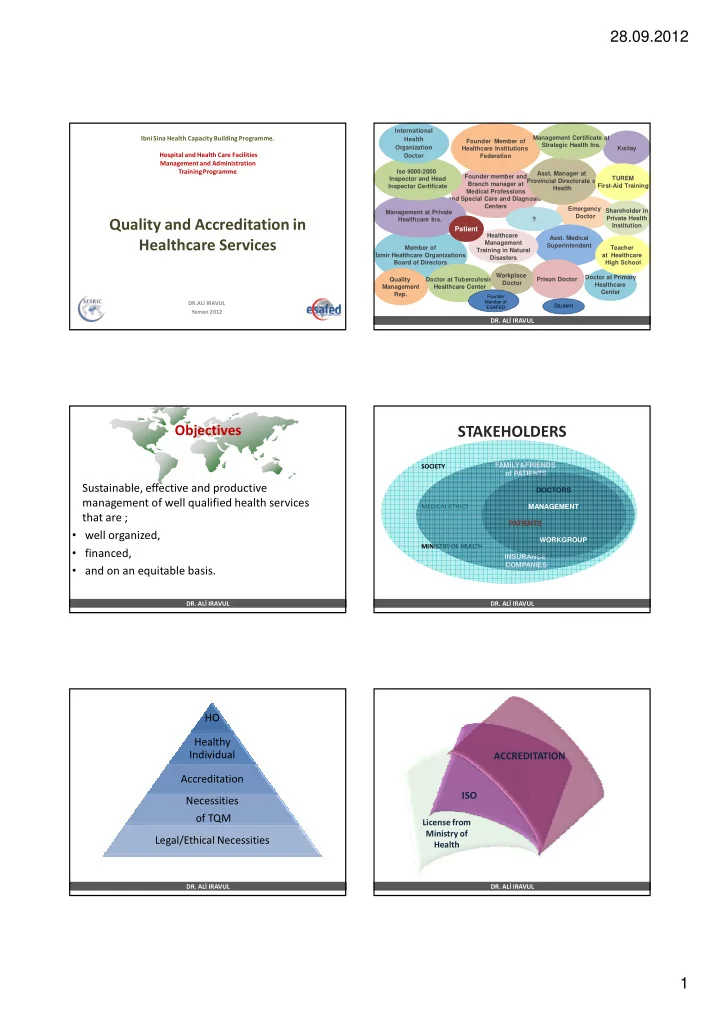
Quality and Accreditation in Healthcare Services

DR.ALİ IRAVUL Yemen 2012

Ibni Sina Health Capacity Building Programme. Hospital and Health Care Facilities Management and Administration Training Programme

DR.ALİ IRAVUL 2

Emergency Doctor Kızılay Founder member and Branch manager at Medical Professions and Special Care and Diagnosis Centers

  • Asst. Medical

Superintendent Member of İzmir Healthcare Organizations Board of Directors Founder Member of Healthcare Institutions Federation Prison Doctor Shareholder in Private Health Institution Management at Private Healthcare Ins. Quality Management Rep.

  • Asst. Manager at

Provincial Directorate of Health Doctor at Primary Healthcare Center Management Certificate at Strategic Health Ins. Healthcare Management Training in Natural Disasters Iso 9000:2000 Inspector and Head Inspector Certificate Doctor at Tuberculosis Healthcare Center Workplace Doctor Teacher at Healthcare High School TUREM First-Aid Training

Patient

?

International Health Organization Doctor International Health Organization Doctor

  • DR. ALİ IRAVUL

Student

Founder Member of ESAFED

Objectives

Sustainable, effective and productive management of well qualified health services that are ;

  • well organized,
  • financed,
  • and on an equitable basis.

DR.ALİ IRAVUL 3

  • DR. ALİ IRAVUL

STAKEHOLDERS

SOCIETY MEDICAL ETHICS MINISTRY OF HEALTH

DR.ALİ IRAVUL 4

FAMILY&FRIENDS

  • f PATIENTS

PATIENTS INSURANCE COMPANIES DOCTORS MANAGEMENT WORKGROUP

  • DR. ALİ IRAVUL

DR.ALİ IRAVUL 5

HO Healthy Individual Accreditation Necessities

  • f TQM

Legal/Ethical Necessities

  • DR. ALİ IRAVUL

DR.ALİ IRAVUL 6

License from Ministry of Health

ISO

  • DR. ALİ IRAVUL

ACCREDITATION

slide-2
SLIDE 2

28.09.2012 2

  • License from Ministry of Health: Minimum legal

standards

  • ISO: System
  • Accreditation:

Services Products Employees

DR.ALİ IRAVUL 7

  • DR. ALİ IRAVUL

Legal Requirements Ministry of Health

  • Employee Standards
  • Infrastructure Standards
  • Required Divisions/Departments (Minimum Level)
  • Work standards for Institutions
  • Emergency Room Services
  • Advertisement and PR Services

DR.ALİ IRAVUL 8

Ministry of Health administrates legislations, in order to determine minimum level of standards in Health Institutions.

  • DR. ALİ IRAVUL
  • Only % 1 of failures result from incompetent

employees.

  • Remaining % 99 results from competent

employees that are hardworking with good intentions.

  • Processes themselves are main reason of failure.*

*Dr.Lucian Leape, Harvard School of Public Health

DR.ALİ IRAVUL 9

  • DR. ALİ IRAVUL

International Standards for Healthcare Institutions

  • ISO 9001:2008 Quality Management System
  • ISO 15189 Laboratory Accreditation
  • Hospital Accreditations (JCI, HKS)
  • ISO 14001 Environment Management Systems
  • OHSAS 18001 Standards of Safety & Health At Work
  • HACCP Safety of Food

DR.ALİ IRAVUL 10

  • DR. ALİ IRAVUL

International Organization for Standardization(ISO)

Quality Management System: Required management system for an institution to manage and organize quality within.

DR.ALİ IRAVUL 11

  • DR. ALİ IRAVUL

ISO

ISO, is an acronym for an international

  • rganization that publishes standards for

products, services and systems.

ISO has been established in 1947, with membership

  • f 146 countries. Headquarters of ISO is based in

Geneva/Switzerland

DR.ALİ IRAVUL 12

  • DR. ALİ IRAVUL
slide-3
SLIDE 3

28.09.2012 3

What does ISO mean?

  • "International Organization for Standardization"

acronym for name in English is "IOS",

  • In French “Organisation internationale de

normalisation” therefore with acronym "OIN"

  • but actually derived from Greek word “ISOS” that

means equal. Source: www.iso.org

DR.ALİ IRAVUL 13

  • DR. ALİ IRAVUL
  • ISO 9000 standards were prepared in 1979

with participation of 20 members and 10

  • bservers by using standards in UK,Canada,US

and Japan.

  • Published in 1987
  • ISO 9000 standards are widely in use in Health

Industry of Turkey.

DR.ALİ IRAVUL 14

ISO 9001:2008 Quality Management System

DR.ALİ IRAVUL 15

  • DR. ALİ IRAVUL

Quality Management System

4.1. General Requirements 4.2. Documentation Requirements 4.2.1. General 4.2.2. Quality Handbook 4.2.3. Documentation Check 4.2.4. Registry Check

DR.ALİ IRAVUL 16

  • DR. ALİ IRAVUL

Management Responsibility

5.1. Managerial Obligation 5.2. Customer Focus 5.3. Quality Policies 5.4. Planning 5.4.1. Quality Targets 5.5. Accountability, Authority and Communication 5.5.1. Accountability and Authority 5.5.2. Management Representation 5.5.3. Internal Communication 5.6. Managerial Review 5.6.1. General 5.6.2. Review Input 5.6.3. Review Output

DR.ALİ IRAVUL 17

  • DR. ALİ IRAVUL

Resource Management

6.1. Resource Supply 6.2. Human Resources 6.2.1. General 6.2.2. Competency, awareness and training 6.3. Infrastructure 6.4. Workplace

DR.ALİ IRAVUL 18

  • DR. ALİ IRAVUL
slide-4
SLIDE 4

28.09.2012 4

Product Realization

7.1. Planning phase 7.2. Customer Related Processes 7.2.1. Determination of product related requirements 7.2.3. Customer Communication 7.3. Design and Development 7.3.1. Planning of design and development 7.3.3. Output of design and development 7.3.4. Review of design and development 7.3.5. Confirmation of design and development 7.3.6. Applying design and development 7.3.7. Review of changes on design and development

DR.ALİ IRAVUL 19

  • DR. ALİ IRAVUL

Purchasing

7.4.1. Purchasing Processes 7.4.2. Purchasing Data 7.5 .Production and Services Supply 7.5.1. Inspection on Production and Services 7.5.2. Validation of Production and Service Processes 7.5.3. Determination and Traceability 7.5.4. Customer Ownership 7.5.5. Product Care/Cover 7.6. Inspection of Observation and Measurement Tools

DR.ALİ IRAVUL 20

  • DR. ALİ IRAVUL

Measurement, analyses and improvement

8.1. General 8.2. Observation and Measurement 8.2.1. Customer Satisfaction 8.2.2. Internal Inspection 8.2.3. Observation and Measurement of Processes 8.2.4. Observation and Measurement of Products 8.3. Inspection of inadequate products 8.4. Data Analyses 8.5. Improvement 8.5.1. Continuous Improvement 8.5.2. Adjustment activities 8.5.3. Preventive activities

DR.ALİ IRAVUL 21

  • DR. ALİ IRAVUL

Principles of Quality Management

  • Customer Focus
  • Leadership
  • Employee Participation
  • Process Approach
  • System Approach in Management
  • Continuous Improvement
  • Realistic Approach in Decision Making
  • Supplier Relations with Mutual Benefits

DR.ALİ IRAVUL 22

  • DR. ALİ IRAVUL
  • 1. Customer Focus: Institutions depend on their customers therefore

they need to well understand and meet current and future needs of customers and strive for going beyond customer expectations.

  • 2. Leadership: Leaders organize, design shared route and objectives .

Leaders should settle and sustain an environment where employees would be able to participate actions necessary to reach goals and focus on objectives.

DR.ALİ IRAVUL 23

  • DR. ALİ IRAVUL
  • 3. Employee Participation: Employees in all levels should be

valued within institution and their participation would enable using their skills most productively for company interests.

  • 4. Process Approach: When activities and related resources

are managed as a process, effective successful results can be achieved.

Plan .. Determine Objectives & Processes

Apply.. Apply Processes Control .. Observe and Measure Improve.. Supply Continuous Improvement

DR.ALİ IRAVUL 24

  • DR. ALİ IRAVUL
slide-5
SLIDE 5

28.09.2012 5

  • 5. Management System Approach: Defining related processes

as a system, enables productive management of meeting goals and efficiency within organizations.

  • 6. Continuous Improvement : Institution should have

permanent objectives in order to improve performance continuously Improvement: Increase in features and characteristics of products and/or increase productivity and efficiency of processes to produce and distribute this products.

DR.ALİ IRAVUL 25

  • DR. ALİ IRAVUL
  • 7. Realistic Approach in Decision Making: Effective decisions

should be based on data and analyses of information.

  • 8. Supplier Relations with Mutual Benefits: An institution and

its supplier are co-dependent and should establish productive relationships with each other that are based on mutual benefits and values.

DR.ALİ IRAVUL 26

  • DR. ALİ IRAVUL

External Benefits:

  • 1. A strong addition to reputation and image,
  • 2. Increase in customer satisfaction,
  • 3. Increased in customer numbers,
  • 4. Increase in competition skills,
  • 5. Improvement in supplier relationships.

DR.ALİ IRAVUL 27

  • DR. ALİ IRAVUL

Internal Benefits:

  • 1. Effective Management
  • 2. Improvement in Organizational Culture
  • 3. Increase in Quality Awareness
  • 4. Better Documentation
  • 5. Systematization
  • 6. Standardization and Consistency
  • 7. Improvement in efficiency, productivity and data gathering
  • 8. Within time decrease in costs
  • 9. A forward step in Institutionalization

DR.ALİ IRAVUL 28

  • DR. ALİ IRAVUL
  • ISO 9001 does not publish features of services as a

standard.

  • ISO is a certificate for Management System, does not

confirm perfection of services or products. “ISO focuses on system quality rather than product or service quality.”

DR.ALİ IRAVUL 29

  • DR. ALİ IRAVUL
  • ISO is a tool to reach goals not an objective.
  • ISO certificate is a first step in road to quality.
  • But ISO Quality Management Certificate is very

useful to establish quality culture within organization and gather knowledge on documentation principles.

DR.ALİ IRAVUL 30

  • DR. ALİ IRAVUL
slide-6
SLIDE 6

28.09.2012 6

ISO REQUIREMENTS

  • QUALITY MANAGEMENT SYSTEM
  • MANAGERIAL ACCOUNTABILITY
  • RESOURCE MANAGEMENT
  • PRODUCT REALIZATION
  • MEASUREMENT,ANALYSES AND IMPROVEMENT

DR.ALİ IRAVUL 31

  • DR. ALİ IRAVUL

How to establish Quality Infrastructure?

  • Determine/appoint manager(leader)
  • Full time visible office to be set
  • Quality Council and Audit Committee to be appointed.
  • Improved quality plan for hospital
  • Quality becomes a part of Hospital Budget
  • Set trainings
  • Appoint workgroups.
  • DR. ALİ IRAVUL

Accreditation

DR.ALİ IRAVUL 33

  • DR. ALİ IRAVUL

Accreditation is an official process of an institution to be acknowledged as suitable with established and published standards by a legal entity that is agreed by all parties. * *Rooney - vanOstenberg 1999

ACCREDITATION

  • DR. ALİ IRAVUL

Licensing

  • Minimum
  • Mandatory
  • Government
  • Infrastructure,

medical equipment, employees (quantity) Accreditation

  • Optimum
  • Voluntary
  • Independent

Institutions

  • Processes,

Organizational Structure, Service Quality (Qualification)

  • DR. ALİ IRAVUL

First Inspection Year Programme # of Program s 1951 USA (JCAHO) 1 1958 Canada 1 1974 Australia (ACHS) 1 1979 USA (AAAHC) 1 1986 Taiwan 1 1987 Australia (QIC) 1 1989 New Zealand 1 1990 UK(HAP) 1 1991 UK (HQS), US (NCQA) 2 1994 South Africa 1 1995 Finland, Korea, Indonesia 3 1996 Argentine, Spain 2 1997 Check Republic , Japan 2 1998 Australia(AGPAL), Brazil, JCI, Poland, Switzerland 5 1999 France, Malaysia, Holland, Thailand, Zambia 5 2000 Portugal ,England (CSBS), Filipinos 3 2001 Bulgaria, Germany , Italy, Ireland 4 Not available yet Colombia, Slovakia, Mongolia, Bosnia 4 Total 39

  • DR. ALİ IRAVUL
slide-7
SLIDE 7

28.09.2012 7

Practices regarding accreditation in countries differs in;

  • whether being mandatory ,
  • whether being issues by government offices ,
  • whether being focused on optimum or basic requirements ,
  • whether based on outputs or processes,
  • whether to improve processes or result in punishments,
  • whether detailed accreditation results to be published publicly
  • r to be kept confidential. (Silimperi and Rooney 2003).
  • DR. ALİ IRAVUL

Accreditation

  • Accreditation is a process in which an independent

institution evaluates whether a health organization have necessary requirements to improve service

  • quality. Institution which does the evaluation should

be independent from health organization to be evaluated, also might be independent from the government authorities.

DR.ALİ IRAVUL 38

  • DR. ALİ IRAVUL

Accreditation

Is a method to commit in

  • improving service quality,
  • creating secure environment for patients,
  • reducing risks that are faced by patients and employees

with help of an independent organization.

DR.ALİ IRAVUL 39

  • DR. ALİ IRAVUL

Accreditation

  • Provides a process to evaluate healthcare service organization

within specific standards.

  • Aim of the programme is to promote continuous and

sustainable progress in healthcare services by applying international consensus standards.

DR.ALİ IRAVUL 40

  • DR. ALİ IRAVUL
  • Logic behind standards depends on quality management and

continuous quality improvement.

  • Accreditation process is designed to adopt legal, religious or

cultural factors within different countries.

  • Even though there would be one type of high standards of

patient care , country specific factors will be included in accreditation process.

DR.ALİ IRAVUL 41

  • DR. ALİ IRAVUL

Accreditation

Table 1: Frequency of citation of different accreditation programs The program name Frequency Percent JCAHO and JCI (USA) 76 91.56 CCHSA (Canada) 17 20.48 UK accreditation programs 16 19.27 ACHS (Australia) 15 18.7 QHNZ (New Zealand) 9 10.87 ANAES (France) 8 9.63 COHSASA (South Africa) 5 6.02 Other programs 11 13.25 Total 83 100

Advantages and Disadvantages of Health Care Accreditation Models *Jafar S. Tabrizi , Farid Gharibi , Andrew J. Wilson Health Promotion Perspectives, Vol. 1, No. 1, 2011; P: 1-31

slide-8
SLIDE 8

28.09.2012 8

Table 2: The comparison between accreditation programs based on 23 defined attributes Organization name .. Attributes JCAHO CCHSA ACHS ANAES QHNZ UK programs Effect on quality improvement **** ** ** * * * Effect on safety improvement **** ** * * * * Improving health care management integration *** ** * * * * Provides health care organizations database * Designing an international branch *

  • -

Influenced other accreditation programs *** * * * * * Evidence of public confidence in process **** * * * * * * Emphasis on efficiency and effectiveness *** ** * * * * Evidence of ongoing innovation **** ** * * * * Influence on global accreditation standards **** ** * * * * Emphasis on patients' rights and providing an ethical atmosphere *** * * * * * Focus on information management *** * * * * * History of organization **** *** ** * * * Effective relationship with stakeholders *** ** ** ** ** ** Outcomes suitable for public reporting) *** ** ** ** ** ** Agreement with AGIL indicator *** *** * ** Breadth of activity scope *** ** ** * ** * Accredited with ISQua * * *

  • - *

Considers all 3 types of performance indicators * *

  • - *

Clear Statement of Intent * * *

  • - -

Voluntary Participation * * *

  • * *

Government/non Government Organizations * * *

  • - *

Span of coverage and scientific level **** ** * * * *

Advantages and Disadvantages of Health Care Accreditation Models *Jafar S. Tabrizi , Farid Gharibi , Andrew J. Wilson Health Promotion Perspectives, Vol. 1, No. 1, 2011; P: 1-31

Categories of JCI Standards

  • Patient Focused Functions
  • Healthcare Organization Management

Functions

DR.ALİ IRAVUL 44

  • DR. ALİ IRAVUL

Functions that directly satisfy patient needs

  • Patient Rights
  • Evaluation of patients
  • Patient Care
  • Training/Education of Patients and their

Families

  • Sustainable Care

DR.ALİ IRAVUL 45

  • DR. ALİ IRAVUL

Patient Focused Functions

  • Access to Services and Sustainability of the Services
  • Rights of Patients and their Families
  • Evaluation of Patients

Clinical Laboratories Radiology

  • Patient Care

Drug Use Surgery and Anesthesia

  • Training/Education of Patients and their Families

DR.ALİ IRAVUL 46

  • DR. ALİ IRAVUL

Healthcare Organization Management Functions

  • Quality Improvement and Patient Safety
  • Prevention and Control of Infections
  • Governance, Leadership & Direction Facility

Management and Safety

  • Qualification and Education of Employees
  • Information Management

DR.ALİ IRAVUL 47

  • DR. ALİ IRAVUL

Organizational Support Functions for Patient Care Functions

  • Leadership (inc. strategic planning, policies and strategy.)
  • Human Resources Management
  • Information Management (inc. medical records and information

analyses )

  • Environment Management and Security
  • Prevention and Control of Infections
  • Performance Improvement (inc. process management, customer

satisfaction and recovery results )

DR.ALİ IRAVUL 48

  • DR. ALİ IRAVUL
slide-9
SLIDE 9

28.09.2012 9

Standards

  • Functions are grouped in whether they are related to safe and

trustworthy healthcare provided to patients or effective and well management of organization

  • This separation should be done for organization as a whole

but also for each division and department.

  • Inspection process provides information whether standards

are met in this step.

  • But accreditation result depends on harmony of function

swithin organization as a whole.

DR.ALİ IRAVUL 49

  • DR. ALİ IRAVUL

Access to Care and Continuity of Care (ACC)

Standard

  • ACC.2.2. Information regarding patient care and patient responses are ought to be shared

between doctors, nurses and other healthcare employees between division transfers and shift changes.

  • Aim of ACC.2.2

Share of information between healthcare employees is very critical for a continuous healthcare

  • service. Information can be shared orally, written or in electronic devices. All organizations

determines how information will be shared. Shared information includes, Health condition of the patient, A summary of care services given, Patients response to services. When a patient is transferred within divisions, reason of the transfer must be shared between employees.

  • Measurement Tools of ACC.2.2

There is a process to share customer related information throughout service period. Shared information includes health status of the patient. Shared information includes a summary of care services given. Shared information contains recovery status of the patient. When a patient is transferred within divisions, reason of the transfer is known between employees.

DR.ALİ IRAVUL 50

  • DR. ALİ IRAVUL

Patient and Family Rights (PFR)

  • PFR.1 Organization is responsible for providing processes that

support patient and family rights.

  • PFR.3 Organization is responsible to inform patients and

families on options regarding body and tissue donations.

  • PFR.4 Organization is responsible to inform patients and

families how and why to participate if possible participations in clinical trials are available.

  • PFR.10 Organization provides healthcare services considering

patient rights , financial, ethical and legal norms.

DR.ALİ IRAVUL 51

  • DR. ALİ IRAVUL

Assessment of Patient (AOP)

  • AOP.1 All healthcare needs of patients within the
  • rganization are assessed through an organized and

pre-determined evaluation process.

  • AOP.2 All first examinations of all patients includes

physical, social and psychological factors that require physical examine and information gathering regarding health history.

DR.ALİ IRAVUL 52

  • DR. ALİ IRAVUL

Care of Patients (COP)

  • COP.1 Policies and procedures, available legislations guides

that all patients should receive same level of care services

  • COP.1 Clinic and administrative leaders within the
  • rganization co-operate in order to give one type of care

process Even though several different facilities are used care services should be in same level and way

DR.ALİ IRAVUL 53

  • DR. ALİ IRAVUL

Patient and Family Education (PFE)

  • PFE.1 Training supports patient and the family in
  • rder to understand and decide on care processes.
  • PFE.3 Patient and family education includes subjects

that are suitable for patient care;

  • Safe use of drugs
  • Safe use of medical equipment
  • Potential interactions of certain drugs and foods
  • Guidance on diet
  • Rehabilitation techniques

DR.ALİ IRAVUL 54

  • DR. ALİ IRAVUL
slide-10
SLIDE 10

28.09.2012 10

Quality Management & Improvement (QMI)

  • QPS.3.2 Clinical observation includes laboratory

and radiology safety and quality control programs

  • QPS.4 Individuals who have suitable experience,

knowledge and qualifications analyses and gathers

  • rganizational information.

DR.ALİ IRAVUL 55

  • DR. ALİ IRAVUL

Prevention and Control of Infection (PCI)

  • PCI.1.1 Organization should include all

patients, employees and visitors to infection control programme.

DR.ALİ IRAVUL 56

  • DR. ALİ IRAVUL

Governance, Leadership & Direction (GLD)

  • GLD.1 Managerial responsibilities are

explained by procedures and documents, published legal papers.

DR.ALİ IRAVUL 57

  • DR. ALİ IRAVUL

Facility Management & Safety (FMS)

  • Reduction of threats and risks
  • Prevention of accidents and injuries
  • All staff should be trained about the facility, how to

eliminate risks and observation and reporting of situations that might cause risks.

DR.ALİ IRAVUL 58

  • DR. ALİ IRAVUL

Staff Qualifications & Education (SQE)

  • Employee recruitment, evaluation and determination are

possible to be done effectively and coordinated only by using

  • ne type of process. Also it is important to well document

qualifications, experience, education and information . It is very important to examine historical data regarding doctors and nurses as this employees are working at core of healthcare services being with interaction to patients all the time.

  • Healthcare organizations should provide necessary

conditions and opportunities to their employees to improve themselves.

DR.ALİ IRAVUL 59

  • DR. ALİ IRAVUL

Management of Information (MOI)

  • Providing patient care is a complex effort mostly based
  • n information.
  • In order to provide ,co-ordinate and integrate services

, health organizations depends on information such as data regarding individual patients, scientific methods

  • f healthcare, list of services that are provided and
  • utput and performance results .

DR.ALİ IRAVUL 60

  • DR. ALİ IRAVUL
slide-11
SLIDE 11

28.09.2012 11

ISO-JCI

  • ISO standards focuses on specific requirements and

ability to meet those requirements. ,

  • JCI standards focuses to promote continuous

improvement for institutional performance and

  • ptimum results.

DR.ALİ IRAVUL 61

  • DR. ALİ IRAVUL

Nitelikli, Etkin, Verimli Ve Hakkaniyete uygun sağlık hizmeti sunumu için Kalite ve Akreditasyon

DR.ALİ IRAVUL 62

  • DR. ALİ IRAVUL

Thank You

DR.ALİ IRAVUL 63 DR.ALİ IRAVUL 64