
SLIDE 1
Outline
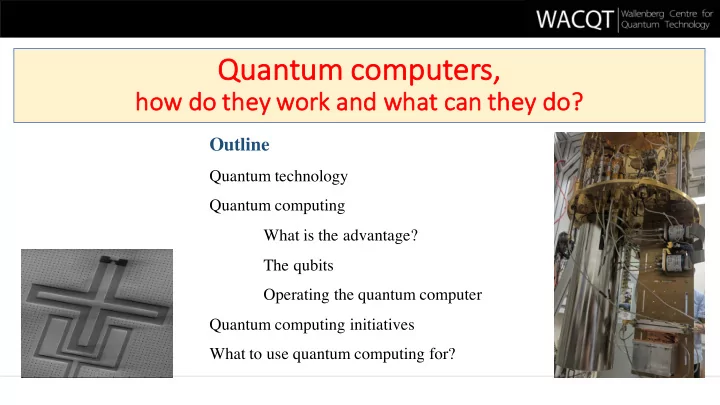
Quantum technology Quantum computing What is the advantage? The qubits Operating the quantum computer Quantum computing initiatives What to use quantum computing for?
Qu Quantum co computers, ho how do do the hey work and nd wha - - PowerPoint PPT Presentation
Qu Quantum co computers, ho how do do the hey work and nd wha hat can n the hey do do? Outline Quantum technology Quantum computing What is the advantage? The qubits Operating the quantum computer Quantum computing initiatives
Quantum technology Quantum computing What is the advantage? The qubits Operating the quantum computer Quantum computing initiatives What to use quantum computing for?
Engineering Quantum physics Basic science, Classical physics Applications Quantum Engineering Quantum applications
Approximation
IT, Electronics, Mechanics, Chemistry, Energy
Serge Haroche and David Wineland were awarded the 2012 Nobel prize in physics for the ability to control quantum systems accurately. The first quantum revolution resulted in: The transistor and the Laser Quantum Technology aims a exploiting the elements of the second quantum revolution: Superposition Entanglement Squeezing… The second quantum revolution was pioneered by people like Haroche and Wineland achieving full control over individual quantum systems.
If we use a quantum system to encode information we call them qubits
Quantum computing
solving problems much faster than
Quantum simulation
processes, otherwise too hard to simulate
Quantum communication
transmitting inherently secure messages
Quantum sensors
improving measurement technology Long-term goal Medium-term goal Already commercial Short-term goal
Four different sub-areas with different levels of maturity:
Secure communication Money transfer Quantum Internet Atomic clocks Quantum limited microwave amplifiers New drugs and catalysts Improving fertilizers Designing new materials Optimization Machine learning Code breaking
Superposition A quantum bit (qubit) can represent two values at the same time: 0 and 1 T wo qubits can represent 4 different numbers Four qubits can represent 16 different numbers, and so on… A register of N qubits can represent 2N different states simultaneously EXAMPLE: A register with 300 qubits can represent 2300 ≈ 10 100 states – more than the number of particles in the universe Making an operation on 300 qubits corresponds to making a calculation on 10100 numbers simultaneously => MASSIVE PARALLELLISM!
21=2 210=1024 220~1 million 60 qubits hard to simulate on todays supercomputer 300 qubits: 2300~10100~more than particles in the universe
1994 Peter Shor demonstrates a quantum computer algorithm to find factors of large numbers
Peter Shor 1994 Bell Labs Now MIT
1789 x 1801 = 3221989 Easy 3221989 = ? x ? Hard (RSA-hard) The asymmetry is used to encode information, used in https
This started the interest in quantum computing
1996 Peter Shor shows that error correction of qubits is possible
anharmonic and addressable
Koch et al. PRA (2007)
Qubit
either relaxationor dephasing
to be in a cold and dark environment
Error correction is complicated by the noncloningtheorem
Relaxation
Spontaneous or stimulated emission The decoherence determines the life time of the qubit If the qubit losses energy we lose the information Counter measures: Cool the environment and decrease the coupling to the environment
Dephasing
Fluctuations of the atom frequency The qubit acts like a clock. Dephasing is when the clock runs at the “wrong” speed We do not know what the phase is. Counter measures: Make sure the frequency of the qubit is insensitive to its environment E=!w
Mathematical description Quantum gates Microwave or laser pulses Convert to quantum gates and optimize number of needed gates Implement each gate into mw/laser pulses Problem to be solves Describe the problem mathematically
Microwave source for single qubit gates and readout Microwave source for qubit coupling Microwave source single qubit gates and readout Operation of the qubits is done by sending microwave pulses to the quantum processor Wallraff group, ETH Zürich Complications Brut force: More than one laser or mw source per qubit Stability and phase noise of the sources
Two consortia have been funded to do quantum computing OpenSuperQ and AQTION
AQTION
Accenture: 20 qubit online 50 qubit testing 10th of November 2017 Futurism news item, 23rd of June 2017, working on 49 qubit processor. Now 72 (March 5 2018) $64 million start-up MIT Technology Review's 2017 list of 50 Smartest Companies June 27th 2017
Main goals i) T
echnology ii) T
T wo parts Core project on quantum computing Excellence program including all of Quantum T echnology Main location: Chalmers Including: KTH, Lund (SU and LiU) Duration: 10 years, (3+4+3 years) started 1/1 2018 Involving industry SME for enabling technology Big industry for applications Funding: 600 MSEK + 200 MSEK + ~150 MSEK KAW Universities Industry partners Quantum technology flagship: OpenSuperQ
Goal: To build a quantum computer with100 superconducting qubits after 10 years Location: Chalmers Two tracks: i) Multi qubit platform ii) Resonator based Cat-qubits
qubits.
them together
quantum algorithms.
with a C-shaped coupler to a superconducting resonator. A Josephson junction which is located on the top arm of the qubit.
20
co-planer microwave circuits
Google, recent PRL T1_mean 25µs Chalmers T1s (unpublished) T1_mean 72 µs
20 40 60 80 100 120 50 100 150 200 250 300 350
T1 (us)
Scalable architecture, in collaboration with ETH and other partners within the QT-Flagship Fixed-frequency transmon qubits form a 2D array. Neighboring qubits are coupled via tunable couplers, which can be RF modulated to parametrically drive qubit-qubit interactions. Control lines and elements for readout are hosted
Scott Aaronson, Scientific American (2008) NIST Quantum Algorithm Zoo lists all known quantum algorithms
Limited coherence time implies limited running time (before error correction is implemented) Simulating 100 qubits is still too memory intensive for a classical supercomputer The answer should fit into the 100 bit output A few examples follow
”Hardware-efficient Quantum Optimizer for Small Molecules and Quantum Magnets”, Abhinav Kandala, Antonio Mezzacapo, Kristan Temme, Maika Takita, Jerry M. Chow, and Jay M. Gambetta (IBM), Nature 549, 242 (2017) 6 qubits + 2 buses + 6 read-out cavities
”Hybrid Quantum-Classical Approach to Correlated Materials ”, Bela Bauer, Dave Wecker, Andrew J. Millis, Matthew B. Hastings and Matthias Troyer, Physical Review X 6, 031045 (2016) ”Elucidating Reaction Mechanisms on Quantum Computers”,
arXiv:1605.03590(2016)
The Black-Sholes equationfor analysing financial derivativesis similar to the Schrödinger equation A quantum computer could find new patterns and explore more scenarios in financial models
19 qubit processor Clustering Clustering
March 2017 5 qubit processor ”Learning Parity with Noise”
Red markes slow trafic Give each car 3 alternative routes and
VW Data in Munich Without optimization With optimization
100 destinations and 100 airplanes 100 destinations and 100 airplanes and 100 crews ~1090 particles in the universe 10157 possibilities 10315 possibilities This problem can be mapped to a the problem of finding the ground state of a Hamiltonian
Quantum technology Quantum computing What is the advantage? The qubits Operating the quantum computer Quantum computing initiatives What to use quantum computing for?