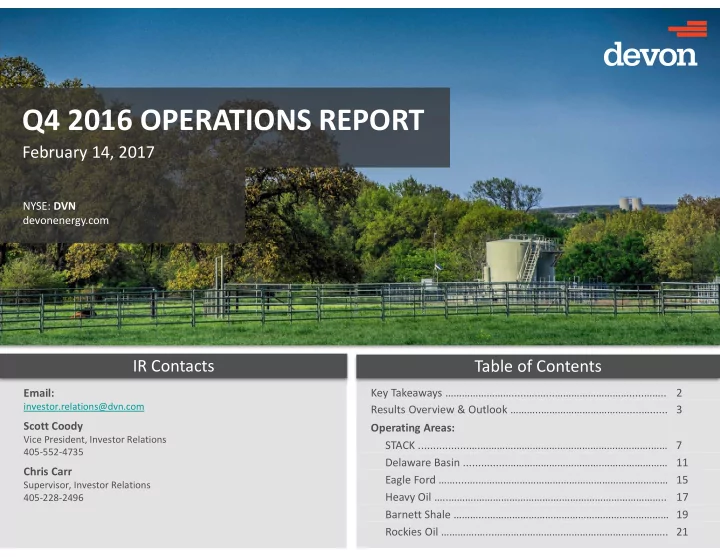
Q4 2016 OPERATIONS REPORT February 14, 2017 NYSE: DVN - - PowerPoint PPT Presentation

q4 2016 operations report
SMART_READER_LITE
LIVE PREVIEW

Q4 2016 OPERATIONS REPORT February 14, 2017 NYSE: DVN - - PowerPoint PPT Presentation

Q4 2016 OPERATIONS REPORT February 14, 2017 NYSE: DVN devonenergy.com IR Contacts Table of Contents Email: Key Takeaways ................ 2 investor.relations@dvn.com Results Overview


slide-1
SLIDE 1

Key Takeaways …………………….....….…...……………………….....…….. 2 Results Overview & Outlook ………..…………………………......…...... 3 Operating Areas: STACK .................….………….………………………………………….…… 7 Delaware Basin ...............…………………………….…………………… 11 Eagle Ford ……....….…………………………………………………………… 15 Heavy Oil …..……….………………………….……………………………….. 17 Barnett Shale ………...………………………………………………………… 19 Rockies Oil ………….…...…………………….……………………………….. 21 Email:

investor.relations@dvn.com

Scott Coody

Vice President, Investor Relations 405‐552‐4735

Chris Carr

Supervisor, Investor Relations 405‐228‐2496

Q4 2016 OPERATIONS REPORT

February 14, 2017

NYSE: DVN devonenergy.com

IR Contacts Table of Contents

slide-2
SLIDE 2

KEY TAKEAWAYS

Q4 2016 OPERATIONS REPORT 2

Heavy Oil Rockies Oil STACK Delaware Basin Eagle Ford Barnett Shale

CORPORATE HIGHLIGHTS ASSET‐LEVEL HIGHLIGHTS

Exceeded fourth‐quarter production expectations Achieved record‐setting well productivity in 2016 Reduced operating expenses in U.S. by 42 percent from peak rates Attained $1.3 billion in annual cost savings Delivered proved reserve growth at attractive finding costs Improved growth outlook driven by accelerated capital investment Meramec drilling inventory increases by 40 percent Leonard Shale and Delaware Sands resource potential expands Staggered spacing tests successful in Eagle Ford Jackfish complex delivers record production Barnett cash flow generation accelerates

slide-3
SLIDE 3

RESULTS OVERVIEW & OUTLOOK

Q4 2016 OPERATIONS REPORT 3

RETAINED ASSETS Q4 STATS

Q4 2016 Q4 2015 Production: Oil & Bitumen (MBOD) 244 260 NGL (MBLD) 90 115 Gas (MMCFD) 1,221 1,351 Retained Assets (MBOED) 537 601 E&P Capital (in millions): $397 Operated Rigs (at 12/31/16): 13 (10 in U.S.) Production Exceeds Midpoint Guidance in Q4 Oil production from Devon’s retained assets totaled 244,000 barrels per day in the fourth quarter. This high‐margin product continues to be the largest component of the company’s production mix at 45% of total volumes. Overall, net production averaged 537,000 Boe per day, exceeding the midpoint

  • f guidance by 2,000 Boe per day. To maximize profitability, Devon rejected

12,000 barrels per day of ethane in Q4. Best Drilling Results in Devon’s 45‐Year History Led by results from the STACK, Delaware Basin and Eagle Ford, Devon’s initial 90‐day production rates in 2016 increased for the 4th consecutive year, advancing >300% from 2012 levels (chart below).

150 300 450 600 750 2012 2013 2014 2015 2016

Devon’s Avg. 90‐Day Wellhead IPs

(BOED, 20:1)

>300%

IMPROVEMENT

These are the best drilling results in the company’s 45‐year history. The productivity improvements in 2016 were driven by activity focused in top resource plays, improved subsurface reservoir characterization, leading‐edge completion designs and improvements in lateral placement. Reserves Report Highlights Operational Excellence At year end, Devon’s proved reserves totaled 2.1 billion Boe, a 3% increase compared to the company’s retained asset portfolio in 2015. The most significant growth came from the company’s U.S. operations, where reserves on a retained asset basis increased 7% to 1.6 billion Boe. Devon’s U.S. capital programs in 2016 added 275 million Boe of reserves (extensions, discoveries and performance revisions). This represents a replacement rate of approximately 175%. Excluding property acquisition costs, these reserves were added at a finding cost of only $5 per Boe. These attractive reserve results within the U.S. were driven by new well activity that achieved record‐setting productivity, a materially improved

  • perating cost structure and successful base production initiatives.

The company’s heavy‐oil reserves in Canada amounted to 504 million Boe at year end. Additionally, tremendous upside potential exists with these top‐tier Canadian assets, with more than 1.4 billion Boe of risked resource.

2016 U.S. RESERVE ADDITIONS

MMBOE REPLACEMENT

slide-4
SLIDE 4

RESULTS OVERVIEW & OUTLOOK

Q4 2016 OPERATIONS REPORT 4 Lease Operating Costs Improve 42% in U.S. Resource Plays Devon continued to make progress lowering operating costs in Q4. LOE costs totaled $367 million for the quarter and were 4% below the midpoint of

  • guidance. The $1.1 billion sale of Access Pipeline added $28 million of

incremental LOE expense during Q4. This strong result was driven by the company’s U.S. asset portfolio where LOE costs improved 42% from peak rates in 2015 (chart below). The company also maintained its significantly improved G&A cost structure in the fourth quarter. Including capitalized costs, G&A totaled $224 million, a nearly 40% improvement compared to peak costs in Q4 2014. Debt Reduction Efforts to Improve Cost Structure Devon completed its $3.2 billion non‐core divestiture program in the fourth quarter, with the sale of its 50% interest in the Access Pipeline for USD $1.1 billion. The majority of divestiture proceeds were utilized to retire $2.5 billion of debt through tender offerings and repayments in 2H 2016. As a result of these debt‐reduction efforts, Devon expects its recurring, go‐forward financing costs to decline by roughly $120 million annually. The company has no significant debt maturities until mid‐2021. Overall, the company possesses investment‐grade credit ratings and exited the quarter with $2 billion of cash on hand and has an undrawn credit facility of $3 billion. Advantaged Capital Structure In addition to an investment‐grade balance sheet, Devon’s financial position is bolstered by its investment in EnLink Midstream and a significantly increased hedging position in 2017. Cost Savings Reach $1.3 Billion in 2016 Overall, Devon’s cost‐reduction initiatives have now achieved $1.3 billion of

  • perating and G&A savings in 2016 compared to peak costs in 2014 (chart

above right). The company expects these cost savings to be sustainable in 2017 due to structural improvements and efficiency gains within its field operations and corporate support groups. LOE – U.S. Operations

($ Millions)

2014 2015 2016

Operating Costs and G&A

($ Billions)

G&A

  • Prod. Taxes

LOE $2.8 $4.1

1.3 B

COST SAVINGS

$

$410 $402 $376 $364 $344 $295 $248 $236

Q1 2015 Q2 2015 Q3 2015 Q4 2015 Q1 2016 Q2 2016 Q3 2016 Q4 2016

42%

IMPROVEMENT

slide-5
SLIDE 5

2017 CAPITAL & RIG ACTIVITY

E&P CAPITAL ($MM) OPERATED RIGS (2017 Avg.) OPERATED RIGS (2017 Exit Rate) STACK $750 7 8 ‐ 10 Delaware Basin $700 7 8 ‐ 10 Heavy Oil $300 ‐ ‐ Eagle Ford $175 ‐ ‐ Rockies Oil $175 1 1 ‐ 2 Barnett Shale $50 ‐ ‐ 2017 Totals $2,000 ‐ $2,300 15 Up to 20

RESULTS OVERVIEW & OUTLOOK

Q4 2016 OPERATIONS REPORT 5 Advantaged Capital Structure (continued) In aggregate, Devon’s ownership in EnLink is valued at $4 billion (table below) and will generate cash distributions of around $270 million annually. To mitigate industry inflation, Devon is using its scale to proactively secure equipment and crews at competitive prices. The company also is taking steps to decouple historically bundled services to attain further cost savings. Additionally, Devon has maintained its organizational capacity to efficiently accelerate activity and expects to execute this program with existing personnel. The recent rise in commodity prices provided Devon the opportunity to increase its hedging position in 2017 and 2018. Devon currently has ≈50% of its estimated 2017 oil and gas production hedged and will continue to further build out its hedging position in the future. The company’s disciplined hedging program is a combination of systematic hedges added on a quarterly basis and discretionary hedges that take advantage

  • f favorable market conditions.

Market Value

($B)

ENLC (115 MM Units) $2.2 ENLK (95 MM Units) $1.8 DVN’s Ownership $4.0 Devon’s Ownership

As of February 2017

Accelerating Investment in U.S. Resource Plays Devon exited Q4 with 10 operated rigs running across its U.S. resource plays and expects to further accelerate drill‐bit activity to as many as 20 rigs in 2017. With this planned activity, Devon expects to invest $2.0 to $2.3 billion of E&P capital in 2017, of which 20% is related to non‐operated activity (table right). Nearly 90% of the capital expenditures are devoted to U.S. resource plays, with the majority of this investment concentrated in the STACK and Delaware Basin. Shift to Higher‐Margin Production Rapidly Expands Cash Flow Devon’s capital plans are expected to drive U.S. oil growth of 13% to 17% in 2017 compared to Q4 2016 (chart next page), which marks the low point of Devon’s production profile. This resumption of growth in high‐ margin production will begin in Q1 2017. The company expects to deliver this oil growth with substantially lower

  • perating costs. In 2017, LOE across the company’s U.S. resource plays is

expected to improve >$100 million compared to 2016.

BILLION

OWNERSHIP DVN’S ENLINK

slide-6
SLIDE 6

RESULTS OVERVIEW & OUTLOOK

Q4 2016 OPERATIONS REPORT 6 Shift to Higher‐Margin Production Rapidly Expands Cash Flow (continued) Looking ahead to 2018, the operational momentum created by accelerated drilling activity in the STACK and Delaware Basin is expected to advance light‐oil production in the U.S. by ≈20% compared to 2017 (chart below). STACK and Delaware: Sustainable Growth Platform with >30,000 Locations Devon’s franchise assets in the STACK and Delaware Basin have exposure to >1 million net acres, providing the company with high‐return, sustainable growth for the foreseeable future. Across these positions, the company has identified >30,000 potential drilling locations, of which roughly 1/3 have been successfully de‐risked. With ongoing STACK appraisal work and further testing of the Leonard and Wolfcamp zones in the Delaware, Devon’s resource base could further expand in 2017. This rapid growth in high‐margin production, combined with a low‐cost structure, positions Devon to deliver peer‐leading cash flow expansion through 2018 (chart below).

2016 2017e 2018e

Upstream Cash Flow Potential(1)

($ Billions)

$0.9(2) $2.7 ≈$3.5 Upstream Cash Flow EnLink Distributions

(1) Assumes $55 WTI and $3 Henry Hub in 2017 and $60 and $3.25 in 2018; excludes EnLink operating cash flow. (2) 2016 excludes $150 million of cash flow associated with divestiture assets and includes $265 million of cash associated with debt repayments.

>275%

INCREASE

Q4 2016 2017e 2018e

105 +13% ‐ 17%

(vs. Q4 16)

U.S. Oil Production Growth

(MBOD)

+≈20%

(vs. 2017)

Catalyst‐Rich Year for Resource Expansion Devon’s catalyst‐rich drilling program in 2017 includes:

  • 1. Initial multi‐zone Meramec development program
  • 2. Ongoing Meramec infill tests to define future developments
  • 3. Substantial productivity gains with Woodford row development
  • 4. Significant Leonard Shale and Wolfcamp drilling programs
  • 5. Infill spacing tests to define Eagle Ford upside
  • 6. Advances in Barnett horizontal refrac design
slide-7
SLIDE 7

STACK

Q4 2016 OPERATIONS REPORT 7

STACK Q4 STATS

Q4 2016 Q4 2015 Production: Oil (MBOD) 19 9 NGL (MBLD) 21 24 Gas (MMCFD) 284 253 MBOED 88 75 E&P Capital (in millions): $146 Operated Rigs (at 12/31/16): 6 Net production averaged 88,000 Boe per day in the fourth quarter. To enhance profitability, the company rejected 6,000 barrels per day of ethane during Q4. For the full year, production in the STACK play increased 37% compared to 2015 (chart below). This growth was driven by higher‐margin liquids production, which increased 56% year over year. 68 93

2015 2016

37%

INCREASE

STACK Production

(MBOED)

High‐Margin Growth Expands Profitability by >90% The company effectively controlled operating costs in the STACK in 2016, with LOE improving to $4.33 per Boe. This represents a reduction of nearly 20% compared to 2015. Key drivers of this improved LOE rate were high well productivity, low water handling expense, lower compression costs and reduced chemical expense. The improved cost structure and growth in oil production expanded cash margin by 93% year over year to $16.48 per Boe in Q4.

INCREASE

Q4

(VS. Q4 2015)

CASH MARGIN

RESOURCE OVERVIEW

NET ACRES RISKED LOCATIONS

>600k 5,400

slide-8
SLIDE 8

STACK

Q4 2016 OPERATIONS REPORT 8 Meramec Drilling Program Accelerates in Q4 The company added 2 operated rigs in Q4, bringing its total rig count to 6 in the STACK at year end. This rig acceleration led to the drilling of 16 Meramec wells in Q4. IP rates from these wells are expected in 1H 2017. Due to timing of completions in Q4, only 2

  • perated wells achieved 30‐day rates, averaging 1,600 Boe per day (70% oil).

Successful Spacing Tests Advance Initial Meramec Development With 3 successful operated spacing tests online and several others flowing back, Devon is incorporating this data into its initial Meramec development, the Showboat project, which is expected to spud in 2H 2017 (map below). With the initial Showboat development, the company is evaluating ≈15 wells in a single drilling unit, co‐developing up to 3 different Meramec intervals. Additional appraisal and infill testing that is currently ongoing could lead to spacing as high as 20 to 30 wells per drilling unit in the future with the co‐development of the Meramec and Woodford formations. Meramec Inventory Increases 40%; Significant Upside Remaining Due to the strong and repeatable economic results delivered to date across all fluid windows, coupled with initial infill spacing success, Devon is raising its resource potential in the Meramec. After adjusting inventory estimates to account for the shift to 10,000’ laterals and tighter spacing assumptions, Devon is increasing its risked inventory in the Meramec to 1,700 undrilled locations (equivalent to 2,800 standard‐length locations). When normalized to previous disclosures of 1,600 risked locations, which were predominately standard length, this revision represents an increase

  • f roughly 40% in risked inventory.

The majority of risked inventory is concentrated in the core of the over‐ pressured oil window. The company anticipates its resource to further expand in the future with continued appraisal and infill drilling success. Meramec Gross Risked Locations Previous Revised % Change Gross Risked Locations 1,600 1,700 Extended‐Reach ≈25% ≈65% Standard‐Reach ≈75% ≈35% Normalized to 5,000’ Laterals 2,000 2,800 40% The parent well on the Showboat lease was drilled in 2015, achieving a 30‐day rate of 1,750 Boe per day (75% oil). Cumulative first‐year production reached an impressive 550,000 Boe.

1

Born Free

2,100 BOED (30‐day rate)

2 3 4 5

Leon Gundy

Online

6 7 8 9

Bernhart Blurton

10 11 12

Alma

1,400 BOED (30‐day rate)

Pump House

2,100 BOED (30‐day rate)

STACK PILOTS – OPERATED & OBO

Chlouber

Online

Ludwig

Online

Chablis

Online

Raptorex

Online

Compton Verona

slide-9
SLIDE 9

STACK

Q4 2016 OPERATIONS REPORT 9 Meramec Inventory Increases 40%; Significant Upside Remaining (continued) Across the Meramec oil window, Devon has identified 4,300 unrisked locations

  • r >7,000 locations normalized to 5,000’ laterals. This assigns no locations to

the highly prospective liquids‐rich window (>120,000 net acres). Woodford Shale: Hobson Row Completion Activity Underway Devon is now developing the 5‐section Hobson Row (≈40 wells, primarily 5,000’ laterals, targeting the Woodford formation) in Canadian County (map right). Currently, 40% of the Devon’s operated wells have now been brought online in the Hobson row and are in the initial stages of flowing back. Early results are positive, with the average well result tracking at or above Devon’s EUR type curve of 1.6 million Boe per well. Peak rates from the Hobson Row are expected to be reached during Q2 2017, with gross production (55% WI) projected to exceed 40,000 Boe per day (>25%

  • il). Gross reserves from this project are estimated at >60 million Boe.

Initial activity in the Jacobs Row (≈70 extended‐reach wells) is expected to commence in the second half of 2017. Accelerating Capital Investment in the STACK Devon expects to continue increasing STACK drilling activity throughout 2017 and run as many as 10 operated rigs by the end of the year. This increase in activity will result in ≈100 gross operated wells tied into production during the year, with roughly two‐thirds of this activity targeting the Meramec formation. 2017 STACK Activity

65% 35%

Operated Non Operated

Capital

($750 Million)

65% 35%

Meramec Woodford

Wells to 1st Production

(≈100 Operated Wells)

10 20 30 40 50 1 2 3 4 5 6 7 8 9

Hobson Row Gross Production Uplift

Months

Forecast

MBOED

>40MBOED

GROSS PEAK PRODUCTION

Jacobs Row to Leverage 10,000’ Laterals The next Woodford project for Devon and its partner is the 13‐section Jacobs Row that is expected to be developed with 10,000’ laterals (map above right).

slide-10
SLIDE 10

STACK

Q4 2016 OPERATIONS REPORT 10 Accelerating Capital Investment in the STACK (continued) In 2017, Devon expects to invest around $750 million of capital in the STACK, of which 35% is attributable to non‐operated activity (chart previous page). STACK to Deliver Prolific High‐Margin Production Growth The STACK capital plan is projected to deliver >35% production growth by year‐ end 2017 compared to Q4 2016, which marks the low point of Devon’s production profile in the play (chart below). This strong growth is underpinned by >70% increase in oil production. Importantly, the accelerated capital investment in the STACK during 2017 positions Devon for aggressive full‐field development in 2018 and low‐risk production growth for many years to come. This premier asset provides a highly visible source of growth for Devon for many years to come. Additionally, this activity will drive significant growth and value for the company’s investment in EnLink Midstream.

(1) Normalizing lateral lengths compared to previous estimates.

Window Net Acres Gross Risked Locations Meramec Oil 10,000 100 Over‐Pressured Oil 120,000 1,600(1) Liquids‐Rich >120,000 TBD Woodford Oil 25,000 200 Liquids‐Rich 180,000 2,200 Dry Gas 100,000 1,300 Exploration 70,000 TBD Total >600,000 5,400 88

Q4 2016 Q1 2017e Q2 2017e Q3 2017e Q4 2017e

STACK Production Growth

(MBOED)

>120

Note: Over‐pressured oil window now includes 30,000 net acres from the condensate window, which was previously categorized in the liquids‐rich window.

40% STACK Resource Potential: A Multi‐Decade Growth Opportunity Devon has the premier STACK position in the industry with more than 600,000 net acres by formation. Across this massive position, the company has identified 5,400 risked, undrilled locations concentrated within the most economic portions of the Meramec and Woodford plays (table right).

>35%

GROWTH

slide-11
SLIDE 11

DELAWARE BASIN

Q4 2016 OPERATIONS REPORT

DELAWARE BASIN Q4 STATS

Q4 2016 Q4 2015 Production: Oil (MBOD) 29 42 NGL (MBLD) 10 11 Gas (MMCFD) 89 82 MBOED 54 66 E&P Capital (in millions): $53 Operated Rigs (at 12/31/16): 3 11 Net production averaged 54,000 Boe per day in the fourth quarter (72% liquids). To enhance cash margin, Devon rejected 2,000 barrels per day of ethane in Q4. The more profitable production mix expanded cash margin in the Delaware Basin to $21 per Boe in Q4, a 54% increase compared to the year‐ago quarter. Record‐Low LOE Rates Achieved Devon continued to make progress lowering operating costs in Q4. LOE declined to a record low of $7.42 per Boe, an improvement of 56% from peak rates in early 2015 (chart below). The majority of these cost savings are expected to be sustainable due to significant enhancements in the power and water‐handling infrastructure over the past few years. $16.87 $14.80 $12.62 $12.00 $10.76 $8.82 $7.72 $7.42

Q1 2015 Q2 2015 Q3 2015 Q4 2015 Q1 2016 Q2 2016 Q3 2016 Q4 2016

56%

IMPROVEMENT

Delaware Basin Unit LOE

($/BOE)

slide-12
SLIDE 12

DELAWARE BASIN

Q4 2016 OPERATIONS REPORT 12 Record‐Low LOE Rates Achieved (continued) Due to the improved infrastructure, Devon was able to reduce operating costs in the Delaware Basin by $132 million in 2016 compared to 2015. Successful Leonard Test Sets Up Initial TRAC Development In Q4, Devon brought online a stacked pilot testing 400’ vertical spacing in the Thistle area between the Leonard “B” and “C” intervals in Lea County. The Thistle wells were drilled with 7,000’ laterals and achieved peak 30‐day rates that averaged 1,875 Boe per day (>70% oil) at a cost of $6 million per well. These learnings will be applied in Devon’s initial TRAC development in 2017. The company plans to drill a 10‐well pattern across 3 Leonard intervals, which will test spacing of up to 19 wells per section (graphic below). Devon has 60,000 net surface acres in the Leonard, prospective for 3 landing intervals. Adding up the leasehold by interval, the company has exposure to 160,000 net effective acres. The company has identified 3,100 unrisked locations across its Leonard Shale position and estimates the upside potential in the play to exceed 1 billion Boe of net recoverable resource. Delaware and Bone Spring Results Showcase Upside Potential Other noteworthy activity in Q4 included 2 Delaware Sands wells, which averaged 1,300 Boe per day (75% oil), at a cost of only $4.7 million per

  • well. These wells exceeded the IP type curve by 60%, and well costs were

25% below expectations. Devon has 80,000 net acres within the Delaware Sands play and, due to

  • ngoing characterization work, is raising its unrisked inventory by 25% to

2,000 locations (700 risked locations). Also in Q4, the company brought online 2 Bone Spring wells in the basin, achieving an average 30‐day rate of 1,400 Boe per day (80% oil). This activity includes a Bone Spring well in the Thistle area, which affirms additional stacked‐pay opportunities that can be co‐developed with the Leonard Shale and Wolfcamp. Leonard Shale Resource Potential Expands With the positive spacing test result in the Leonard, Devon has raised its risked inventory in the Leonard Shale to 950 gross locations, an increase of nearly 20%. 800 950

Previous Revised

20%

INCREASE

Leonard Shale Risked Inventory

(Locations)

LEONARD UNRISKED POTENTIAL

BBOE

Initial TRAC Development

(10‐well pattern testing 3 Leonard zones)

LEONARD A B C

750’ 880’

Appraisal Well

slide-13
SLIDE 13

DELAWARE BASIN

Q4 2016 OPERATIONS REPORT 13 Drilling Efficiencies Continue in Q4 Devon resumed drilling operations in the Delaware Basin during the second half

  • f 2016, and rig productivity reached a record‐high of 973 feet drilled per day,

an increase of 84% from early 2015. A record drill time was set in Q4 with the Cotton Draw 179H, achieving a spud‐ to‐target‐depth time of only 9 days. Shift to Multi‐Zone Pad Developments Underway in 2017 To maximize efficiencies and returns, Devon’s 2017 capital program is focused on development drilling in the basin of SE New Mexico across the company’s 4 core operating areas (see map below). 529 573 650 783 856 920 973

Q1 2015 Q2 2015 Q3 2015 Q4 2015 Q1 2016 Q3 2016 Q4 2016

Delaware Basin Drilling Efficiency

(Feet Per Day) Note: no drilling activity occurred in Q2 2016.

84%

INCREASE

Nearly 70% of Devon’s capital activity is focused on pad development

  • drilling. Devon’s shift to larger, multi‐zone pad development drilling that

utilizes the TRAC concept will begin in 2017 and accelerate into 2018. Rig Acceleration Plan Remains on Track Devon’s acceleration plan in the Delaware Basin remains on track as the company exited 2016 with 3 operated rigs running. With improving cash flow, Devon expects to steadily ramp‐up activity throughout 2017 and exit the year with as many as 10 operated rigs running. For 2017, Devon expects to invest around $700 million of capital in the Delaware Basin, with 15% attributable to non‐operated activity (chart above right). This increase in activity will result in ≈100 operated wells spud during the year, with drilling focused on Bone Spring, Leonard Shale and Wolfcamp targets (chart above right). 2017 Delaware Basin Activity

85% 15%

Operated

Capital

($700 Million)

36% 36% 23% 5%

Bone Spring Leonard Shale Wolfcamp Delaware Sands

Drilling

(≈100 Operated Wells)

Non Operated

CORE DEVELOPMENT AREAS

slide-14
SLIDE 14

DELAWARE BASIN

Q4 2016 OPERATIONS REPORT 14 A World‐Class Growth Platform with Massive Resource Upside Adding up leasehold by formation, Devon has a top‐tier position in the Delaware Basin with 670,000 risked net acres and 5,850 risked undrilled locations (table below). 4,615 4,618 4,714 4,778 5,304 6,471

2012 2013 2014 2015 2016 2017e

Delaware Basin Laterals

(Avg. Lateral Length by Year)

≈40%

INCREASE

Formation Net Acres Risked Gross Locations Unrisked Gross Locations Delaware Sands 80,000 700 2,000 Leonard Shale 60,000 950 3,100 Bone Spring 285,000 3,500 5,700 Wolfcamp 225,000 500 >9,000 Other (Yeso & Strawn) 20,000 200 200 Total 670,000 5,850 >20,000 Production Growth to Exceed 20% by Year‐End 2017 The Delaware Basin capital plan is projected to stabilize production by the end

  • f Q1 2017 and positions these assets to deliver >20% top‐line growth by the

end of 2017 (chart below). The company also possesses massive resource upside with >20,000 unrisked locations. The most significant potential resides in the emerging Wolfcamp and Leonard plays. The characterization of this upside will take a major step forward in 2017 as nearly 60% of capital will be deployed toward Wolfcamp and Leonard Shale projects in the upcoming year. Delaware Basin Production Growth

(MBOED)

54

Q4 2016 Q1 2017e Q2 2017e Q3 2017e Q4 2017e

>65 In 2017, well productivity and capital efficiency are expected to drive returns higher as Devon increases the use of extended‐reach laterals. The shift to longer laterals will increase the weighted‐average lateral length in the Delaware Basin to around 6,500’ during 2017, a 40% increase in lateral length compared to Devon’s historical well design (chart below).

>20%

GROWTH

slide-15
SLIDE 15

EAGLE FORD

Q4 2016 OPERATIONS REPORT 15

EAGLE FORD Q4 STATS

Q4 2016 Q4 2015 Production: Oil (MBOD) 34 60 NGL (MBLD) 11 27 Gas (MMCFD) 90 152 MBOED 60 113 E&P Capital (in millions): $62 Operated Rigs (at 12/31/16): Net production in the Eagle Ford averaged 60,000 Boe per day in the fourth

  • quarter. To maximize margins, the company rejected 4,000 barrels per day of

ethane during Q4. World‐Class Development Results in DeWitt County Devon achieved excellent results from its Eagle Ford development program in DeWitt County during the fourth quarter. The company brought online 35 wells during Q4, with the majority tied in during December. Initial 30‐day rates from these wells averaged 2,300 Boe per day (60% oil).

Q4 HIGHLIGHTS VS PEAK 2015 COSTS LOE MILLION FREE CASH FLOW

Eagle Ford Generates >$350 Million of Free Cash Flow in 2016 Devon delivered another strong cost performance in Q4 by limiting LOE in the Eagle Ford to $30 million, a decline of 45% compared to peak costs in 2015. Efficiency gains, lower labor and service cost reductions led to the improved LOE rates. The strong cost performance and higher prices increased the cash margin to $27 per Boe in the quarter, up 22% from Q3. The steady improvement in per‐unit margin in 2016 helped the Eagle Ford generate >$350 million of free cash flow for the full year. Staggered Lower Eagle Ford Spacing Test Successful Of the 35 wells brought online during the fourth quarter, 19 wells were associated with Devon’s staggered lateral infill program in the Lower Eagle

  • Ford. 30‐day rates from these wells averaged 2,300 Boe per day (map right).
slide-16
SLIDE 16

EAGLE FORD

Q4 2016 OPERATIONS REPORT 16 Staggered Lower Eagle Ford Spacing Test Successful (continued) Early flow‐back results from these staggered lateral wells, which were spaced at 440 feet, are encouraging and in line with expectations. As a result, Devon expects recoveries per section to significantly increase compared to historical results in the play. 2017 Outlook: Eagle Ford Production Growth Resumes In 2017, Devon and its partner plan to run as many as 3 rigs and invest $175 million of capital. This activity includes the company’s initial Austin Chalk development pad (online by YE 2017). The company exited 2016 with a DUC inventory of 70 wells and expects to work down its DUC count to 30 to 40 wells by the end of 2017. This 9‐well pilot is currently flowing back and initial 30‐day rates are expected in Q1 2017. 81 79 89 93 70

12/31/15 3/31/16 6/30/16 9/30/16 12/31/16 12/31/17e

Eagle Ford DUC Inventory

(Number of Wells) Cretaceous AUSTIN CHALK

UPPER EAGLE FORD SHALE LOWER EAGLE FORD SHALE

BUDA DEL RIO

Diamond Stack Test

(9‐well pattern testing up to 18 wells per section) 880’ 440’

Due to the more active completion program, Devon expects its Eagle Ford production profile for the full‐year 2017 to achieve single‐digit production growth compared to Q4 2016. Importantly, this capital program is expected to deliver some of the best returns in the company’s portfolio and, at $55 WTI, the Eagle Ford assets are expected to generate operating cash flow in excess of $600 million in 2017. “Diamond Stack” Spacing Test Flowing Back The company also is evaluating up‐hole, stacked‐pay potential across the majority of its acreage in the Eagle Ford and currently is testing the co‐ development of the Lower and Upper Eagle Ford intervals. The initial 9‐well pilot will utilize a “diamond stack” pattern, which will test the concept of up to 18 wells per section across 3 different landing zones. Efficiencies Drive 45% Improvement in Well Costs Eagle Ford drilling times improved by 80% over the past two years, with a record rate of 30 wells per rig line per year in 2016. Due to these efficiencies and completion cost reductions, Devon is reducing its Eagle Ford D&C costs to $5.5 million per well, an improvement of 45% from peak rates.

BY YEAR END 2017WELLS

30-40

slide-17
SLIDE 17

HEAVY OIL

Q4 2016 OPERATIONS REPORT 17

HEAVY OIL Q4 STATS

Q4 2016 Q4 2015 Production: Oil & Bitumen (MBOD) 139 121 Gas (MMCFD) 18 24 MBOED 141 126 E&P Capital (in millions): $47 Operated Rigs (at 12/31/16): 3 Net oil production in Canada averaged a record 139,000 barrels per day in the fourth quarter. This strong result was driven by the Jackfish complex, where gross production exceeded nameplate capacity by 15%, averaging 121,000 barrels per day. This represents a growth rate of 26% year over year (chart below). 96 121

Q4 2015 Q1 2016 Q2 2016 Q3 2016 Q4 2016

Jackfish Complex Gross Production

(MBOD)

26%

GROWTH

The company expects cash flow generation to accelerate at Jackfish in

  • 2017. At $55 WTI oil, operating cash flow in Canada has the potential to

approach $800 million for the year. Massive Cash Flow Generating Capabilities Devon’s Jackfish projects are also significant cash flow generators. In the fourth quarter, these assets produced $167 million of operating cash flow, bringing the full‐year total to $420 million. Since first production occurred at the Jackfish complex in late 2007, these industry‐leading projects have generated $3.6 billion of cumulative cash flow from operations (chart right).

$0 $1,000 $2,000 $3,000 $4,000 $5,000 2008 2009 2010 2011 2012 2013 2014 2015 2016

Jackfish Complex – Cumulative Operating Cash Flow

($ US Millions) Jackfish 1 Jackfish 2 Jackfish 3 THROUGH YEAR END 2016

BILLION

3.6 $

2008 2009 2010 2011 2012 2013 2014 2015 2016 2017e

slide-18
SLIDE 18

HEAVY OIL

Q4 2016 OPERATIONS REPORT 18 Industry‐Leading Operating Performance The company’s excellent operating performance at Jackfish in 2016 was driven by best‐in‐class plant utilization along with one of the best steam‐to‐oil ratios in the industry (chart below). The Jackfish complex is delivering some of the lowest operating costs in the SAGD industry. LOE averaged $9.59 per barrel in Q4, a 57% decline compared to peak rates driven by higher plant utilization rates and lower service costs. Jackfish 2 Production Advances 51% Gross production at Jackfish 2 averaged 41,300 barrels per day (net 40,500 barrels per day), a 51% increase compared to Q4 2015. The strong production growth at Jackfish 2 was driven by the successful ramp‐up of two new well pads over the past year. Jackfish 3 Production Exceeds 45,000 Barrels per Day Gross production at J3 reached a record‐setting 45,300 barrels per day in Q4 (net 44,600 barrels per day), exceeding nameplate capacity by 30%. Since start‐up, production has increased every quarter with volumes exceeding facility design for 6 consecutive quarters (chart below). 2017 Outlook In 2017, Devon expects net oil production from its heavy‐oil operations to range between 130,000 and 135,000 barrels per day. This assumes a 6% royalty rate in 2017 compared to a 3% rate in 2016 due to higher prices. The capital to deliver this production profile is $300 million in 2017, of which two‐thirds is maintenance capital at the Jackfish complex. Investment in the Bonnyville (Lloydminster) cold‐flow heavy oil program and technology projects is the other third of Canadian capital in 2017. Performance of Industry SAGD Projects

(Plant Utilization & SOR) Source: Industry regulatory reporting. August 2016 data.

0% 20% 40% 60% 80% 100% 120% 1.00 2.00 3.00 4.00 5.00 6.00 % Nameplate Capacity Steam‐To‐Oil Ratio

Jackfish

Top‐Quartile Projects Jackfish 1 Growth Driven by Successful New Well Pad Gross production at Jackfish 1 increased to 33,900 barrels per day during the fourth quarter (33,600 barrels after royalties) and exited the year at nameplate capacity of 35,000 barrels per day. This result was driven by the successful ramp‐up of a new well pad, which increased net production at Jackfish 1 by 17% compared to Q4 2015. 36.2 38.1 40.0 41.7 42.0 45.3

Q3 2015 Q4 2015 Q1 2016 Q2 2016 Q3 2016 Q4 2016

Jackfish 3 Gross Production

(MBOD)

Facility Nameplate Capacity: 35 MBOD

slide-19
SLIDE 19

BARNETT SHALE

Q4 2016 OPERATIONS REPORT 19

BARNETT SHALE Q4 STATS

Q4 2016 Q4 2015 Production: Oil (MBOD) 1 1 NGL (MBLD) 43 49 Gas (MMCFD) 710 786 MBOED 163 181 E&P Capital (in millions): $9 Operated Rigs (at 12/31/16): Net production averaged 163,000 Boe per day in Q4. With improving prices, cash flow generation in the Barnett increased to $107 million in the quarter. Base Production Initiatives Yielding Excellent Results In 2016, the company’s Barnett operations were focused on optimizing existing well performance across its 5,000 operated wells in the play. These base production initiatives included line pressure reduction projects, artificial lift programs and efforts to further reduce controllable downtime which has improved 65% since 2015 (chart below). Reserve Additions Showcase Operational Excellence With the successful base production initiatives and an improved cost structure, the company added 97 million equivalent barrels of proved reserves through performance revisions during 2016. With limited capital investment of only $31 million in 2016, these reserve additions were added at record‐low finding costs. 0.86% 0.69% 0.61% 0.71% 0.54% 0.46% 0.35% 0.30%

Q1 '15 Q2 '15 Q3 '15 Q4 '15 Q1 '16 Q2 '16 Q3 '16 Q4 '16

Barnett Controllable Downtime

65%

IMPROVEMENT

Over the past year, these efforts have improved the Barnett’s unaided PDP decline by ≈5 percentage points, translating into incremental production of >3 million equivalent barrels over this time period.

INCREASE

REVISIONS PERFORMANCE

MMBOE

90% 10% Barnett Proved Reserves

(At 12/31/16)

Performance Revisions

(97 MMBOE)

slide-20
SLIDE 20

BARNETT SHALE

Q4 2016 OPERATIONS REPORT 20 Future Development Activity to Unlock Massive Upside Potential Devon has tremendous upside beyond proved reserves in the Barnett where the company has 1.9 billion Boe of risked resource (table below). Barnett Risked Resource BBOE Proved reserves (at 12/31/16) 1.0 Undrilled locations and refracs 0.9 Total Risked Resource 1.9 Development opportunities that can convert this resource upside into reserves resides primarily with 2,500 risked locations associated with horizontal refracs and new rig line activity (map below). 2017 Outlook: Capital Investment Increases In 2017, Devon plans to invest $50 million of capital in the Barnett to

  • ptimize base production and further de‐risk future development activity.

As part of this activity, the company is testing completion technologies that have the potential to reduce horizontal refrac costs to $700,000 per well, a 25% improvement from previous estimates. The company is also initiating a drilling pilot of 5 to 10 wells in the Barnett during 2017 to leverage modern drilling and completion technology in this legacy field. These appraisal projects have the potential to deliver returns that are highly competitive in Devon’s portfolio. This could lead to additional capital being allocated to the Barnett during 2017.

FUTURE DEVELOPMENT

Significant Leverage to Higher Commodity Prices In addition to the meaningful upside to higher recoveries, the Barnett Shale also has significant leverage to an improving commodity price environment. Cash flow in the Barnett can approach $600 million annually at a realized price of $3 per Mcfe (chart below).

$200 $400 $600 $800 $2.00 $2.25 $2.50 $2.75 $3.00 $3.25 $3.50 $3.75 Free Cash Flow ($ MM) Realized Price ($/Mcfe)

Annualized Cash Flow Sensitivities

slide-21
SLIDE 21

ROCKIES OIL

Q4 2016 OPERATIONS REPORT 21

ROCKIES OIL Q4 STATS

Q4 2016 Q4 2015 Production: Oil (MBOD) 11 15 NGL (MBLD) 1 1 Gas (MMCFD) 17 38 MBOED 15 23 E&P Capital (in millions): $27 Operated Rigs (at 12/31/16): 1 Net production was 15,000 Boe per day in the fourth quarter. Light‐oil production accounted for 74% of the product mix and roughly 90% of revenue in the Rockies. LOE Declines 53% from Peak Rates Devon continued to make progress lowering operating costs in the Rockies during the fourth quarter. Total LOE declined to $15 million in Q4, an improvement of 53% from peak costs in early 2016. $32 $26 $17 $15

Q1 2016 Q2 2016 Q3 2016 Q4 2016

Rockies LOE

($ Millions)

53%

DECLINE

The key drivers of the decrease in LOE are lower power costs, declining chemical expenses and improved water‐handling infrastructure. Drilling Activity Resumes in the Powder River Basin The company resumed drilling operations in the Rockies with one operated rig during the fourth quarter and spud 5 wells in the Powder River Basin oil fairway (map right).

Upper Cretaceous TECKLA TEAPOT PARKMAN

SHANNON/SUSSEX NIOBRARA SHALE

TURNER FRONTIER Lower Cretac. MOWRY SHALE MUDDY

INITIAL POWDER RIVER FOCUS AREAS

slide-22
SLIDE 22

ROCKIES OIL

Q4 2016 OPERATIONS REPORT 22 Drilling Activity Resumes in the Powder River Basin (continued) Initial drilling activity was focused primarily on the Parkman formation, and 30‐ day production rates from these wells are expected in Q1 2017. The Parkman is an Upper Cretaceous oil formation that sits at a vertical depth of around 7,000 feet (geologic column previous page). Devon expects D&C costs for a 10,000’ lateral well to range from $5.5 to $6 million with average EURs of approximately 500,000 Boe (table below). Rig productivity for this activity in Q4 improved to a record high of >1,000 feet drilled per day in the fourth quarter. This represents a productivity increase of 30% over the past two years (chart above). The Powder River has several billion barrels of resource in place across the basin and the company’s high‐return inventory will increase over time as the company deploys additional activity to de‐risk the oil fairway. Parkman Type Well 10,000’ Lateral 30‐Day IP

BOED

>1,000 EUR

MBOE

≈500

(90% light oil)

D&C Cost

$MM

$5.5 ‐ 6.0 2017 Outlook Devon plans to drill around 20 operated wells in the Powder River Basin during

  • 2017. This drilling activity will target the Parkman, Teapot and Turner

formations. This capital activity is projected to stabilize Devon’s Rockies production in 2017 compared to Q4 2016 exit rates. The capital investment associated with this 2017 activity is approximately $175 million, of which $50 million is related to maintenance capital at its CO2 facilities in Wyoming. Development Inventory Increases 20% The Powder River oil fairway is an emerging stacked‐pay resource

  • pportunity in Devon’s portfolio with exposure to ≈400,000 net effective

acres across the Teapot, Parkman and Turner formations. Given the high oil content, project economics have significant leverage to WTI prices. With the recent rise in prices, Devon has now identified 240 locations that are capable of delivering competitive returns in its portfolio, a 20% increase from previous disclosures (table below). 796 899 1,031

2014 2015 2016

Rig Productivity

(Feet Drilled Per Day)

30%

IMPROVEMENT

Formation High‐Return Inventory at $55 Oil

Teapot

40

Parkman

75

Turner

125 240

HIGH‐RETURN INVENTORY

UNDRILLED LOCATIONS INCREASE

slide-23
SLIDE 23

INVESTOR NOTICES & RISK FACTORS

Q4 2016 OPERATIONS REPORT 23 Forward‐Looking Statements This presentation includes "forward‐looking statements" as defined by the Securities and Exchange Commission (the “SEC”). Such statements include those concerning strategic plans, expectations and objectives for future operations, and are often identified by use of the words “expects,” “believes,” “will,” “would,” “could,” “forecasts,” “projections,” “estimates,” “plans,” “expectations,” “targets,” “opportunities,” “potential,” “anticipates,” “outlook” and other similar terminology. All statements, other than statements of historical facts, included in this presentation that address activities, events or developments that the Company expects, believes

  • r anticipates will or may occur in the future are forward‐looking statements. Such statements are subject to a number of assumptions, risks and uncertainties, many
  • f which are beyond the control of the Company. Statements regarding our business and operations are subject to all of the risks and uncertainties normally incident

to the exploration for and development and production of oil and gas. These risks include, but are not limited to: the volatility of oil, gas and NGL prices; uncertainties inherent in estimating oil, gas and NGL reserves; the extent to which we are successful in acquiring and discovering additional reserves; the uncertainties, costs and risks involved in exploration and development activities; risks related to our hedging activities; counterparty credit risks; regulatory restrictions, compliance costs and

  • ther risks relating to governmental regulation, including with respect to environmental matters; risks relating to our indebtedness; our ability to successfully

complete mergers, acquisitions and divestitures; the extent to which insurance covers any losses we may experience; our limited control over third parties who

  • perate our oil and gas properties; midstream capacity constraints and potential interruptions in production; competition for leases, materials, people and capital;

cyberattacks targeting our systems and infrastructure; and any of the other risks and uncertainties identified in our Form 10‐K and our other filings with the SEC. Investors are cautioned that any such statements are not guarantees of future performance and that actual results or developments may differ materially from those projected in the forward‐looking statements. The forward‐looking statements in this presentation are made as of the date of this presentation, even if subsequently made available by Devon on its website or otherwise. Devon does not undertake any obligation to update the forward‐looking statements as a result of new information, future events or otherwise. Use of Non‐GAAP Information This presentation may include non‐GAAP financial measures. Such non‐GAAP measures are not alternatives to GAAP measures, and you should not consider these non‐GAAP measures in isolation or as a substitute for analysis of our results as reported under GAAP. For additional disclosure regarding such non‐GAAP measures, including reconciliations to their most directly comparable GAAP measure, please refer to Devon’s fourth‐quarter 2016 earnings release at www.devonenergy.com. Cautionary Note to Investors The SEC permits oil and gas companies, in their filings with the SEC, to disclose only proved, probable and possible reserves that meet the SEC's definitions for such terms, and price and cost sensitivities for such reserves, and prohibits disclosure of resources that do not constitute such reserves. This release may contain certain terms, such as resource potential, potential locations, risked and unrisked locations, estimated ultimate recovery (EUR), exploration target size and other similar terms. These estimates are by their nature more speculative than estimates of proved, probable and possible reserves and accordingly are subject to substantially greater risk

  • f being actually realized. The SEC guidelines strictly prohibit us from including these estimates in filings with the SEC. Investors are urged to consider closely the

disclosure in our Form 10‐K, available at www.devonenergy.com. You can also obtain this form from the SEC by calling 1‐800‐SEC‐0330 or from the SEC’s website at www.sec.gov.