SLIDE 1
Q38.1 In an experiment to demonstrate the photoelectric effect, In - - PowerPoint PPT Presentation
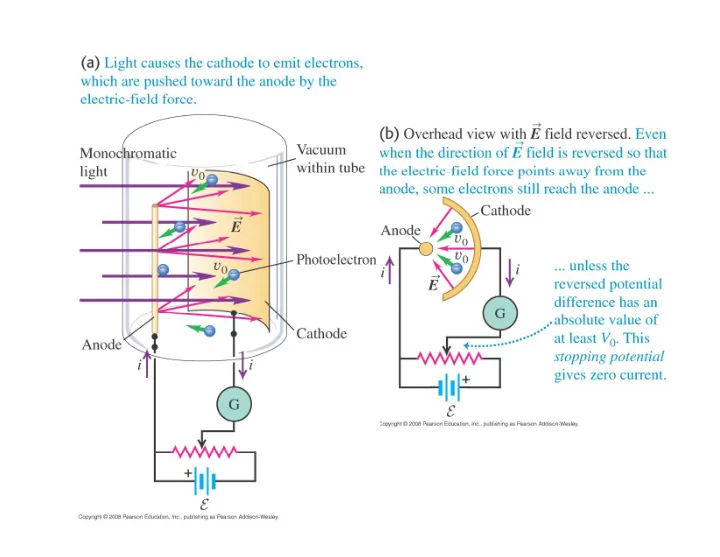
Q38.1 In an experiment to demonstrate the photoelectric effect, In an experiment to demonstrate the photoelectric effect, you shine a beam of monochromatic blue light on a metal plate. As a result, electrons are emitted by the plate. If you
SLIDE 2
SLIDE 3
SLIDE 4
In an experiment to demonstrate the photoelectric effect, Q38.1 In an experiment to demonstrate the photoelectric effect, you shine a beam of monochromatic blue light on a metal
- plate. As a result, electrons are emitted by the plate.
If you increase the intensity of the light but keep the color of the light the same, what happens?
- A. More electrons are emitted per second.
- B. The maximum kinetic energy of the emitted electrons
gy increases.
- C. both A. and B.
- D. neither A. nor B.
SLIDE 5
This graph in shows the Q38.2 This graph in shows the stopping potential as a function of the frequency
- f light falling on a metal
- surface. If a different
type of metal is used,
- A. the graph could have a different slope.
B the graph could intercept the horizontal axis at a
- B. the graph could intercept the horizontal axis at a
different value.
- C. both A. and B.
- D. neither A. nor B.
SLIDE 6
SLIDE 7
A t i t h t l l h i diff Q38.3 A certain atom has two energy levels whose energies differ by 2.5 eV. In order for a photon to excite an electron from the lower In order for a photon to excite an electron from the lower energy level to the upper energy level, what must be true about the energy of the photon?
- A. Its energy must be greater than or equal to 2.5 eV.
B Its energy must be exactly 2 5 eV
- B. Its energy must be exactly 2.5 eV.
- C. Its energy must be less than or equal to 2.5 eV.
- D. none of the above