SLIDE 1
More BinaryTree methods Tree Traversals
Q1 Q1-3
After today, you should be able to… … traverse trees on paper & in code
SLIDE 2
} Doublets is next assignment. } Also with a partner – meet later during
today's class.
} Instructor demo later too.
SLIDE 3 } Please complete the Stacks&Queues partner
evaluation in Moodle after you submit your final code. Due as soon as you submit the project (or by Mon night).
} Optional Exam 1 review session:
- Tue 9/18 from 8–11pm, Percopo classroom, led by
Connor Boyle
} Questions (exam, Stacks & Queues, HW3)?
SLIDE 4
Quiz question: What became clear to you as a result of class? CSSE230 student: I was tre treeted to some good knowledge by the time I le leaft.
SLIDE 5
4 possibilities for children (leaf, Left only, Right only, Both)
1 possibility for children: Both (which could be NULL_NODE)
NULL_NODE
SLIDE 6
Simpler Simpler
SLIDE 7
Comment out unused tests and uncomment as you go Write containsNonBST(T item) now.
SLIDE 8 } If (node is null)
simple
} Recurse to the left } Recurse to the right } Combine results
with this node
SLIDE 9 } If (node is null)
simple
} Recurse to the left } Recurse to the right } Combine results
with this node
SLIDE 10 } If (node is null)
simple
} Recurse to the left } Recurse to the right } Combine results
with this node
SLIDE 11 } If (node is null)
simple
} Recurse to the left } Recurse to the right } Combine results
with this node
} Print the tree
contents
} Sum the values of
the nodes
} Dump the contents
to an array list
} Lots more } In what order
should we print nodes?
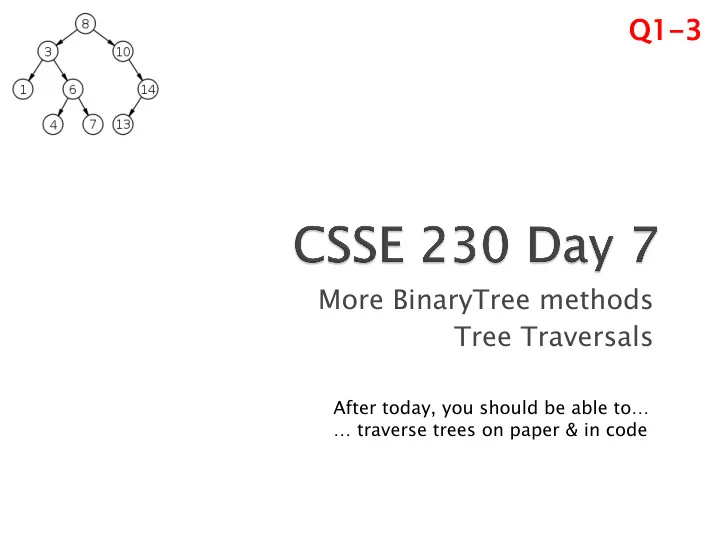
SLIDE 12 } InOrder (left-to-right, if tree is spread out)
} PreOrder (top-down, depth-first)
} PostOrder (bottom-up)
} LevelOrder (breadth-first)
- Level-by-level, left-to-right within each level
4-7
SLIDE 13 If the tree has N nodes, what’s the (worst- case) big-Oh run-time
traversal?
SLIDE 14
} Brainstorm how to write:
public ArrayList<T> toArrayList()
} Then BST toString() will simply be:
return toArrayList().toString();
8
SLIDE 15
Size(), height(), contains(), toArrayList(), toString(), etc. What if we want an iterator (one element at a time)? Next class
SLIDE 16