
SLIDE 1
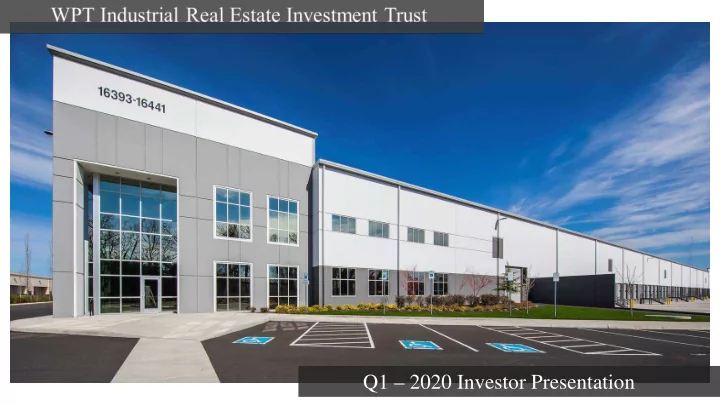
Q1 2020 Investor Presentation ForwardLooking Statements This - - PowerPoint PPT Presentation
Q1 2020 Investor Presentation ForwardLooking Statements This presentation contains "forward-looking information" as defined under Canadian securities laws (collectively, forward-looking statements ) which reflect
This presentation contains "forward-looking information" as defined under Canadian securities laws (collectively, “forward-looking statements”) which reflect management’s expectations regarding objectives, plans, goals, strategies, future growth, results of operations, performance, business prospects and opportunities of the REIT. The words “plans”, “expects”, “scheduled”, “estimates”, “intends”, “anticipates”, “projects”, “believes”, or variations of such words and phrases (including negative variations) or statements to the effect that certain actions, events or results “may”, “will”, “could”, “would”, “might”, “be achieved”, or “continue” and similar expressions identify forward-looking statements. Some of the specific forward-looking statements in this presentation include, but are not limited to statements regarding the objectives and strategic focus of the REIT; future distributions by the REIT; predictability and certainty of cash flow; investment
rates in the state-of-the-art distribution market and absorption of vacancy in distribution investment properties in major distribution markets in the U.S. over the past years; re-tenanting costs; key trends and continued and increased demand within the industrial real estate market; the effect of the experience of the asset and property manager of the REIT; in the U.S. industrial real estate market on tenant retention and future acquisitions by the REIT; the expected accretion to the REIT’s funds from operations (“FFO”) per Unit and adjusted funds from operations (“AFFO”) per Unit from completed acquisitions; the sources of organic growth; including initiatives aimed at optimizing the performance; value and long-term cash flow of the REIT’s investment property portfolio; the REIT’s external growth strategy; including diversification; the REIT’s cost of capital; borrowing costs and opportunities to increase the cash flow and value of the existing portfolio of investment properties through initiatives designed to enhance operations; future maintenance expenditures; future project costs related to the development of investment properties; the attractiveness of newer investment properties to prospective tenants; the quality and future valuations of the REIT’s portfolio of investment properties; lease terms; termination and future maintenance and leasing expenditures; the REIT’s ability to meet all of its ongoing obligations with current cash generated from operations; draws on its Credit Facility and new equity and debt issuances; the fair values of the REIT’s investment properties; the REIT’s debt strategy, including the REIT’s intention to maintain staggered mortgages payable maturities; and anticipated and potential adverse impacts resulting from the coronavirus disease (COVID-19) pandemic. Forward-looking statements are necessarily based on a number of estimates, beliefs and assumptions that are inherently subject to significant business, economic and competitive uncertainties and contingencies which could cause actual results to differ materially from those that are disclosed in such forward-looking statements. While considered reasonable by management of the REIT as at the date of this presentation, any of these estimates, beliefs or assumptions could prove to be inaccurate, and as a result, the forward-looking statements based on those estimates, beliefs or assumptions could be incorrect. Such estimates, beliefs and assumptions include the various estimates, beliefs and assumptions set forth herein, and include but are not limited to, the desirability of investment properties in the distribution subsector of the U.S. industrial real estate market to investors, including the industrial investment properties in the REIT’s portfolio; key trends and continued and increased demand within the industrial investment property real estate market; the effect of management’s experience in the U.S. industrial real estate market on tenant retention and future acquisitions by the REIT; the future growth potential of the REIT and its properties; anticipated amounts of expenses; results of operations; future prospects and opportunities; the demographic and industry trends remaining unchanged; no change in legislative or regulatory matters; future levels of indebtedness; the tax laws in both Canada and the U.S. as currently in effect remaining unchanged; current levels of volatility in the demand for space in the distribution sub-segment have increased as a result
which the REIT’s investment properties are located; and the scope and duration of the COVID-19 pandemic and its impact on the REIT. This presentation does not constitute or form part of any offer for sale or solicitation of any offer to buy or subscribe for any securities nor shall it or any part of it form the basis of or be relied on in connection with, or act as any inducement to enter into, any contract or commitment whatsoever. The information contained in this presentation concerning the REIT and its affiliates does not purport to be all-inclusive or to contain all the information that a prospective purchaser or investor may desire to have in evaluating whether or not to make an investment in the REIT. The information is qualified entirely by reference to the REIT’s MD&A and the AIF. Certain terms includes in this presentation such as debt-to-gross book value (“GBV”), FFO, AFFO, net operating income (“NOI”), book value per Unit, same property net operating income (“Same property NOI”), capitalization rate, cash re- leasing spread, and straight-line rent re-leasing spread are used by management to measure, compare and explain the operating results and financial performance of the REIT and are not recognized terms under IFRS, and therefore should not be construed as alternatives to net income (loss) and comprehensive income (loss) or cash flow from operating activities calculated in accordance with IFRS. Management believes these terms are relevant measures in comparing the REIT’s performance to industry data, the REIT’s ability to earn and distribute cash returns to holders of the REIT’s trust units, and the REIT’s ability to meet its ongoing obligations. These terms are defined and reconciled to the most directly comparable measure specified in the REIT’s MD&A. Such terms do not have a standardized meaning prescribed by IFRS and may not be comparable to a similarly titled measure presented by other issuers.
2
WPT Industrial Real Estate Investment Trust is an internally managed and publicly traded REIT focused exclusively on the U.S. industrial sector
4
Seasoned management team with extensive knowledge of the U.S. industrial sector Access to high-barrier U.S. markets through off-market private capital acquisition pipeline Unit price and annual distribution of $0.76/unit in U.S. Dollars
5
OFF-MARKET INVESTMENT PIPELINE FEE REVENUE FROM PRIVATE CAPITAL
EXTERNAL GROWTH
EXTENSIVE INDUSTRY RELATIONSHIPS
PARTNERSHIPS WITH PREMIER GLOBAL INVESTORS
ENTRY INTO NEW U.S. MARKETS STRATEGIC FINANCING CONTRACTUAL RENT INCREASES MAINTAINING CONSISTENTLY HIGH OCCUPANCY
INTERNAL GROWTH
ROLLING RENTS TO MARKET AT RENEWAL PROPERTY EXPANSION AND DEVELOPMENT
WPT MANAGEMENT PLATFORM
6
Location Basis Building Functionality We underwrite investments focusing on asset basis relative to current replacement costs and competitive future speculative development We target Tier 1 and 2 distribution markets with proximity to major population centers, significant transportation infrastructure, access to cost-effective labor, and favorable long-term rent growth prospects We focus on acquisition of assets with in-place rents that compare favorably to market rents to drive long term NOI growth We analyze submarket and tenant-specific demand drivers to determine desired building attributes
Rents Relative to Market
7
………………………………
…………………………………
……………………………………….
INVESTMENT PROPERTIES2
………………………………
TOTAL SQUARE FEET OF GLA2
…………………………………
FAIR VALUE OF INVESTMENT PROPERTIES
1. As at March 31, 2020 2. Includes two assets held in joint venture
(all figures in ‘000s, except per Unit amounts and gross leasable area (“GLA”))
Q1 2020 Q4 2019 Q3 2019 Q2 2019 Q1 2019
Investment properties revenue $ 32,481 $ 31,882 $ 29,335 $ 28,714 $ 25,198 Management fee revenue 273 501 2,237 358 491 NOI 23,381 23,145 21,788 21,164 18,141 FFO 13,749 14,176 14,807 12,961 9,614 FFO per Unit (diluted) 0.184 0.216 0.243 0.213 0.176 AFFO 10,284 11,069 11,980 9,759 6,698 AFFO per Unit (diluted) 0.137 0.169 0.197 0.161 0.123 Book value per Unit 12.98 13.31 13.09 12.88 12.40 GLA 1 32,152,917 22,870,482 22,765,482 20,767,799 18,850,627 Occupancy 1,2 95.7% 99.0% 99.5% 99.4% 99.1% Same property NOI %
3
1.4% 3.1% 4.5% 4.1% 3.4% Weighted average remaining lease term (years) 1 4.7 4.9 5.1 4.9 4.5
8
1. Excludes properties owned by the equity accounted joint venture 2. Exclusive of leases commencing after quarter end. Totaled leased GLA at 3/31/2020 was 97.3%, inclusive of leases commencing in Q2 2020 3. Quarterly same property NOI vs. comparable period for the prior year
9
1 1. As at March 31, 2020
Tenant
Industry % of Total Annualized Base Rent1 GLA Occupied (‘000s sq. ft.)1 (%) of Total Portfolio GLA1
FedEx Ground Package System, Inc. Third Party Logistics 13.7% 1,874.1 5.9% IKEA Distribution Services, Inc. Consumer Products 3.5% 996.5 3.1% General Mills Operations, LLC Consumer Products 3.0% 1,512.6 4.8% Continental Tire the Americas Consumer Products 2.8% 740.9 2.3% Unilever Home & Personal Care Consumer Products 2.8% 1,262.5 4.0% Amazon.com E-Commerce 2.6% 936.0 2.9% Keystone Automotive2 Consumer Products 2.3% 754.8 2.4% Zulily LLC E-Commerce 2.1% 737.5 2.3% Exel, Inc Third Party Logistics 1.7% 800.0 2.5% FullBeauty Brands, Inc. E-Commerce 1.7% 741.1 2.3% Total 36.2% 10,356.0 32.5%
10
1. As at March 31, 2020 2. Comprised of two leases with Keystone Automotive Operations, Inc. and Keystone Automotive Industries, Inc.; both wholly-owned subsidiaries of LKQ Corporation.
1
11
1. As at March 31, 2020
12
1
1. As at March 31, 2020
3.4% 4.6% 3.8% 3.8% 1.2% 1.0% Weighted average interest rate of maturities
Weighted average interest rate
35.7 74.9 27.7 84.5 42.4 53.0
331.7 350.0
50 100 150 200 250 300 350 2020 2021 2022 2023 2024 2025 Maturities ($ in Millions)
Debt Maturities by Year
Mortgages Credit Facility
Weighted average remaining lease term
13
1. As at March 31, 2020
6 27 33 21 31 13 48 Number of Leases Expiring
1.2% 9.4% 21.5% 11.0% 15.2% 11.1% 30.6%
2020 2021 2022 2023 2024 2025 2026+
Lease Expiration (% of GLA) by Year ¹
1
As at 6/30/2017, the REIT had 4 leases totaling 2.1% of the portfolio remaining to be renewed.
14
1. As at March 31, 2020
Highlights
For the three months ended March 31, 2020, the REIT entered into approximately 30,500 and 355,200 sq. ft. of new and renewal leases, respectively. Renewals commencing in 2020 had a weighted average cash re-leasing spread and straight-line rent re-leasing spread of 4.5% and 17.1%, respectively. During the quarter, the REIT renewed approximately 753,200 sq. ft. of leases commencing after March 31, 2020 with a weighted average cash re-leasing spread and straight-line rent re-leasing spread of 10.4% and 16.1%, respectively. Occupancy stabilized at 97.3%, including two leases with an weighted average remaining lease term of 4.7 years, signed in the quarter that commence in the second quarter.
1
15
91.0 125.9 108.5 80.3 70 90 110 130 150 170 190 210 Mar-13 Sep-13 Mar-14 Sep-14 Mar-15 Sep-15 Mar-16 Sep-16 Mar-17 Sep-17 Mar-18 Sep-18 Mar-19 Sep-19 Mar-20 WIR (US$) WIR (CAD$) S&P/TSX Composite Index (CAD$) S&P/TSX Capped REIT Index (CAD$)
17
The acquisition is immediately accretive to the REIT’s FFO and AFFO on a per unit basis The acquisition significantly increased the size and scale of the REIT’s portfolio to approximately $2.3 billion, with a 39% increase in total GLA to approximately 32 million square feet, enhancing the REIT’s ability to leverage its fully internalized management platform The acquisition portfolio consists of institutional quality assets with an average age of approximately 14 years, average clear height of 31 feet Approximately 60% of base rent is derived from investment grade tenants, with limited
term of 4.6 years Expands WPT’s presence and operating platform in the high-barrier coastal markets of New Jersey, California and Florida and strengthens the REIT’s presence in other key U.S. distribution markets Portfolio NOI can be increased over time through vacancy lease up, future development
Increased size and scale from the acquisition enhances the REIT’s ability to reassess portfolio composition and recycle capital over the near term IMMEDIATELY ACCRETIVE TRANSACTION INCREASED PORTFOLIO SCALE AND LEVERAGE ON FIXED COSTS INSTITUTIONAL QUALITY ASSETS STRONG AND DIVERSE IN-PLACE TENANT ROSTER INCREASED HIGH-BARRIER MARKET EXPOSURE AND GEOGRAPHIC DIVERSIFICATION FUTURE VALUE CREATION OPPORTUNITIES CAPITAL RECYCLING OPTIONALITY
18
19
Acquired: Jan 2020 Purchase Price: $16.2mm Square Feet: 126,303 Capitalization Rate: 5.6% Clear Height: 24’ Occupancy: 100.0% Lease Term: 3 Years Dock Doors: 18
Increased E-Commerce Penetration
E-commerce continues to grow with sales increasing dramatically in response to COVID-19
Measured Supply
New Supply levels are increasingly muted as new developments are put on hold or cancelled.
Fragmented Market
Very few experienced operators relative to other asset classes
Rising Inventory Levels
Inventory levels are expanding in response to disruptions caused by COVID-19 21
Reshoring
Many companies have begun to reevaluate their supply chains in response to COVID-19
22 “The global pandemic’s effect on the industrial market sector remains in flux, as the length and severity of its impact on the economy have yet to be
the new year with strong fundamentals and we expect trends to follow suit going forward. We continue to see growth in the e-commerce and grocery industries along with suppliers for critical products including medical devices and pharmaceuticals. As we move forward, we believe many companies will be reevaluating their supply and stocking operations as well as redesigning their distribution networks in response to the supply chain shock from COVID-19, driving demand for manufacturing and last-mile facilities.”
Source: JLL Q1 2020 Industrial Outlook Source: CBRE Q1 2020 U.S. Industrial & Logistics Figures
23
24
Market Indicators
“Despite a potential slowdown in leasing activity as the market adjusts to the global pandemic, top logistics markets continue to operate at a sub 3.0 percent vacancy rate, and although leasing activity will drop in the coming quarters, we expect continued competition for quality space adding pressure on rents through 2020. “
Market Indicators
Source: Cushman & Wakefield Q1 2020 U.S. Industrial MarketBeat report
Overall Vacancy 4.9% 4.9% Net Absorption 42.3mm 45.4mm Weighted Asking Rent (NNN) $6.49 $6.40
Reverse Logistics Driving Demand
U.S. Research Report | Q4 2019 | Industrial Market Outlook | Colliers International
25
“The U.S. industrial vacancy rate closed out 2019 at 5.1% — one
(BPS) over the prior quarter and 14 BPS higher than year-end
Source: JLL Q3 2019 Industrial Outlook Source: CBRE Q1 2020 U.S. Industrial & Logistics Figures
Q1 20 Q1 19
26
commerce, Retail, and Logistics & Distribution. E-commerce nearly doubled its leasing volume compared to the previous quarter from 10.7 million square feet to 24.9 million square feet. Inland Empire, Dallas-Fort Worth, Eastern and Central Pennsylvania, and Houston continue to produce the highest deliveries and leasing volume in the industrial market. Moving forward we expect this trend to continue as the adoption of e-commerce and technology by consumers evolves resulting in a focus on Urban Logistics and demand for last mile spaces
demand will be bolstered by greater inventory controls, supply chain diversification and e-commerce growth.
period in 2018 compared to a total retail sales increase of 4.0%.
(Source: JLL– Q1 2020 United States Industrial Outlook) (Source: CBRE Research,, Q1 2020) (Source: Q4 2019 US Census Bureau’s ‘Quarterly Retail E-Commerce Sales)
Name Firm Email Phone
Troy MacLean, CFA BMO Capital Markets troy.maclean@bmo.com (416) 359-8366 Mark Rothschild Canaccord Genuity Corp mrothschild@canaccordgenuity.com (416) 869-7280 Chris Couprie, CFA CIBC chris.couprie@cibc.com (416) 594-7194 Michael Markidis, CFA Desjardins Capital Markets michael.markidis@desjardins.com (416) 607-3028 Brad Sturges, CFA iA Securities bsturges@iagto.ca (416) 203-5827 Matt Kornack National Bank Financial matt.kornack@nbc.ca (416) 507-8104 Neil Downey, CFA, CA, CPA RBC Capital Markets neil.downey@rbccm.com (416) 842-7835 Himanshu Gupta, CPA, CA, CFA Scotia Capital himanshu.gupta@scotiabank.com (416) 863-7218
27
Trustee Real Estate/Board Experience Independent Trustee Audit Committee Investment Committee CG&N1 Committee
Milo Arkema
Louie DiNunzio
Scott Frederiksen
Chair of the Board
Sarah Kavanagh
Stuart H.B. Smith
Pamela Spackman
Province of British Columbia
Robert Wolf
Lead Trustee
(CHAIR) (CHAIR) (CHAIR)
28
Scott Frederiksen
Chief Executive Officer P: 612-800-8501 E: stf@wptreit.com