Pyrrolizidine alkaloids: analytical challenges and perspectives - - PowerPoint PPT Presentation

pyrrolizidine alkaloids analytical challenges and
SMART_READER_LITE
LIVE PREVIEW

Pyrrolizidine alkaloids: analytical challenges and perspectives - - PowerPoint PPT Presentation

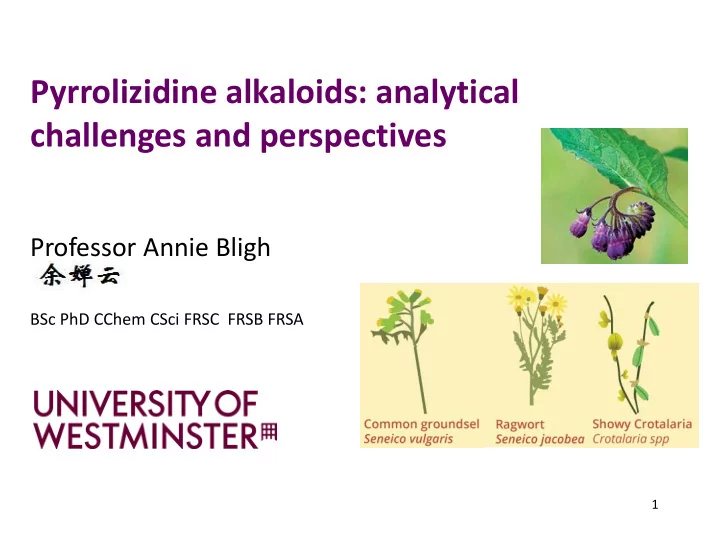
Pyrrolizidine alkaloids: analytical challenges and perspectives Professor Annie Bligh BSc PhD CChem CSci FRSC FRSB FRSA 1 Outline What are pyrrolizidine alkaloids (PA)? Why are they toxic? How can the insects manage the toxin? PA

slide-1
SLIDE 1

1

Pyrrolizidine alkaloids: analytical challenges and perspectives

Professor Annie Bligh

BSc PhD CChem CSci FRSC FRSB FRSA

slide-2
SLIDE 2

2

Outline

Analytical challenges?

  • What are pyrrolizidine alkaloids (PA)?
  • Why are they toxic? How can the insects

manage the toxin?

  • PA distribution in plants
  • What are the analytical techniques

available?

Specificity and Sensitivity

slide-3
SLIDE 3

3

What are pyrrolizidine alkaloids (PAs)?

  • PAs are plant defence weapons against

herbivores.

  • They are present in several different plant species,

for example,

  • Eupatorium (Asteraceae)
  • Crotolaria (Fabaceae)
  • Senecio (Asteraceae)
  • PAs can occur in two forms, the tertiary free base

and the N-oxide.

slide-4
SLIDE 4

4

Some examples of Pas – free base

Retrorsine Heliotrine Echimidine Senecionine

slide-5
SLIDE 5

5

Common necine bases of PA

Retronecine N-oxide

slide-6
SLIDE 6

6

Why are they toxic?

  • Genotoxic: Capable of forming DNA adduct
  • Hepatotoxic: Veno-occlusive
  • Damage to heart and lung in high dose
  • The PA N-oxide itself, which is non-toxic per

se, cannot be directly converted into toxic pyrrols and is hydrophylic and unable to passively pass through membranes

  • But N-oxide can be broken down to the free

base in the gut of insects and mammals, where it is absorbed and further reduced to highly unstable toxic pyrrols.

slide-7
SLIDE 7

7

slide-8
SLIDE 8

8

  • A. R. MATTOCKS

Toxicology Research Unit, MRC Laboratories, Surrey, UK

Toxicity of Pyrrolizidine Alkaloids

A new class of metabolite, with a pyrrole-like structure, has been demonstrated in the tissues of animals poisoned by pyrrolizidine alkaloids. There is some correlation between the degree of hepato-toxicity and the amount of "pyrrole" found in the liver. Evidence has been found of the types of reactions such metabolites might undergo with tissue constituents.

1968, vol 217, 723

Mattocks AR. Chemistry and toxicology of pyrrolizidine alkaloids. London: Academic Press, 1986.

slide-9
SLIDE 9

9

How can the insects manage the toxin?

  • around 40 insect herbivores feed on the PA-

containing Senecio jacobaea

  • insects are able to detoxify PAs in their host

plant through N-oxidation

  • By N-oxidation potentially toxic free bases

are converted back into PA N-oxides that cannot be transformed into toxic pyrrolic derivatives

Attract and deter: a dual role for PAs in plant–insect interactions

slide-10
SLIDE 10

10

A: Larvae of the specialist moth Tyria jacobaeae feeding on their host plant Senecio jacobaea B: adult T. jacobaeae Both larvae and adults contain pyrrolizidine alkaloids and show warning coloring.

Photo: Eric Thomassen

slide-11
SLIDE 11

11

PAs distribution in plants

  • In the roots, the PAs were almost

exclusively present as N-oxides and not as free bases.

  • In the shoots around 35% of the PAs were

tertiary free bases.

  • Younger leaves have higher PA

concentrations than the older leaves.

  • For example, adonifoline in Senecio

scandens, flower > stem > root > leaf

slide-12
SLIDE 12

12

What are the analytical techniques available?

Separation

  • thin layer chromatography (TLC)
  • high performance liquid

chromatography (HPLC)

  • UPLC
  • gas chromatography (GC)
  • supercritical fluid

chromatography (SFC) Detection

  • colorimetry
  • mass spectrometry (MS)
  • nuclear magnetic

resonance (NMR)

  • chemiluminescence (CE)
  • Diode array detection

(DAD) However, most of these methods were strictly limited by the structural specificity of different types of PAs.

slide-13
SLIDE 13

13

slide-14
SLIDE 14

14

Colorimetric

Not for OTO-PAs! Sensitivity: 5 ppm

slide-15
SLIDE 15

15

Pre-column derivatization HPLC-DAD

RET type of PAs Sensitivity 1 ppm

slide-16
SLIDE 16

16

UPLC-MS/MS - dual parent ion scans

  • an effective strategy involving dual parent ion

scans of diagnostic ion pairs by UPLC-MS/MS

slide-17
SLIDE 17

17

Examples of PAs found in Senecio species. Senecionine N-

  • xide is the basic

structure from which other PAs are formed. These senecionine type PAs have an

  • tonecine

(senkirkine) or retronecine ester base (e.g., senecionine) and a 12-membered macro-cyclic ring

slide-18
SLIDE 18

18

PIS profile of PAs and main PAs in S. vulgaris

slide-19
SLIDE 19

19

UPLC-MS/MS - dual parent ion scans

  • Two Senecio herbs, Sececio vulgaris L. and S.

scandens Buch.-Ham, showed great difference in their hepatotoxicity.

  • Significant difference was shown between their

PAs’ fingerprint profiles.

  • In all, 53 PAs, including 22 RET-PAs, 14 RET-PA-N-
  • xides, 11 saturated-RET-PAs, 1 OTO-PAs, and 5

dehydro-OTO-PAs, were detected.

  • The average content of PAs in S. vulgaris was

found about 25 times higher than that in S. scandens (1123.08 µg/g vs 44.31 µg/g)

slide-20
SLIDE 20

20

slide-21
SLIDE 21

21

Conclusions

  • What do we know about PAs ?
  • Very toxic due to its reactivity to produce

dehydroPAs

  • Structurally diverse

 Challenges in extraction  Challenges in specificity – impossible to have all the reference standards  Challenges in sensitivity

  • Way forward?
  • Better instrumentation
  • Better database - algorithms
slide-22
SLIDE 22

22

Acknowledgements

Shanghai University of Traditional Chinese Medicine

  • Professor Li Yang
  • Professor Zhengtao Wang

Thank you