Putting more Ma in your Maternity Noah Litherland 1 and Sabrina - - PDF document

putting more ma in your maternity
SMART_READER_LITE
LIVE PREVIEW

Putting more Ma in your Maternity Noah Litherland 1 and Sabrina - - PDF document

12/13/2017 Putting more Ma in your Maternity Noah Litherland 1 and Sabrina Portner 2 1 Dairy Youngstock Technical Specialist 2 Vita Plus Inter Summer 2017 (Senior at ISU) Why Focus on Maternity? Classically overlooked and poorly


slide-1
SLIDE 1

12/13/2017 1

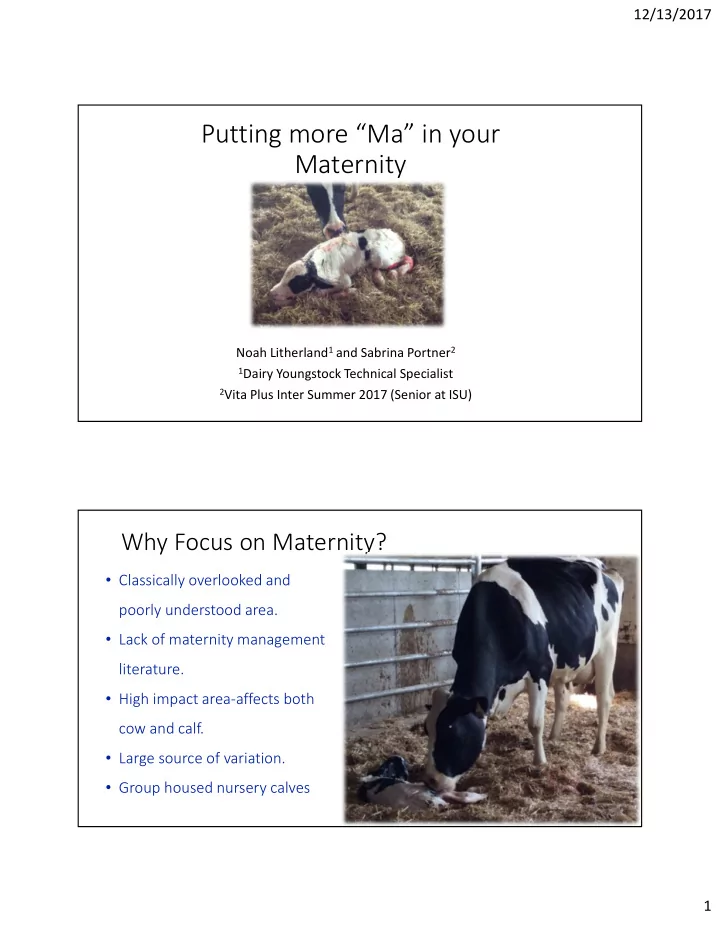
Putting more “Ma” in your Maternity

Noah Litherland1 and Sabrina Portner2

1Dairy Youngstock Technical Specialist 2Vita Plus Inter Summer 2017 (Senior at ISU)

Why Focus on Maternity?

  • Classically overlooked and

poorly understood area.

  • Lack of maternity management

literature.

  • High impact area-affects both

cow and calf.

  • Large source of variation.
  • Group housed nursery calves
slide-2
SLIDE 2

12/13/2017 2

Today’s Approach

  • Sabrina Portner- Summer 2017 internship project
  • Large herd maternity data analysis (1,670 calving’s)
  • Latest (2017) Journal of Dairy Science research
  • Tips and tricks from top maternity managers

5- Key Areas

  • 1. Managing pre-calving variables
  • 2. Calving pen dynamics
  • 3. Navel care
  • 4. Colostrum management and feeding
  • 5. Maternity team calibration

Dairies Surveyed- 22 Farms

  • Minnesota (3) and Wisconsin (19)
  • Herd Size
  • Average: 1,173 cows (lactating)
  • High: 4,000 cows
  • Low: 220 cows
  • Milk Production
  • Average: 86.6 lbs.
  • High: 113 lbs.
  • Low: 57 lbs.
  • Milk Production Holsteins

– Average: 93.6 lbs. – High: 113 lbs. – Low: 75 lbs.

  • Milk Production Other Breeds

– Average: 71.5 lbs. – High: 99 lbs. – Low: 57 lbs.

  • Dairy Comp

Dairy Comp Dairy Comp Dairy Comp

  • ATP Swabs

ATP Swabs ATP Swabs ATP Swabs - All relevant equipment

  • Ag Source Culturing

Ag Source Culturing Ag Source Culturing Ag Source Culturing – Colostrum, dry cow and calving pen bedding

  • 3M Petri Film

3M Petri Film 3M Petri Film 3M Petri Film – Gram negative plate counts in colostrum

  • Brix Refractometer

Brix Refractometer Brix Refractometer Brix Refractometer – Colostrum IgG

  • Calf Blood Samples

Calf Blood Samples Calf Blood Samples Calf Blood Samples – Serum total protein

slide-3
SLIDE 3

12/13/2017 3

Similar milk production within Holstein herds Not able to use milk production to categorize maternity success

10 20 30 40 50 60 70 80 90 100 110 120

1 2 3 4 5 6 7 8 9 10 11 12 13

Lbs/head/day Individual Holstein Farms

Alternative Analysis- by Herd Size

Item <1,000 cows >1,000 cows

  • Avg. milk yield, lb/d

87.5 86

  • Avg. herd size, cows

479 2007 Calving strategy Bedded Pack % 50 Just in time calving, % 50 100

Cow moved from group pen either at 1st signs of calving or feet showing into individual pen to calve

slide-4
SLIDE 4

12/13/2017 4

Managing Pre-calving Variables Gestation Length (GL)

  • Holstein (Norman et al., 2009)
  • Heifers (277.8 ± 5.5 d)
  • Cows (279.4 ± 5.7 d)
  • Factors influencing GL
  • Genetics, calf gender, singleton or twin, age of dam, and season of year.
  • Intermediate GL (274-281 d) optimized lifetime productivity, calving

ease, and incidence of still-birth (Norman et al., 2011)

  • Cows with GL short or long had increased incidence of stillbirth, and

dystocia compared with GL 274-281 d (Nogalski and Piwczyński, 2012).

slide-5
SLIDE 5

12/13/2017 5

  • Parturition is triggered by

the increase in fetal glucocorticoid concentration.

  • Signal of maturation is

activation of the fetal hypothalamic-pituitary- adrenal axis (HPA-axis).

Hypothalamus-Adrenal-Pituitary Axis HPA-Axis

Dam/daughter interactions impact GL

  • Hypoxemia (low oxygen) is a potent stimulus to increase activity of

calf HPA-axis and results in parturition (Matthew and Challis, 1996).

  • Primiparous cows have less body capacity than multiparous cows, so

space limitations can create fetal stress and early parturition.

  • Similarly, cows calving in heat stress have shorter gestation periods

than cows calving in cool season.

  • Evaporatively cooled late gestation cows had GL 3.5 d longer than cows not

receiving cooling (Tao and Dahl, 2014).

  • It is possible heat stress promotes maturation of the HPA-axis and

shorter GL. (Vieira-Neto et al., 2017)

slide-6
SLIDE 6

12/13/2017 6 Two California dairies (3,335 Primi- and 4,909 Multiparous cows) Impact of gestation length

Vieira-Neto et al., 2017

Average Short Long P-value Mean gestation, d 276 266 285 Range, d 270 to 282 256 to 269 283 to 296 Milk production, lb./d 84.8 80.7 83.0 < 0.01 (SEM = 0.67)

Herd survival of Holstein heifers born alive according to gestation length

Vieira-Neto et al., 2017

slide-7
SLIDE 7

12/13/2017 7

Prepartum Management by Herd Size

Description <1,000 cows >1,000 cows Heifers Age 1st calving, mo. 23.6 22.7 Dry cow Days dry 54.9 54 Dry cow stocking density % 161.8 104.2 Hygiene score 1.2 1 # pen moves dry off - calving 2.6 3.1

Number of Pen Moves from Dry off to Calving Number of Pen Moves from Dry off to Calving Number of Pen Moves from Dry off to Calving Number of Pen Moves from Dry off to Calving Average: 2.86 High: 5 (2 farms) Low: 1 (1 farm)

Does number or timing of Pen Moves impact

  • n GL?

Chebel et al., 2016

slide-8
SLIDE 8

12/13/2017 8

3 Stages of parturition (Noakes et al., 2001; Jackson, 2004)

Stage 1- Opening of the cervix and the initiation of uterine contractions. Stage 2-Dialation of the birth canal by amniotic sacs and ends with expulsion of the fetus. Stage 3-Release of fetal membranes

Evaluating calving behavior in 1st calf heifers What to look for and when (Lange et al., 2017) (Germany)

Tail raising Clear vaginal discharge Lying lateral w/ abdominal contractions Bloody vaginal discharge

slide-9
SLIDE 9

12/13/2017 9

Electronic Prediction

  • f Calving

Titler et al., 2015 Lying bouts Steps Lying time Standing time

Calving outside of normal working hours can put strain on labor and can also result in less supervision at calving.

Feed close-up cows in the evening to skew calving time towards daylight hours?

slide-10
SLIDE 10

12/13/2017 10

Feed close-up cows in the evening to skew calving time towards daylight hours?

  • Feeding close-up cows at 5:30 pm vs. 8:00 am increased daytime

calving’s by 17% (72% of calving during daytime). (Clarke et al., 1983)

  • Others reporting similar effects:
  • Yarney et al., 1979; Lowman et al., 1981; Gleeson et al., 2007
  • Physiology behind shift in calving time:
  • Behavioral shift in time of day standing (decreased intra-uterine pressure)
  • Rumen function- Frequency of rumen contractions decrease in the hours

prior to calving. Increased rumen contractions associated with feeding might influence calving time.

Calving Pen

slide-11
SLIDE 11

12/13/2017 11

Calving Environment-by Herd Size

Description <1,000 cows >1,000 cows % cows calving in maternity 91.8 92.5 Calving ease (1= no assistance; 4 = mechanical assistance) 1.26 1.88 Time to dystocia intervention, min. 80 72 Bedding culture calving pen, million cfu/g 1.7 1.8 Clean wheat straw = 22,000 cfu/g Low = 50% High = 3 mil.

Distribution of time in calving pen before calving. Average = 50.5 minutes

100 200 300 400 500 600 700 800

200 400 600 800 1000 1200 1400 1600

Minutes in Maternity before calving

# cows Impressive consistency in calving time

lapse

slide-12
SLIDE 12

12/13/2017 12

Simple privacy accommodations

Calf DOA rate

  • Dead on Arrival (DOA)
  • Average: 7%
  • High: 18.3%
  • Low: 4%
  • 2 yr. Old DOA
  • Average: 9.0%
  • High: 20%
  • Low: 5%
slide-13
SLIDE 13

12/13/2017 13

DOA rate similar between herd sizes

Description <1,000 cows >1,000 cows DOA, % 7.0 5.7 DOA 2 year olds, % 8.7 9.2 Twinning, % 6.0 4.8

What has been the level of calf DOA for each lactation group?

20% DOA in 1st calf heifers, consider evaluating:

  • 1. Age/size at breeding
  • 2. Sire Selection-GL = lung development
  • 3. Maternity management for 1st calf heifers.
  • 4. Decrease pre-calving stress (moves)
slide-14
SLIDE 14

12/13/2017 14

Navel Care

Umbilical infection

P1- Distal end of umbilical stalk P2-Base of umbilical stalk P3-Umbilical vein P5-Umbilical artery

  • Occurring in 1.3% (Svensson et

al., 2003) to 29.9% (Hathaway et al., 1993) of newborn dairy calves.

  • Besides the local infection and

inflammation, bacteria can spread via blood into joints, lungs, kidneys causing health complications.

  • Increased risk for respiratory

disease (Perez et al., 1990)

  • Decreased growth rate (Virtala

et al., 1996) and increased mortality rate (Donovan et al., 1998).

(Wieland et al., 2017)

slide-15
SLIDE 15

12/13/2017 15

Umbilical cord care in calves (Wieland et al., 2017)

  • Calves of 1st calf heifers had decreased odds of umbilical infection

compared with calves of multiparous dams.

  • Heavier calves (2 lb. increase in birth BW) increased odds of umbilical

infection marginally.

  • Calves with presence of umbilical cord at 2 days age had decreased
  • dds of umbilical infection.

Navel Guard 7% iodine tincture 2% Nolvasan P-value Umbilical infection, % 29.1 (41/141) 28.0 (40/143) 24.5 (34/139) 0.66 Mortality rate, % 14.9 5.6 7.9 0.02 Postmorten exam-Scours 19/21 4/8 9/11 …

Signs of umbilical infection

  • Positive pain response at palpation
  • Presence of a fistula (hole) in abdominal wall
  • Presence of discharge
  • Umbilical stalk larger than 1 inch in diameter and continued increase

in swelling. Protocol for treatment (Weiland et al., 2017 Cornell University) Two dose of IM florfenicol, 20 mg/kg BW, 48 hr. One dose of Meloxicam, 1 mg/kg

slide-16
SLIDE 16

12/13/2017 16

Umbilical infection-preventative measures

  • Maternity pen hygiene
  • Decreased residency time of the newborn calf in the maternity pen
  • Adequate colostrum management
  • Antiseptic umbilical cord care

Colostrum Feeding and Management

slide-17
SLIDE 17

12/13/2017 17

Colostrum yield Just in time calving Milked within 30 min.

  • 15,081 lb. of colostrum from

1,662 cows

  • 9.1 lb. of colostrum/calf
  • Colostrum yield is sufficient to

feed all calves 1-gallon of 1st milking maternal colostrum. Brix, % # cows (% cows) <19 50 (3.5%) 19-22 179 (12.6%) >22 1,196 (83.9%) Average Brix, % 25.6

Colostrum yield, lb. # cows % cows 223 13.4 < 8 603 36.4 8.4 459 27.7 > 8.4 595 35.9

Colostrum Management

  • Time from Calving to Colostrum Harvest

Time from Calving to Colostrum Harvest Time from Calving to Colostrum Harvest Time from Calving to Colostrum Harvest

  • Average: 2 hrs. 44 minutes
  • High: 6 hrs. (4 farms)
  • Low: 10 min. (1 farm)
  • Colostrum Quality Decisions

Colostrum Quality Decisions Colostrum Quality Decisions Colostrum Quality Decisions

  • Don’t Measure – 22.7%
  • Won’t Feed <22 Brix – 45.5%
  • Won’t Feed <24 Brix – 13.6%
  • Wont feed <20 – 4.5%
  • Only feed colostrum replacer – 4.5%
  • Heat treated:

Heat treated: Heat treated: Heat treated: 36.4%

  • Time from Birth to Colostrum Feeding

Time from Birth to Colostrum Feeding Time from Birth to Colostrum Feeding Time from Birth to Colostrum Feeding

  • Average: 1 hr. 17 min.
  • High: 6 hrs. (1 farm)
  • Low: 20 min. (1 farm)
  • 91% of farms feed 4

91% of farms feed 4 91% of farms feed 4 91% of farms feed 4 qts qts qts

  • qts. of Colostrum or 3

. of Colostrum or 3 . of Colostrum or 3 . of Colostrum or 3 qts qts qts

  • qts. for Jerseys

. for Jerseys . for Jerseys . for Jerseys
slide-18
SLIDE 18

12/13/2017 18

Colostrum Management- by Herd Size

Description <1,000 cows >1,000 cows Calving to colostrum harvest avg. hrs. 3.7 1.6 Brix, % 21.6 25.3 Birth to colostrum feeding, hrs. 1.6 0.9 Colostrum feeding amount, quarts 3.9 3.8 Herds with 2nd colostrum feeding, % 58.3 30.0 Herds heat treating colostrum 33 40

Serum total protein was ~13% greater in calves born on farms > 1,000 cows

5.8 6.6

5.4 5.6 5.8 6 6.2 6.4 6.6 6.8

< 1,000 cows > 1,000 cows

Serum total Protein, mg/dL

slide-19
SLIDE 19

12/13/2017 19

Serum Total Protein is a Strong Signal of Maternity Success

  • Average Total Protein <6: 8 farms
  • Average Total Protein >6: 10 farms

Description <6 Serum Total Protein >6 Serum Total Protein Average milk yield, lb/d 83.6 93.9 Dry cow stocking density, % 187.0 105.6 Cows calving in maternity, % 88.1 95.9 Second colostrum feeding, % 22.2 70 Total colostrum feeding, quarts 3.9 5.1 Colostrum coliform count, cfu/mL 1,200 842 Serum total protein, mg/dL 5.5 6.8 Description <1,000 cows >1,000 cows Gram-negative plate count, cfu/mL 12,664 2,245 Coliform count 1,100 817 Colostrum harvesting equipment ATP 1,899 1,177 Colostrum feeding equipment ATP 533 403

Bacterial contamination of colostrum (McGuirk and Collins, 2004; Morrill et al., 2012) Total plate count of < 100,000 cfu/mL Total coliform count of < 1,000 cfu/mL

slide-20
SLIDE 20

12/13/2017 20

Scours/respiratory cascade

Scours ↓ ↓ ↓ ↓ Nutrient absorption and GI tract development Inflammation/Immune challenge Pathogens sense stress/attack Systemic infection

  • ccurs

Bovine Respiratory Disease Shift in gut function and protective microbial ecology

Critical Control Points- Colostrum hygiene

Harvest

Processing/Storage Feeding

Calf care.ca

From your employees perspective….is the task of harvesting, processing/storing colostrum an efficient/repeatable task?

slide-21
SLIDE 21

12/13/2017 21

Heat treated (in single serve or batch) colostrum

  • utperforms non-heat-treated colostrum

(Kryzer et al., 2015)

Heat treatment of colostrum increases beneficial bacteria in day old calves

Treatments:

  • 1. No colostrum (NC)
  • 2. Fresh colostrum (FC)
  • 3. Heat treated colostrum (HC)

Summary:

  • A. Bifidobacterium were 3.2 and 5.2 fold greater in HC
  • vs. FC and NC.
  • B. Colonization of E. Coli. was drastically decreased in

HC calves v. FC and NC.

Malmathugue et al., 2015

slide-22
SLIDE 22

12/13/2017 22

Colostrum cooling Colostrum warming

slide-23
SLIDE 23

12/13/2017 23

Maternity Workers

  • 68% of farms have designated maternity employees
  • Large enough to have specific maternity team?

Large enough to have specific maternity team? Large enough to have specific maternity team? Large enough to have specific maternity team?

  • >1,000 cows = 100%

>1,000 cows = 100% >1,000 cows = 100% >1,000 cows = 100%

  • <1,000 cows = 41.67 %

<1,000 cows = 41.67 % <1,000 cows = 41.67 % <1,000 cows = 41.67 %

Maternity and Youngstock Team

Farm Manager Mike McCarthy Maternity Team Calf Team Barn Team Team Leader Mike McCarthy Team Leader Dom Capers Team Leader Ron Zook Assistant Herdsman Aaron Rogers Team Member Jordy Nelson Team Member David Bahktiari Lead Feeder Blake Martinez Team Member Clay Mathews Specialist Mason Crosby Team Member Brette Goode

slide-24
SLIDE 24

12/13/2017 24

How to evaluate success? Philosophically speaking….

  • “When you step back and analyze it…success in

maternity impacts all aspects of the dairy”

Owner

  • “If I spend more time in maternity, then the culture of

accountability loses traction”

Owner

  • “Just in time calving is more art than science, but 24

hour surveillance is the key.”

Farm Manager

  • “Group housed calf health and performance is a

direct reflection on maternity success.”

Youngstock Manager

slide-25
SLIDE 25

12/13/2017 25

Summary

  • Manage pre-calving variables
  • Gestation length, pen moves, recognize first calf heifer needs,
  • Calving pen
  • Hygiene, privacy, when to move/optimizing just in time calving, size for calving peaks
  • Navel care
  • Navel infection can lead to systemic infections
  • Colostrum feeding and management
  • Critical control points, hygiene, second milking/feeding (4 + 2)
  • Maternity team
  • Train, collect and evaluate data, review, retrain, and repeat….

Key Takeaways

1. 1. 1.

  • 1. Measure Serum Total Protein

Measure Serum Total Protein Measure Serum Total Protein Measure Serum Total Protein 2. 2. 2.

  • 2. Maternity bedding needs to be clean

Maternity bedding needs to be clean Maternity bedding needs to be clean Maternity bedding needs to be clean 3. 3. 3.

  • 3. Feed 6 quarts of heat treated colostrum

Feed 6 quarts of heat treated colostrum Feed 6 quarts of heat treated colostrum Feed 6 quarts of heat treated colostrum 4. 4. 4.

  • 4. First calf heifers are unique

First calf heifers are unique First calf heifers are unique First calf heifers are unique 5. 5. 5.

  • 5. Training and focus of personnel.

Training and focus of personnel. Training and focus of personnel. Training and focus of personnel.