Punishment is Mostly Many studies focus on prisons only. Yet - - PowerPoint PPT Presentation

punishment is mostly
SMART_READER_LITE
LIVE PREVIEW

Punishment is Mostly Many studies focus on prisons only. Yet - - PowerPoint PPT Presentation

Punishment is Mostly Many studies focus on prisons only. Yet England and Wales 2014: 218,000 people under community supervision compared to 84,000 in prison. Germany 2011: 190,000 people under community supervision compared to


slide-1
SLIDE 1
slide-2
SLIDE 2

Punishment is Mostly

  • Many studies focus on prisons only.
  • Yet…

– England and Wales 2014: 218,000 people under community supervision compared to 84,000 in prison. – Germany 2011: 190,000 people under community supervision compared to 54,000 in prison. – [In the USA in 2013, 2.2M people in jail or prison, 4.75M under community supervision]

slide-3
SLIDE 3
slide-4
SLIDE 4

‘Mass supervision’

  • Aebi, Delgrande and Marguet (2015):

– 17 of the 29 countries in their review now have more people under supervision than in prison. – This cannot be explained by crime rates. – It has not led to a reduction in the use of imprisonment. 7 of the countries with the highest probation rates are also among the top 10 in their rates of imprisonment.

  • The expansion of these forms of sanction has led to

widening of the net, sweeping more European citizens into diversifying forms of penal control.

See: http://pun.sagepub.com/content/17/5/575.refs, accessed 4th March 2016.

slide-5
SLIDE 5

‘Supervisible’

  • Focused not on the numbers, but on the lived

experience of ‘offender supervision’ – Depth, weight and tightness (Crewe, 2011)

  • Those on supervision in the community (or with previous

experience of such supervision) took photographs that visually represented their experiences and feelings.

  • We conducted focus groups and interviews with the

participants to discuss these representations, and asked them to caption some of the images.

  • This combined a new forms of (visual) data with our

usual approach: analysing ‘talk’.

slide-6
SLIDE 6
slide-7
SLIDE 7

‘The long walk’ by Messiah 10 (Scotland)

“My first picture is just a picture of the beach, going up to the beach right

  • there. A woman walking her dog. For me it kind of relates prison and

probation and stuff. Whereas it’s the kind of relationship is one’s the boss. One’s the obedient one: the dog. It depends how you’re treated. The dog looked happy on a walk, obviously treated well, that’s the first one”.

slide-8
SLIDE 8

Uncaptioned by Elvis (Scotland)

“The wee tree in the cage is sort of being restricted to where it can go without a cage, a kind of obstacle round it. So it’s still got the walls but it’s not got its

  • freedom. It’s confined within its areas…because it is… it’s restricted and that. If you

look at that [other tree] behind it, there’s nothing round that. That’s a free tree, do you know what I mean? That’s going where it’s meant to go.”

slide-9
SLIDE 9

Uncaptioned by Vivaldi (Germany)

“I have taken this photo just because… When you are out of prison… You are still directed… and, ah, you are not allowed to decide for yourself and things like that […] I would describe this lady as, let’s say, lady justice. […] She is the decider. She is the [puppet-master]. You also can’t state your opinion freely or, ah, simply move freely, or leave, or whatever else. […] With the justice system for me it is simply like this, that you are forced into a corner or into a dead-end road. And you are no more allowed to leave from there”.

slide-10
SLIDE 10

Uncaptioned by Stephan (Germany)

“Yes, this photo is for example – walking head down, isn’t it? After prison. I didn’t like myself anymore. Yes, I also lost self-

  • confidence. What I see mostly are my feet.”
slide-11
SLIDE 11

‘You don’t know a man until you’ve walked in his shoes’ by Mandy “…[it’s] about the whole judgment, you shouldn’t, you don’t know a man until you’ve walked a mile in his shoes.”

slide-12
SLIDE 12

Uncaptioned by E. & K. (Germany)

“Well, this is, if you are under probation and things like that, then you often feel laid bare. ‘Sometimes like being caught or whatever.’ [..] ‘Strong claws. You have to pull through. Yes, this is to be steadfast, isn’t it? To… that there is no other way than to remain steadfast.”

slide-13
SLIDE 13

Uncaptioned by Stephan (Germany)

“This is me, isn’t it? Behind bars. Outside, but still… Well, everybody is able to determine my fate for five years more. And this is his situation as well, isn’t it? But he will be directed for his whole life, where he is allowed to go to and where not.”

slide-14
SLIDE 14

Uncaptioned by Andy (Germany)

“The jumps you have to make, so to say, from the first stone that symbolizes the start, over the next stones towards the bridge at the back or something like that. Thus these are big jumps one has to make during the…for oneself…now during supervision […] If you break the rules of supervision, you can easily slip into the

  • water. I have now made it with all the jumps over the stones but always in

danger of falling into the water.”

slide-15
SLIDE 15

Uncaptioned by Stephan (Germany)

“Yes. This was a… I always have these aspirations. I would like to have such a spaceship – that will take me to outer space, to a planet where I could start

  • again. This is my desire.”
slide-16
SLIDE 16

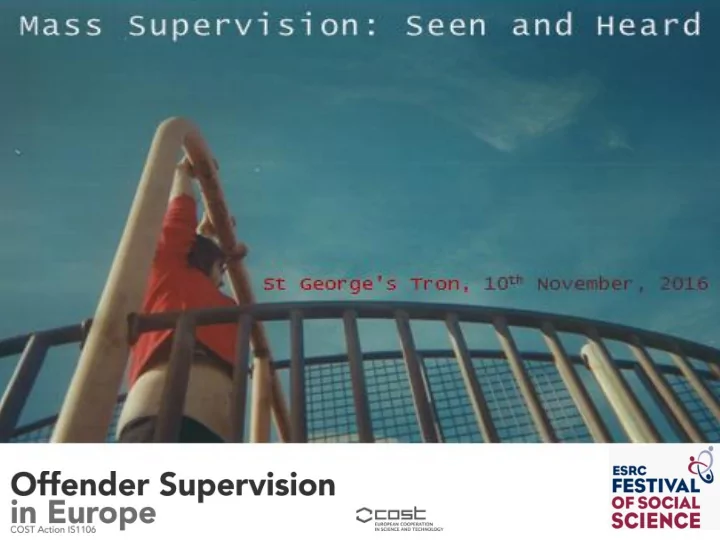
and Heard

slide-17
SLIDE 17

You’re Waiting

slide-18
SLIDE 18

Blankface

slide-19
SLIDE 19

Five Days

slide-20
SLIDE 20

There’s Always a Way

slide-21
SLIDE 21

Major themes

  • From photos and discussion

–Constraint –Time –Waste –Judgement –Growth/Hope

slide-22
SLIDE 22

Discussion

  • Challenging findings:

– Why so different from other methods?

  • Supervision is a diffuse and pervasive

experience:

– It extends beyond supervisory encounters – It is not only disciplinary…

  • It is experienced in diverse and ambiguous

ways:

– Helpful constraint/painful growth.

slide-23
SLIDE 23

Discussion

  • Supervision hurts (even when it helps):

– Being constrained – Being judged – Being threatened

  • ‘Half-citizens’:

– Liberty preserved conditionally, but autonomy and status reduced

slide-24
SLIDE 24

Conclusions

  • We need more (and better) mixed-

methods comparative research on these experiences.

  • We must…

– Recognise these pains – Limit them by proportionality – Moderate them:

  • Legitimacy and helpfulness may ease these pains,

but they will not remove them.

slide-25
SLIDE 25

Resources

  • EP of ‘Seen and Heard’ songs:

https://voxliminis.bandcamp.com/album/seen-and- heard-ep

  • For more information on ‘Seen and Heard’, including a

podcast about the process: http://www.offendersupervision.eu/supervisible

  • A recent book chapter by Fitzgibbon, Graebsch and

McNeill can be found in this collection: https://www.routledge.com/Routledge-International- Handbook-of-Visual-Criminology/Brown- Carrabine/p/book/9781138888630

  • A shorter briefing on the Scottish sub-project can be

found here: http://howardleague.org/publications/supervisible- experiences-of-criminal-justice-supervision-in-scotland/