
SLIDE 1
PULPDENT PULPDENT Adhesives DenTASTIC UNO DenTASTIC UNO DenTASTIC - - PowerPoint PPT Presentation
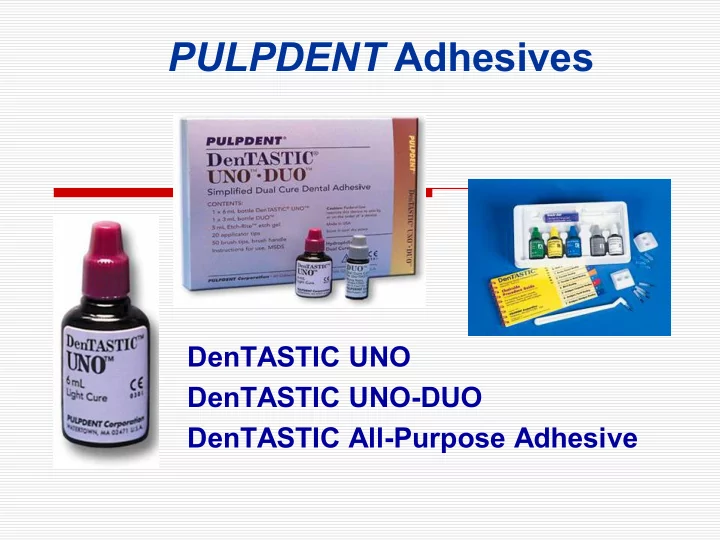
PULPDENT PULPDENT Adhesives DenTASTIC UNO DenTASTIC UNO DenTASTIC UNO DenTASTIC UNODUO DenTASTIC All DenTASTIC AllPurpose Adhesive PULPDENT DenTASTIC Adhesives DenTASTIC Adhesives 40 years of research Developed by Dr. Rafael Bowen
Dental Association Health Foundation (ADAHF)
magnesium salt of NTGGMA
Developed by Dr. Rafael Bowen Patents assigned to American Dental Association Health Foundation Extensive Published literature Advanced PMDGM chemistry with GMA
unfilled resin bonding agent.
are 2part and dual cure.
Dual Cure Hydrophilic Wet Bonding
Solvent based primers are separate from unfilled resin bonding agent. Both primers and unfilled resin bonding agent
Wet Bonding
th Generation Light Cure
Light Cure Hydrophilic Wet Bonding
unfilled resin bonding agent are combined in the same bottle.
Wet Bonding
One bottle system. Primer and unfilled resin bonding agent are combined in the same bottle.
th Generation Dual Cure
Dual Cure Hydrophilic Wet Bonding
Wet Bonding
Simplified dual cure system. DUO is the dual cure catalyst for UNO.
th Generation
th Generation Dual Cure
solvents that chase moisture and carry the adhesive resin into the open collagen and dentinal tubules.
tags in the dentinal tubules that provides exceptional micro mechanical retention.
Hydrophilic adhesive monomers are combined with solvents that chase moisture and carry the adhesive resin into the open collagen and dentinal tubules. This forms a hybrid layer of collagen and resin with resin tags in the dentinal tubules that provides exceptional micro
Dentin is a fiber reinforced tissue consisting of minerals, collagen and water. The mineral content is mostly calcium
a rotary bur produces a smear layer of dentinal debris.
Smear Layer Dentin Dentinal Tubules
Tubules
Smear Layer Dentin Dentinal Tubules
Etching dentin removes the smear layer, dissolves the minerals at the surface exposing the collagen fiber matrix, and slightly opens the dentinal tubules.
Etched Dentin Dentin Dentinal Tubules
Etching dentin removes the smear layer, dissolves the minerals at the surface exposing the collagen fiber
Etched Dentin Dentin Dentinal Tubules
th Generation Adhesive
Adhesive Primer is applied first, and Unfilled Resin Bonding Agent is applied in a second step.
Composite Unfilled Resin Bonding Agent Adhesive Primer Hybrid Layer Dentinal Tubules
Adhesive Primer is applied first, and Unfilled Resin Bonding Agent
Composite Unfilled Resin Bonding Agent Adhesive Primer Hybrid Layer Dentin Dentinal Tubules
Adhesive Primer and Unfilled Resin Bonding Agent are combined into a single component that forms an interlocking matrix layer with the moist collagen and dentinal tubules creating a hybrid layer that provides extraordinary mechanic retention. DenTASTIC UNO or UNODUO Hybrid Layer Dentin Dentinal Tubules
Adhesive Primer and Unfilled Resin Bonding Agent are combined into a single component that forms an interlocking matrix layer with the moist collagen and dentinal tubules creating a hybrid layer that provides extraordinary
This unique light microscopy cross shows the dentinadhesive interface.
Unaltered (not etched) dentin Dentinal Tubules (crosssection) Hybrid layer of collagen and bonding agent Unfilled resin bonding agent Bonding agent tags in dentinal tubules (redblue dots)
This unique light microscopy crosssection adhesive interface.
Etch all enamel and dentin surfaces for 15 seconds.
Figure 1
Rinse thoroughly and remove excess moisture leaving tooth surface slightly moist.
Figure 2
Apply 23 coats of UNO to all wet enamel and dentin surfaces.
Figure 3
Light cure for 10 seconds. Now you are ready to place your preferred composite.
Figure 4
Acid etch all enamel and dentin surfaces for 15 seconds.
Figure 1
Pulpdent LimeLite is placed over near exposure sites and light cured for 20 seconds.
Figure 2
Apply 23 coats of UNO to all wet enamel and dentin surfaces.
Figure 3
Light cure for 10 seconds. Now you are ready to place your preferred composite.
Figure 4
Figure 5
Shows tooth restored with composite resin.
Figure 5
Shows tooth restored with composite resin.