SLIDE 1
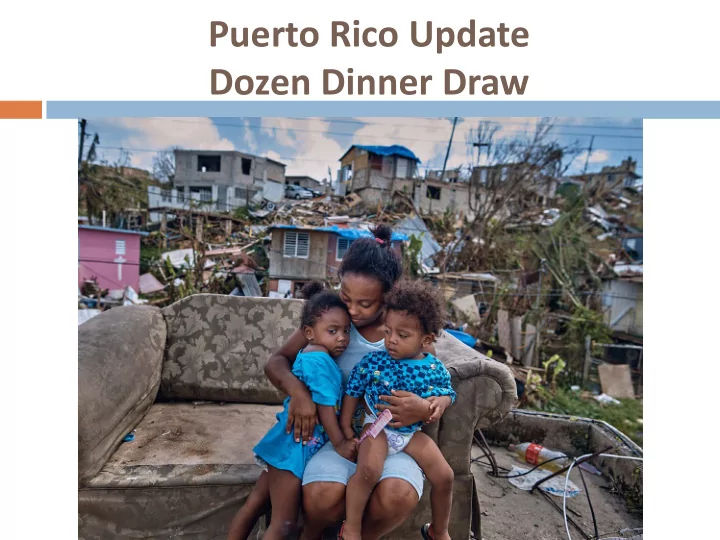
Puerto Rico Update Dozen Dinner Draw Rotarians - People of Action - - PowerPoint PPT Presentation
Puerto Rico Update Dozen Dinner Draw Rotarians - People of Action Water, Sanitation and Hygiene: Rotarys greatest challenge F. Ronald Denham, Chair Emeritus Water & Sanitation Rotarian Action Group March 2017 The Background: 663
SLIDE 2
SLIDE 3
- F. Ronald Denham, Chair Emeritus
Water & Sanitation Rotarian Action Group March 2017
Water, Sanitation and Hygiene: Rotary’s greatest challenge
SLIDE 4
The Background:
- 663 million people (one in ten) lack
access to safe water
SLIDE 5
SLIDE 6
SLIDE 7
SLIDE 8
SLIDE 9
The Background:
- 2.4 billion have no sanitation
- That’s 7.7 times entire US
SLIDE 10
SLIDE 11
SLIDE 12
SLIDE 13
The consequences are critical:
- 8,000 people, mostly children, die every day.
- Women and children, usually girls, spend up to
six hours per day hauling water.
- Young girls miss classes, drop out of school.
- 40 billion hours spent annually hauling water.
SLIDE 14
But Rotarians are liberating women and children from hauling water:
Dug wells Bore holes
SLIDE 15
Rainwater harvesting Household filters and purification
SLIDE 16
SODIS (Solar Water Disinfection)
SLIDE 17
Pipelines and distribution systems Sand, earth and concrete dams
SLIDE 18
SLIDE 19
Having liberated women from hauling water, Rotarians help them to start small businesses.
SLIDE 20
SLIDE 21
SLIDE 22
Rotary’s programs do more than provide water, they improve life and livelihood:
- People create economic value.
- Micro-bank gives them confidence and hope.
- Crops and livestock flourish.
- Food supply is assured, poverty reduced.
- Children are healthier.
- Youth, especially girls, are being educated.
SLIDE 23
But, together, we can do so much more:
- Have greater impact
- Ensure sustainability
- Empower a community to realize its
vision
SLIDE 24
We should be BIGGER – have more impact
- Water is the #1 humanitarian challenge
- Isolated projects – little learning
- Little leverage with other organizations
- Limited use of Rotary Community Corps.
- Few opportunities to scale up to the larger community
- Too small to attract outside financing
SLIDE 25
We should be BETTER
- Too many projects are unsustainable
- Too much emphasis on activity, too little on humanitarian
- utcomes
- Supply-driven, inappropriate technology
- Little emphasis on community ownership
- No behaviour change: e.g. hand washing
- No monitoring and evaluation
SLIDE 26
We should be BOLDER
- Create “programs” not “projects”
- Include the region, watershed, river basin, etc.
- Focus on humanitarian and economic outcomes
- Leverage other organizations: local authorities, NGOs,
government agencies
- Encourage entrepreneurs
- Be advocates for change
SLIDE 27
WASRAG can help you and your partners in this process:
- Assist in preparing “needs assessments”
- Show how to find a project and get started
- Provide a compendium of best practices
- Evaluate alternative technologies
- Match with clubs and NGOs
- Facilitate partnerships, attract sponsors and outside
financing
SLIDE 28
WASRAG is Rotary’s resource for WASH, helping you to transform communities:
- Go to: www.wasrag.org
- Click on “Sign Up”
SLIDE 29
Join WASRAG: www.wasrag.org
SLIDE 30
SLIDE 31
SLIDE 32