Public Key Algorithms hash: irreversible transformation(message) - - PDF document

public key algorithms
SMART_READER_LITE
LIVE PREVIEW

Public Key Algorithms hash: irreversible transformation(message) - - PDF document

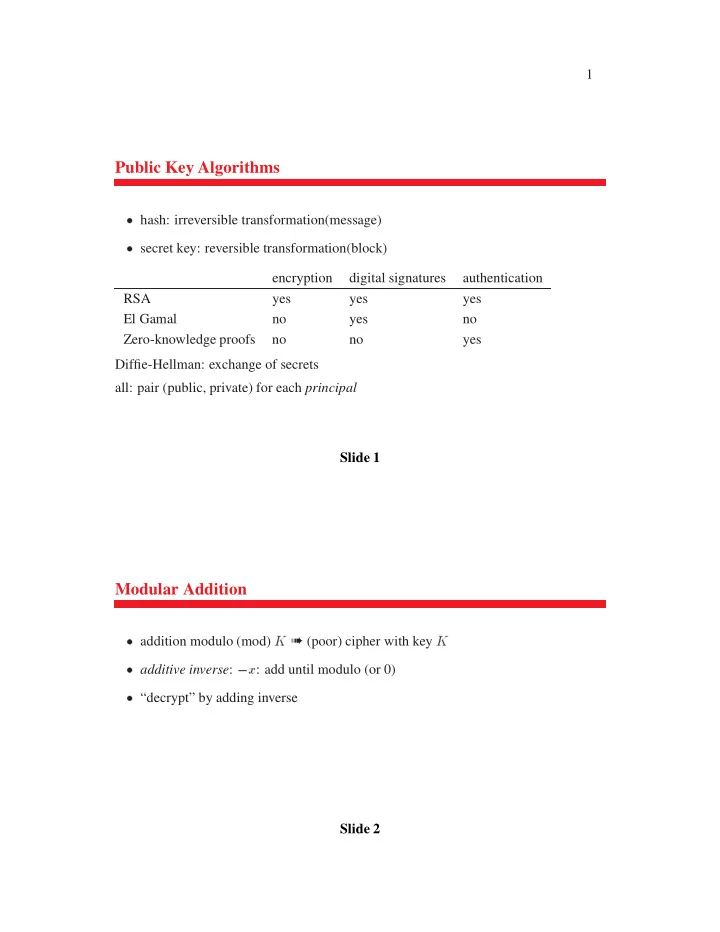
1 Public Key Algorithms hash: irreversible transformation(message) secret key: reversible transformation(block) encryption digital signatures authentication RSA yes yes yes El Gamal no yes no Zero-knowledge proofs no no yes


slide-1
SLIDE 1

1

Public Key Algorithms

hash: irreversible transformation(message) secret key: reversible transformation(block)

encryption digital signatures authentication RSA yes yes yes El Gamal no yes no Zero-knowledge proofs no no yes Diffie-Hellman: exchange of secrets all: pair (public, private) for each principal Slide 1

Modular Addition

addition modulo (mod) K ➠ (poor) cipher with key K additive inverse: x: add until modulo (or 0) “decrypt” by adding inverse

Slide 2

slide-2
SLIDE 2

2

Modular Multiplication

  • 1

2 3 4 5 6 7 8 9 1 1 2 3 4 5 6 7 8 9 2 2 4 6 8 2 4 6 8 3 3 6 9 2 5 8 1 4 7

multiplication by 1, 3, 7, 9 works as cipher multiplicative inverse x 1: y
  • x
= 1
  • nly 1, 3, 7, 9 have multiplicative inverses (e.g., 7
$ 3) use Euclid’s Algorithm to find inverse

Slide 3

Totient Function

  • x;
m relatively prime = no other common factor than 1 relatively prime 6= prime (9 rel. prime 10) e.g., 6 not relatively prime to 10: 2 divides both 6 and 10 totient function (n): number of numbers less than n relatively prime to n

– if

n prime, f1; 2; : : : ; n
  • 1g are rp ➠
(n) = n
  • 1

– if

n = p
  • q,
p; q distinct prime ➠ (n) = (p
  • 1)(q
  • 1):
  • n
= pq numbers in f0; 1; 2; : : : ; n
  • 1g; exclude non-rp
➠ exclude multiples of p or q
  • p multiples of
q < pq (0,1,...), q multiples of p < pq thus, exclude p + q
  • 1 numbers – don’t count 0 twice
  • (pq
) = pq
  • (p
+ q
  • 1)
= (p
  • 1)(q
  • 1)

Slide 4

slide-3
SLIDE 3

3

Modular Exponentiation

x y mo d n 6= x y +n mo d n! x y

1 2 3 4 5 6 7 8 9 10 11 12 1 1 1 1 1 1 1 1 1 1 1 1 1 1 2 1 2 4 8 6 2 4 8 6 2 4 8 6 3 1 3 9 7 1 3 9 7 1 3 9 7 1 4 1 4 6 4 6 4 6 4 6 4 6 4 6 5 1 5 5 5 5 5 5 5 5 5 5 5 5 6 1 6 6 6 6 6 6 6 6 6 6 6 6 7 1 7 9 3 1 7 9 3 1 7 9 3 1 8 1 8 4 2 6 8 4 2 6 8 4 2 6 9 1 9 1 9 1 9 1 9 1 9 1 9 1 Slide 5

Modular Exponentiation

encryption: x 3 works, x 2 does not exponentiative inverse y of x: (a x ) y = a columns: 1 = 5; 2 = 6; 3 = 7; : : :
  • x
y mo d n = x y mo d (n) mo d n
  • r
p(10) = f1; 3; 7; 9g ➠ (n) = 4 true for almost all n: any n =product of distinct primes (square-free) for any y with y = 1 (mo d (n)) ➠ x y mo d n = x mo d n (e.g., 1, 5 and 9)

Slide 6

slide-4
SLIDE 4

4

RSA

Rivest, Shamir, Adleman variable key length (common: 512 bits) ciphertext length = key length slow ➠ mostly used to encrypt secret for secret key cryptography

Slide 7

RSA Algorithm

Generate private and public key:

choose two large primes, p and q, about 256 bits (77 digits) each
  • n
= p
  • q (512 bits), don’t reveal
p and q factoring 512 bit number is hard

public key:

e rp (n) = (p
  • 1)(q
  • 1) ➠
he; ni

private key:

d = (e mo d (n)) 1 ➠ hd; ni

encryption: of

m < n: = m e mo d n

decryption:

m = d mo d n

verification:

m = s e mo d n (signature s)

Slide 8

slide-5
SLIDE 5

5

RSA example

p = 47 q = 71 n = pq = 3337 e = 79 prime, i.e., rp to (p
  • 1)(q
  • 1)
d = 79 1 mo d 3220 = 1019 m = 688232687666683 m 1 = 688 1 = 688 79 mo d 3337 = 1570 p 1 = 1570 1019 mo d 3337 = 688

Slide 9

Why does RSA work?

  • n
= pq, (n) = (p
  • 1)(q
  • 1)
  • de
= 1 (mo d (n)) since e rp (n) and d = e 1
  • x
de = x (mo d n)8x encryption: x e decryption: (x e ) d = x ed = x signature: reverse

Slide 10

slide-6
SLIDE 6

6

Why is RSA secure?

factor 512-bit number: half million MIPS years (= all US computers for one year) given public key he; ni need to find exponentiative inverse of e need to know p, q to compute (n) abuse: if limited set of messages, can compare ➠ append random number 2/2/1999: RSA-140 was factored.

Slide 11

RSA Efficiency: Exponentiating

  • 123
54 mo d 678 = (123
  • 123
  • )=678
modular reduction after each multiply:
  • (a
  • b
  • )
mo d m = (((a
  • b)
mo d m)
  • )
mo d m 123 2 = 123
  • 123
= 15129 = 213 (mo d 678) 123 3 = 123
  • 213
= 26199 = 435 (mo d 678) 123 4 = 123
  • 435
= 53505 = 435 (mo d 678) 54 small multiplies, 54 divides exponent power of 2: 123 32 123 2 = 123
  • 123
= 15129 = 213 (mo d 678) 123 4 = 213
  • 213
= 45369 = 671 (mo d 678) 123 8 = 621
  • 621
= 385641 = 213 (mo d 678)

Slide 12

slide-7
SLIDE 7

7

  • 123
2x+1 = 123 2x
  • 123

Slide 13

RSA Efficiency: Exponentiating

54 = 110110 2; start with exponent “1”. 10
  • 123
2 = 123
  • 123
= 15129 = 213 (mo d 678) 11 +1 123 3 = 213
  • 123
= 26199 = 435 (mo d 678) 110
  • 123
6 = 435
  • 435
= 189225 = 63 (mo d 678) 1100
  • 123
12 = 63
  • 63
= 3969 = 579 (mo d 678) 1101 +1 123 13 = 579
  • 123
= 71217 = 27 (mo d 678) 11010
  • 123
26 = 27
  • 27
= 729 = 51 (mo d 678) 11011 +1 123 27 = 51
  • 123
= 6273 = 171 (mo d 678) 110110
  • 123
54 = 171
  • 171
= 29241 = 87 (mo d 678)
  • r
x 54 = (((((x) 2 x) 2 ) 2 x) 2 x) 2 = 87 (mo d 678)

➠ 8 multiplies, 8 divides ➠ linearly with exponent bits Slide 14

slide-8
SLIDE 8

8

RSA Implementation

public key:

O (k 2 ), private key: O (k 3 ), key generation: O (k 4 )

DES Pijnenburg PCC101 CFB 90 Mb/s Vasco CRY12C102 CFB 22 Mb/s RSA Pijnenburg PCC202 512 40 kb/s 1024 25 kb/s Vasco PQR512 512 32 kb/s

fastest RSA hardware: 300 kb/s 90 MHz Pentium: throughput (private key) of 21.6 kb/s, 7.4 kb/s per second with a

1024-bit modulus

DES software: 100 times faster than RSA DES hardware: 1,000 to 10,000 times faster

Slide 15

Finding Big Primes

p and q infinite number of primes, probability 1= ln n ten-digit number: 1 in 23, hundred-digit: 1 in 230 pick at random and check if prime bad: divide by all p n Euler’s Theorem: a rp n ➠ a (n) = 1 (mo d n) if n prime, (n) = n
  • 1

Theorem 1 (Fermat’s Little Theorem) If

p is prime and < a < p, a p1 = 1 (mo d p) if p not prime, does not usually hold ➠ pick some a < n, compute a n1 mo d n ? ! 1 probability of accepting bad n: 10 13 ➠ repeat

Slide 16

slide-9
SLIDE 9

9

Carmichael Numbers

Carmichael numbers n: not prime, but a n1 = 1 (mo d n)8a (where a not a

factor in

n) infinitely many first few: 561, 1105, 1729, 2465, 2821, 6601, 8911 246,683 below 10 16 example: 7 560 mo d 561 = 1, but 3 560 mo d 561 = 375

Slide 17

Finding Big Primes

p and q: Miller and Rabin

Variation on Fermat test:

express n
  • 1 as
2 b , where b
  • compute
a n1 (mo d n) (Fermat) as (a ) 2 b (mo d n) ➠ square b times if not 1 ➠ not prime; if 1, test:

– if

a (mo d n) 6= 1 ➠ squaring not-1 ! 1

– ➠ square root of 1 – rule: if

n is prime (mo d n), p 1 are 1 and 1(= n
  • 1)

– ➠ if

p 1 6= 1, n not prime

– try many values for

a; 75% of a fail the test if n not prime

Slide 18

slide-10
SLIDE 10

10

Big Primes: Implementation

  • 1. pick odd random number
n
  • 2. check
n=f3; 5; 7; 11; : : :g and try again
  • 3. repeat until failure or confidence:

(a) pick random

a and compute a (mo d n), with n
  • 1
= 2 b

(b) compute

a , then b times: (a ) 2

(c) if result = 1: operand =

1 ? ➠ no prime if not

Slide 19

Finding

d and e
  • e = any number rp to
(p
  • 1)(q
  • 1)
  • ed
= 1 (mo d (n)) ➠ Euclid’s algorithm

Options for picking

e:
  • 1. pick randomly until
e is rp to (p
  • 1)(q
  • 1)
  • 2. choose
e and pick p; q so that (p
  • 1);
(q
  • 1) are rp to
e

Slide 20

slide-11
SLIDE 11

11

Having a Small Constant

e
  • e same small number
  • d can’t be small (searchable)
  • e
= 3 or e = 65537 can’t use 2: not rp to (p
  • 1)(q
  • 1)
message must be bigger than 3 p n send copies of message to three people: e i = h3; n i i

– Trudy:

m 3 mo d n 1 n 2 n 3 = m 3 (Chinese remainder)

– ➠ choose random/individualized padding Slide 21

RSA:

e = 3 3 rp to (n) = (p
  • 1)(q
  • 1) since
d = e 1 each p
  • 1,
q
  • 1 must be rp to 3
3 is factor of x ➠ x mo d 3 =
  • (p
  • 1) rp 3 ➠
p = 2 (mo d 3) ➠ (p
  • 1)
= 1 (mo d 3)
  • (q
  • 1) rp 3 ➠
q = 2 (mo d 3) ➠ (q
  • 1)
= 1 (mo d 3) choose p = r
  • 3
+ 2, r random, odd

Slide 22

slide-12
SLIDE 12

12

RSA:

e = 65537 65537 = 2 16 + 1, (Mersenne prime: 2 n
  • 1!)
  • nly 17 multiplies to exponentiate:
x 2 16 x random 512-bit number: 768 multiplies avoid “3” problems:
  • 1. few
m with m 65537 < n (512 bits)
  • 2. have to send to 65,537 recipients

3.

n rp (n) ➠ reject p; q = 1 (mo d 65537)

Slide 23

RSA Threats: Smooth Numbers

product of “small” primes signed m 1 ; m 2 ➠ can compute signatures on m 1
  • m
2 ; m 1 =m 2 ; m j 1 ; m j 2 ; m j 1 m k 2 example: m 2 1 : (m d 1 mo d n) 2 mo d n if m 1 =m 2 is prime, can fake signature on that prime ➠ any product of this collection pad with zero on left ➠ small number ➠ smooth " pad on right with x bits
  • n
  • 2
x pad on right with random data ➠ cube root problem

Slide 24

slide-13
SLIDE 13

13

RSA Threats: Cube Root Problem

Carol wants your signature for message with digest h message digest h; h = pad with zeros on right “signature” r = d 3 p h e ➠ r e = r 3 = h

Slide 25

Public Key Cryptography Standards (PKCS)

  • perational standards
deal with threats (smooth numbers, multiple recipients, ...) encryption with PKCS#1

– random padding prevents guessing from known messages – random padding prevents

e = 3, multiple-recipient attack

– cube root decryption ➠ longer than 21 bytes ( >

11 + data) signing with PKCS#2

– large padding ➠ not smooth – include digest algorithm ➠ prevent spoofing Slide 26

slide-14
SLIDE 14

14

PKCS #1 – RFC 2313

Also X.509: RSAPublicKey ::= SEQUENCE { modulus INTEGER,

  • - n

publicExponent INTEGER

  • - e

} Encryption block =

00jBT jPS j00jD with padding PS of k
  • 3
  • jD
j octets.

private-key 00 1 private-key FF (large!) 2 public-key pseudo-random Slide 27

PKCS #1 Signature

DigestInfo ::= SEQUENCE { digestAlgorithm DigestAlgorithmIdentifier, digest Digest } DigestAlgorithmIdentifier ::= AlgorithmIdentifier AlgorithmIdentifier ::= SEQUENCE { algorithm OBJECT IDENTIFIER, parameters ANY DEFINED BY algorithm OPTIONAL } md5 OBJECT IDENTIFIER ::= { iso(1) member-body(2) US(840) rsadsi(113549) digestAlgorithm(2) 5 } Digest ::= OCTET STRING Slide 28

slide-15
SLIDE 15

15

Diffie-Hellman Key Exchange

shared key, public communication no authentication of partners
  • p prime,
512 bits, public
  • g
< p, public Alice, Bob choose random, secret S A, S B transmit T A = g S A mo d p, T B = g S B mo d p Alice computes T S A B (mo d p) = (g S B ) S A (mo d p) both get same number = key would need to compute discrete logs to get S A from g S A not secure against bucket-brigade attacks

Slide 29

public numbers instead of invention

Slide 30

slide-16
SLIDE 16

16

Bucket Brigade Attack

“man-in-the-middle” X establishes security association with Alice, Bob can read/write from/to both relays messages, passwords between them prevention: make g S A mo d p public ➠ can’t be replaced

Slide 31

Diffie-Hellman: Offline

Bob publishes hp B ; g B ; T B i Alice computes K AB = T S A B mo d p B Alice sends g S A B mo d p B to Bob

Slide 32

slide-17
SLIDE 17

17

El Gamal Signatures

D-H: public: hg ; p; T i; private: S ; g s mo d p = T new public/private key for each message compute T m = g S m mo d p for random S m for each msg. m digest d m = mjT m signature = X = S m + d m S (mo d p
  • 1)
transmit m; X ; T m verification: g X =?T m T d m mo d p g X = g S m +d m S = g S m g S d m = T m T d m (mo d p)

Slide 33

El Gamal Properties

Exercises:

message modification ➠ signature won’t match signature does not divulge S don’t know S ➠ can’t sign

Slide 34

slide-18
SLIDE 18

18

Digital Signature Standard (DSS)

related to El Gamal, but some computations mo d q, q = 160 bits < jpj = 512 bits speeded up for signer rather than verifier: chip cards

Slide 35

DSS Algorithm

  • 1. generate public
p (512 bit prime) and q (160 bit prime) p = k q + 1
  • 2. generate public
g g q = 1 (mo d p)
  • 3. choose long-term
hT ; S i with random S T = g S mo d p for S < q
  • 4. choose
hT m ; S m i with random S m
  • T
m = ((g S m mo d p) mo d q calculate S 1 m mo d q
  • 5. calculate
d m = SHS(message)

Slide 36

slide-19
SLIDE 19

19

  • 6. signature
X = S 1 m (d m + S T m ) mo d q
  • 7. transmit
m; T m ; X
  • 8. verify based on
d m: z ? = T m x = d m
  • X
1 mo d q y = T m
  • X
1 mo d q z = (g X
  • T
y mo d p) mo d q

Slide 37

DSS Algebra

v = (d m + S T m ) 1 mo d q X 1 = (S 1 m (d m + S T m )) 1 = S m (d m + S T m ) 1 = S m v mo d q x = d m X 1 = d m S m v mo d q y = T m X 1 = T m S m v mo d q z = g x T y = g d m S m v g S T m S m v = g (d m +S T m )S m v = g S m = T m mo d p mo d q

any multiple of

q in exponent drops out

Slide 38

slide-20
SLIDE 20

20

RSA vs. DSS

fixed moduli
  • hp;
q ; g i ➠ pick one ➠ juicy target trapdoor primes slower than RSA( e = 3), but signatures can be done ahead of time needs per-message random secret patent (Schnorr)

Slide 39

Zero-Knowledge Proofs

prove knowledge without revealing it RSA signatures graph isomorphism: rename vertices Alice: graph A and B
  • A
public key: graphs A; B private key: mapping between vertices Alice: create G i and sends to Bob Bob ! Alice: how did A or B ! G i? zero-knowledge: Bob knows some G i’s Fred can create G i from either A or B, but not both

Slide 40

slide-21
SLIDE 21

21

Zero-Knowledge Proofs: Fiat-Shamir

Alice: public key hn; v i, n = pq
  • v: Alice knows secret
s = p v (mo d n)
  • 1. Alice chooses
k random numbers r 1 ; : : : ; r k
  • 2. Alice sends
r 2 i mo d n
  • 3. Bob chooses a random subset 1 of
r 2 i

subset 1 subset 2 Alice sends

sr i mo d n r i mo d n

Bob checks

(sr i ) 2 (r i ) 2

=?

v r 2 i (r i ) 2

Fred

(r i ) 2 (easy)
  • 4. finding square roots is hard

Slide 41

  • 5. Fred gets some
hr 2 i ; sr i i
  • 6. can use these for subset 1, pick own for subset 2
  • 7. Carol picks which she wants

much faster than RSA: 45 multiplies for Alice, Bob Slide 42