Public Engagement in 1. Involving Absent Stakeholders Agency - - PDF document

public engagement in
SMART_READER_LITE
LIVE PREVIEW

Public Engagement in 1. Involving Absent Stakeholders Agency - - PDF document

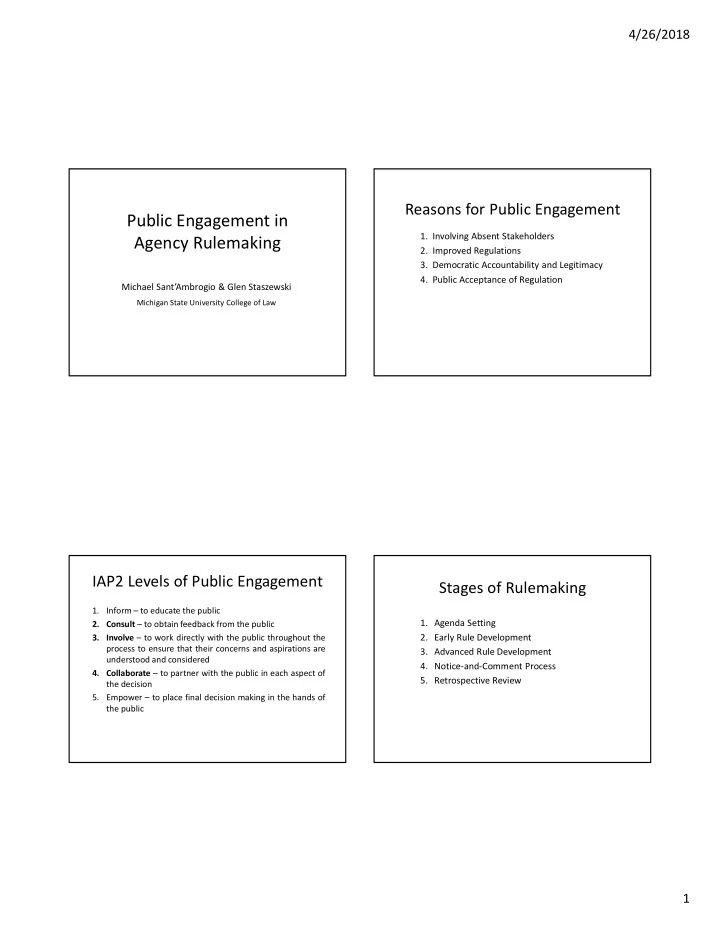
4/26/2018 Reasons for Public Engagement Public Engagement in 1. Involving Absent Stakeholders Agency Rulemaking 2. Improved Regulations 3. Democratic Accountability and Legitimacy 4. Public Acceptance of Regulation Michael SantAmbrogio


slide-1
SLIDE 1

4/26/2018 1

Public Engagement in Agency Rulemaking

Michael Sant’Ambrogio & Glen Staszewski

Michigan State University College of Law

Reasons for Public Engagement

  • 1. Involving Absent Stakeholders
  • 2. Improved Regulations
  • 3. Democratic Accountability and Legitimacy
  • 4. Public Acceptance of Regulation

IAP2 Levels of Public Engagement

  • 1. Inform – to educate the public
  • 2. Consult – to obtain feedback from the public
  • 3. Involve – to work directly with the public throughout the

process to ensure that their concerns and aspirations are understood and considered

  • 4. Collaborate – to partner with the public in each aspect of

the decision

  • 5. Empower – to place final decision making in the hands of

the public

Stages of Rulemaking

  • 1. Agenda Setting
  • 2. Early Rule Development
  • 3. Advanced Rule Development
  • 4. Notice-and-Comment Process
  • 5. Retrospective Review
slide-2
SLIDE 2

4/26/2018 2

Levels of engagement + Stages of RM =

(1) Why does agency want to engage with the public? (2) Who is the agency trying to reach? (3) What type of information is the agency seeking? (4) How is this information most likely to be

  • btained?

(5) When should these efforts occur? (6) What will the agency do with this information?

Agenda Setting

Modes of Public Engagement

  • 1. Rulemaking Petitions
  • 2. Advisory Committees
  • 3. Focus Groups
  • 4. Requests for Information
  • 5. Public Hearings/Listening Sessions
  • 6. Hotlines or Suggestion Boxes
  • 7. Public Complaints
  • 8. Notice & Comment Related to Agenda
  • 9. Enhanced Deliberative Exercises

Agenda Setting

  • Under what circumstances is public engagement

with agenda setting most/least useful?

  • What are the most/least effective means of

engaging the public in agenda setting?

  • What are the limitations or challenges of public

engagement in agenda setting?

Rule Development

Modes of Public Engagement

  • 1. Advisory Committees
  • 2. Focus Groups
  • 3. Requests for Information (early)
  • 4. Public Hearings/Listening Sessions
  • 5. Internet and Web-Based Outreach
  • 6. Status updates & Impact Reports
  • 7. Advance NPRMs (advanced)
  • 8. Negotiated Rulemaking (advanced)
  • 9. Development of Plain Language NPRMs (advanced)
  • 10. Enhanced deliberative exercises
slide-3
SLIDE 3

4/26/2018 3

Rule Development

  • When

is public engagement with rule development most/least useful?

  • What are the most/least effective means of

engaging the public in rule development?

  • What are the limitations or challenges of public

engagement in rule development?

Notice & Comment Rulemaking

Current Status and Challenges

  • Formally most open part of rulemaking to the public

– Anyone may comment – Agency must respond to salient comments

  • Frequently dominated by sophisticated stakeholders
  • Difficult for unsophisticated stakeholders to effectively

comment on long, complex, and detailed proposals

  • Perception that agency has already made up its mind
  • Legal constraints on dialogic communications

Notice & Comment Rulemaking

Enhancing Public Engagement

  • 1. Plain-language NPRMs
  • 2. Effective Commenting Tutorials
  • 3. User-friendly, dynamic e-rulemaking dockets
  • 4. Status Reports and Notifications
  • 5. Reply Comment Periods
  • 6. Public Hearings
  • 7. Supplemental Deliberative Exercises

Notice & Comment Rulemaking

  • When are supplemental efforts to engage the public

in notice & comment rulemaking most/least useful?

  • What are the most effective strategies for facilitating

engagement with rulemaking by absent

  • r

unsophisticated stakeholders?

  • What

are the limitations

  • r

challenges

  • f

supplemental efforts to engage the public with notice & comment rulemaking?

slide-4
SLIDE 4

4/26/2018 4

Retrospective Review

Modes of Public Engagement

  • 1. Rulemaking Petitions
  • 2. Advisory Committees
  • 3. Focus Groups
  • 4. Requests for Information
  • 5. Public Hearings/Listening Sessions
  • 6. Hotlines or Suggestion Boxes
  • 7. “Living” Rulemaking Dockets
  • 8. Public Notice and Comment

Retrospective Review

  • When is public engagement with retrospective

review most/least useful?

  • What are the most/least effective means of

engaging the public in retrospective review?

  • What are the limitations or challenges of public

engagement in retrospective review?

Incentives and Regulatory Culture

There are many, many examples of agencies engaging in meaningful public engagement in rulemaking –

  • How do we establish incentives to improve on existing

practices and institutionalize best practices in this area, particularly when flexibility is needed and uniform legal requirements may be undesirable?

  • What are the challenges or obstacles to enhancing

public engagement?

The Importance of Planning

  • How should agencies plan for public engagement?
  • Should agencies develop specific plans for each

rulemaking initiative that an agency undertakes or seriously considers? What should they include?

  • What are the challenges to planning for public

engagement in rulemaking?

slide-5
SLIDE 5

4/26/2018 5

Outreach and Communication

  • How can agencies reach targeted stakeholders,

persuade them to participate, and provide them with tools to do so effectively?

  • What are the challenges or obstacles to reaching and

incentivizing participation by the public in agency rulemaking?

Toward Deliberative Democracy

Enhanced Public Deliberation in Rulemaking

  • 1. Regulation Room
  • 2. Citizen Juries
  • 3. Citizen Advisory Committees
  • 4. Citizen Assemblies
  • 5. Deliberative Polls
  • 6. 21st Century Town Meetings
  • 7. Participatory Budgeting

Public Deliberation in Rulemaking

  • When would deliberative exercises like Regulation

Room be most useful and worth the effort?

  • What

are the limitations

  • r

challenges

  • f

undertaking highly deliberative exercises?