SLIDE 1
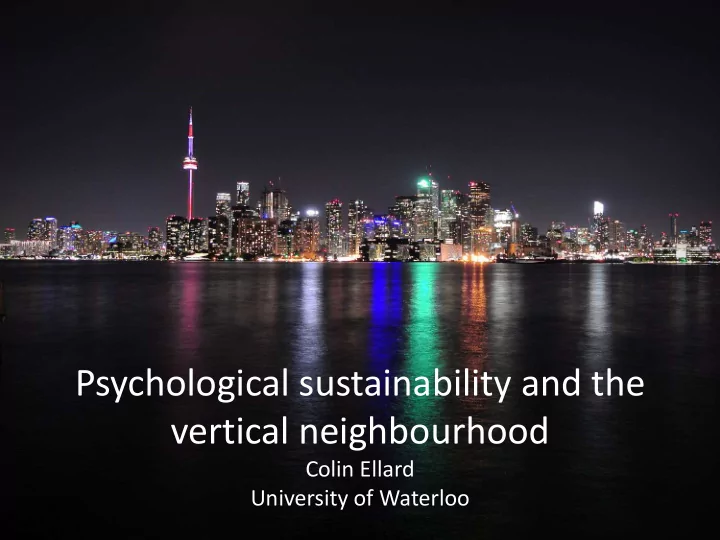
Psychological sustainability and the vertical neighbourhood
Colin Ellard University of Waterloo
SLIDE 2 Quick outline of a quick talk!
- 1. The challenge of wellbeing in the urban
environment: what the data say
- 2. The three pillars of personal wellbeing
- 3. How the three pillars are supported (or not)
but urban design
- 4. Special challenges of the vertical
neighbourhood
- 5. Blockages to future success
SLIDE 3
The urban brain
SLIDE 4 Psychiatric disorders and urbanicity Depression: 40% higher in cities Anxiety: 20% higher in cities Schizophrenia: 100% higher in cities
SLIDE 5
This is your amygdala on city
SLIDE 6
“…cities are, by definition, full of strangers.” (Jane Jacobs)
SLIDE 7
SLIDE 8
Connectedness Mastery Autonomy The three pillars of individual wellbeing
SLIDE 9
Connectedness Command Control The three pillars of community wellbeing
SLIDE 10
Connectedness Command Control The three pillars of community wellbeing
SLIDE 11
HOW TO GROW CONNECTEDNESS: INCLINATION AND OPPORTUNITY
SLIDE 12
The elevator pitch
SLIDE 13
Nature
SLIDE 14
Life
SLIDE 15
Vitality
SLIDE 16
SLIDE 17
SLIDE 18 Opportunity: we have ways
SLIDE 19 COMMAND
Legibility, culture, history, sense of place
SLIDE 20
SLIDE 21
SLIDE 22
SLIDE 23 Lansdowne Fence by Scott Eunson and Marianne Lovink. Photo: Diana Fleming
SLIDE 24 CONTROL
Psychological ownership, perceived publicness, equity
SLIDE 25
ACCOMPLISHING THE 3 PILLARS IN VERTICAL NEIGHBORHOODS
SLIDE 26 The enemies
- Geometry
- Sterility
- Isolation
SLIDE 27
VALIANT EFFORTS
SLIDE 28 Axis Mundi proposal MOMA Extension NYC
SLIDE 29 Linked Hybrid (Beijing) Steven Holl
SLIDE 30 How to save the world (or at least a piece of it)
- Use data!
- There is a community of scientists who can
give you the data you would like to have!
- Don’t rely on policy – policy is most often for
emergencies
- Consider the economic value of wellbeing as
well.
SLIDE 31
THANKS FOR LISTENING!