
SLIDE 1
March 2017
DISC FOR CL 64/2
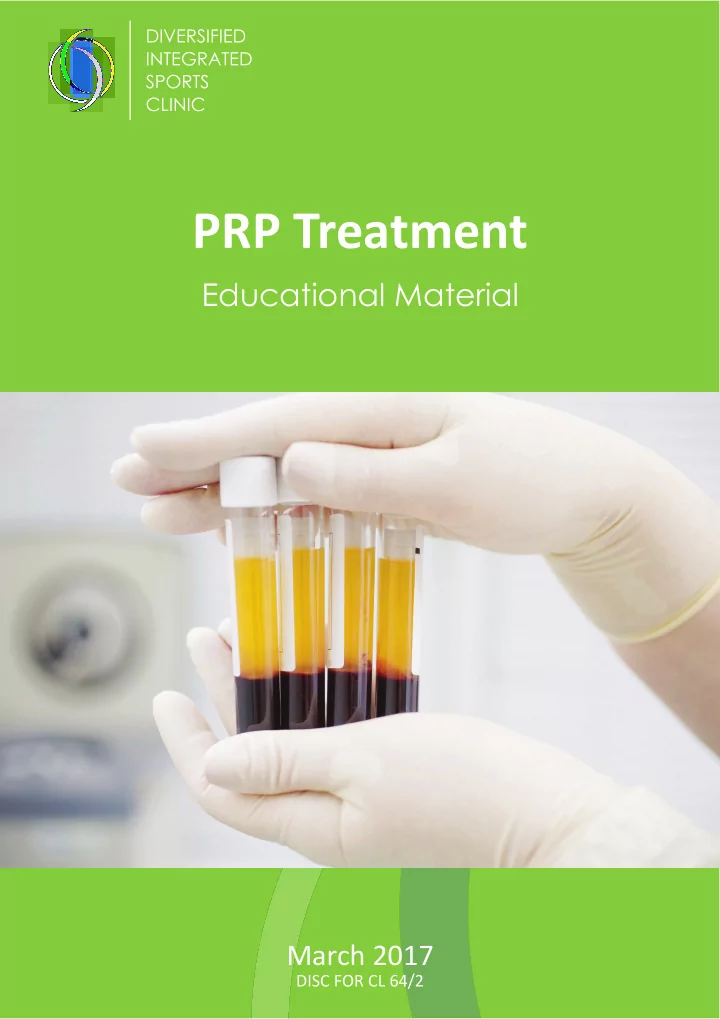
PRP Treatment Educational Material March 2017 DISC FOR CL 64/2 - - PDF document
PRP Treatment Educational Material March 2017 DISC FOR CL 64/2 What is PRP ? Platelet-Rich Plasma Therapy speeds healing of musculoskeletal Injuries Platelet-rich plasma (PRP) therapy, a treatment for aiding the regeneratjon of ligament
DISC FOR CL 64/2
”Platelet-Rich Plasma Therapy speeds healing of musculoskeletal Injuries”
Platelet-rich plasma (PRP) therapy, a treatment for aiding the regeneratjon of ligament and tendon injuries, helps to shorten rehabilitatjon tjme and ofuen eliminates the need for surgery. Platelet-rich plasma therapy is part of a relatjvely new fjeld of medicine known as orthobiologics that includes the use of stem cells and emphasizes employing the latest technologies along with the body’s natural ability to heal itself. “One of our major goals is to make healing tjme faster for patjents with sofu tjssue injuries,” says Christopher S. Ahmad, MD, Director, Center for Pediatric and Adolescent Sports Medicine at NewYork-Presbyterian Morgan Stanley Children’s Hospital. “For example, a patjent undergoing elbow ligament reconstructjve surgery, commonly referred to as Tommy John surgery, may take a year to recover. That’s a long tjme. Recovery tjme for anterior cruciate ligament [ACL] surgery is approximately six months. So while we are very good at performing surgery to correct these injuries, we’re now acceleratjng the healing by biologic manipulatjon. That’s where platelet- rich plasma comes in.”
What is Platelet-Rich Plasma?
Blood is made of red blood cells, white blood cells, plasma, and platelets. Platelet-rich plasma (PRP) is the name given to blood plasma with a high concentratjon of platelets that contains huge doses of bioactjve proteins, such as growth factors, that are critjcal in the repair and regeneratjon of tjssues. In order to extract these platelets, a small amount of blood is drawn from the patjent and it immediately undergoes centrifugatjon, a process in which mixtures are separated using centripetal force. This process separates out red blood cells, which carry oxygen, and the platelet and the plasma. The platelets with the plasma have all of the healing agents. Once the separatjon is done, the platelet-rich plasma is extracted and can then be injected back into the patjent’s injured area. It is their own platelet-rich plasma -- it isn’t taken from another person or derived in a laboratory. Growth factors can dramatjcally enhance tjssue recovery and the special proteins also initjate new blood vessel formatjon, bone regeneratjon and healing, connectjve tjssue repair, and wound healing. There is litule chance for rejectjon because the components used for treatment are extracted from a person’s own
incision, with a considerably shorter recovery tjme than afuer surgery.
Research studies are currently being conducted to evaluate the efgectjveness of PRP treatment. Here are some studies abstracts that we encourage you to read before making any decision:
Study Source Pub. Link Conclusion PRP in OA knee - update, current confusions and future options Department of Orthopaedics, Post Graduate Institute of Medical Education and Research, Chandigarh 160012, India March 2017
www.ncbi.nlm.nih.gov/pubmed/28322719
Positive results have been uniformly
platelet-rich plasma (PRP) in early
few years. PRP has clearly demonstrated its supremacy in comparison to hyaluronic acid (HA) and placebo in various clinical trials and is undoubtedly the best option available for symptomatic treatment in early OA. Protective Nature of Platelet-Rich Plasma Against Chondrocyte Death When Combined With Corticosteroids or Local Anesthetics 1Department of Orthopaedic Surgery, University of Connecticut Health Center, Farmington, Connecticut, USA. 2Center for Sports Medicine, University of Pittsburgh Medical Center, Pittsburgh, Pennsylvania, USA. 3Department of Orthopaedic Surgery, University of Connecticut Health Center, Farmington, Connecticut, USA Aug 2016
www.ncbi.nlm.nih.gov/pubmed/27582279
The addition of PRP can significantly reduce the cytotoxic effects of corticosteroids and/or local anesthetics applied to chondrocytes. PRP can improve the proliferation of chondrocytes compared with corticosteroids or local anesthetics alone Efficacy of Intra-articular Platelet-Rich Plasma Injections in Knee Osteoarthritis: A Systematic Review Department of Orthopedics and Sports Medicine, Houston Methodist Hospital, Houston, Texas, U.S.A. March 2016
www.ncbi.nlm.nih.gov/pubmed/26432430
In patients with symptomatic knee OA, PRP injection results in significant clinical improvements up to 12 months postinjection. Clinical
significantly better after PRP versus HA at 3 to 12 months postinjection. There is limited evidence for comparing leukocyte-rich versus leukocyte-poor PRP or PRP versus steroids in this study. Both groups presented pain reduction at six months. The VAS scores for the PRP group improved by at least 50% from their initial value, particularly at three months following the final infiltration, with results resembling those of the HA group at six months. PRP was more effective in patients with lower
treatments improved pain in knee
statistically significant differences between them. However, PRP injection was proved to improve pain three months after the final infiltration and to be more effective in lower osteoarthritis grades Intra-Articular Injections of Platelet-Rich Plasma versus Hyaluronic Acid in the Treatment of Osteoarthritic Knee Pain: A Randomized Clinical Trial in the Context of the Spanish National Health Care System. Department of Orthopedic Surgery and Traumatology, Virgen de la Victoria University Hospital, Malaga E- 29010, Spain June 2016
www.ncbi.nlm.nih.gov/pubmed/27384560
Study Source Pub. Link Conclusion Ultrasound guided platelet- rich plasma injection for the treatment of rotator cuff tendinopathy. 1Department of Orthopedic, Kashani Hospital, Isfahan University of Medical Sciences, Isfahan, Iran. 2Department of Physical Medicine and Rehabilitation, University of Medical Sciences, Shiraz, Iran. 3Department of Orthopedic, University of Medical Sciences, Isfahan, Iran; Dec 2016
www.ncbi.nlm.nih.gov/pubmed/26033459
Single injection of PRP is effective to reduce pain and improve range of motion in patients with bursal side partial tearing of RC who failed to respond to conservative treatments. 1Department of Medicine, Division
Sciences Centre and the Canadian 2Faculty of Medicine, University of Ottawa, Toronto, Canada. 3Canadian Memorial Chiropractic College and the Canadian Centre for Integrative Medicine, Toronto, Canada. 1Department of Rehabilitation Medicine, New York-Presbyterian Hospital-Columbia and Cornell, Harkness Pavilion 1st Floor, Rm 180, 180 Fort Washington Ave, New York, NY 10032∗. Electronic address: paul.scholten@gmail.com. 2Department of Physiatry, Hospital for Special Surgery, 75th Street Campus, New York, NY(†). 3Department of Athletics, St. John's University, Queens, NY(‡). 1Orthopedic Surgery, Menofiya University, Al Minufya, Egypt. 2Pediatric Orthopedics, Tanta University, 13 Omar Zafan St., 6th Floor., Tanta, Gharbia, 3111, Egypt 1Department of Biochemistry and Molecular Medicine, Faculty of Medicine, Autonomous University of Nuevo León (UANL), Ave Francisco I. Madero and Eduardo Aguirre Pequeño S/N, Colonia Mitras Centro, C.P. 64460, Monterrey, NL, México. 2Department of Orthopaedics and Traumatology, University Hospital, UANL, Monterrey, NL, México Case series of ultrasound- guided platelet-rich plasma injections for sacroiliac joint dysfunction
www.ncbi.nlm.nih.gov/pubmed/28217638
Platelet-rich plasma therapy exhibits clinical usefulness in both pain reduction and for functional improvement in patients with chronic SI joint pain. The improvement in joint stability and low back pain was maintained at 1- and 4-years post-treatment. June 2016 Subacromial injection of autologous platelet-rich plasma versus corticosteroid for the treatment of symptomatic PRP injections showed earlier better results as compared to corticosteroid injections, although statistically significant better results after 6 months could not be found. Leukocyte-poor platelet- rich plasma is more effective than the conventional therapy with acetaminophen for the treatment of early knee
www.ncbi.nlm.nih.gov/pubmed/27506585
Treatment with LP-PRP injections resulted in a significantly better clinical outcome than did treatment with acetaminophen, with sustained lower EVA and WOMAC scores and improvement in quality-of-life (higher SF-12 score). Therapy with LP- PRP may positively modify the inflammatory joint environment by counteracting IL-1β action Successful treatment of athletic pubalgia in a lacrosse player with ultrasound-guided needle tenotomy and platelet-rich plasma injection: a case report Athletic pubalgia is a syndrome of persistent groin pain due to chronic repetitive trauma or stress involving the pelvic joints and many musculotendinous structures that cross the anterior pelvis. As a result, the differential diagnosis can be complex, but insertional tendinopathies are the most
a novel approach to the treatment of distal rectus abdominis tendinopathies with ultrasound- guided needle tenotomy and platelet- rich plasma (PRP) injection. After injection, the patient returned to pain-free play at his previous level of
be a useful treatment for this diagnosis.
www.ncbi.nlm.nih.gov/pubmed/25134854
Aug 2016
www.ncbi.nlm.nih.gov/pubmed/27544678
Jan 2015 Aug 2016
Before receiving the PRP therapy, you will have to sign the Injectjon Informed Consent provided by your physician. Please read it carefully and never hesitate to ask more questjons and seek a second opinion from another physician.
DISC-FOR-CL-62 Rev 1 July 2016
Patient information:
Name: ................................................................................................................................ EMR: .......................... D.O.B: .....................
INJECTION CONSENT FORM
Name of proposed procedure: (Including side) Statement of health professional:
(to be filled in by health professional with appropriate knowledge of proposed procedure) I have explained the procedure to the patient. In particular. The intended benefits: The side effects may include: Headache, no decrease in pain, worsening of pain, fluid retention/swelling/increased blood pressure, increased blood sugars (if diabetic), mood changes, lowered resistance to infection, menstrual irregularities (for women) and facial flushing. Rare but serious side effects may include: 1:7000 chance including but not limited to allergy, infection, bleeding and nerve injury. I have confirmed with the patient that he/she has no further questions and wishes the procedure to go ahead. If having radio frequency denervation, I have checked that the patient does not have a pacemaker or an artificial hip. SIGNATURE OF HEALTH PROFESSIONAL: …………………………………………………. PRINT NAME: Dr Arthur Williams JOB TITLE: Family Medicine Specialist DATE: TIME:
Statement of patient:
Please read this form carefully. If your treatment has been planned in advance, you should already have a leaflet which describes the benefits and risks of the proposed treatment. If not you will be offered a copy and a copy of this consent form now. If you have any further questions, do ask. You have the right to change your mind at any time, including after you have signed this form. For self-paying clients I understand the cost of my treatment today is UAE I understand my diagnosis which has been explained to me. I agree to the procedure or course of treatment described on this form. I agree that information and/or surgical images kept in my records may be used anonymously for education, audit and research approved by an ethics committee, to improve the quality of patient care. I understand that the person performing the procedure has the appropriate experience or is training under direct supervision. I understand that any procedure in addition to those described on this form will only be carried out if it is necessary to save my life or to prevent serious harm to my health. I understand the alternatives to the procedure to be: medication, physical therapy or do nothing. I agree that I have had a chance to ask appropriate questions. I agree to the contents of this form and I agree to receive the treatment. SIGNATURE OF PATIENT:………………………………………………….PRINT NAME: …………………………… DATE: …………………..…… TIME: ................ A witness should sign below if the patient is unable to sign but has indicated his or her consent. Young people (under 18 years of age) and children should also have a parent sign here. SIGNATURE OF WITNESS/PARENT OR GUARDIAN :……………………………PRINT NAME:………………………… DATE: …………… TIME: .................. RELATIONSHIP TO PATIENT: ………………………..
Fee for the proposed procedure:
General Principles
reductjon of symptoms
you must contact the doctor
we expect. Should your pain not improve within the fjrst 5 days, please contact the doctor
RICE - Rest, Ice, Compression, and Elevatjon
Rest Rest and protect the injured or sore area. Stop, change, or take a break from any actjvity that may be causing your pain or soreness. Ice Cold will reduce pain and swelling. Apply an ice or cold pack right away to prevent
pack for 10 to 20 minutes, 3 or more tjmes a day. Afuer 48 to 72 hours, if swelling is gone, apply heat to the area that hurts. Do not apply ice or heat directly to the skin. Place a towel over the cold or heat pack before applying it to the skin. Compression Compression, or wrapping the injured or sore area with an elastjc bandage (such as an Ace wrap), will help decrease swelling. Don’t wrap it too tjghtly, because this can cause more swelling below the afgected
increased pain, coolness, or swelling in the area below the bandage. Talk to your doctor if you think you need to use a wrap for longer than 48 to 72 hours; a more serious problem may be present. Elevatjon Elevate the injured or sore area on pillows while applying ice and anytjme you are sittjng or lying down. Try to keep the area at or above the level of your heart to help minimize swelling.
The following rehabilitatjon protocol is applicable to acute injuries, chronic injuries and trigger point areas (myofascial syndrome). This guideline may vary according to the degree of pathology, patjent response and advice from the physician or therapist. Day afuer treatment Acute injuries Chronic injuries Myofascial Syndrome (Trigger point) Same day afuer procedure (1st PRP) RICE regime - Rest, Ice, Compression and elevatjon is important - Ice on treated area 20 minute of each hour every 2 hours for fjrst 12 hours - No actjve movement
Day 2 (48 hours post procedure) Start with passive stretching, light massage and range of movement exercises. Bruised feeling will be subsided to a lower grade. Ice at end of the day. Day 3-4 Passive stretches, light exercises, start using the joint/muscle at 20-30% of normal
area will be between 1-3/10. See physio/ chiropractor or sports therapist on Day 3 or Day 4. Day 5 -6 Actjve stretches or moderate exercise at 50% of normal use or within pain free
weak due to the lack of training in that area. Day 7 2nd PRP + RICE Regime Follow up with physician Day 8 RICE regime, no local or deep tjssue treatment Slowly increase actjvity according to advice from Physician Day 9-10 Start exercises where ended on Day 6, bruise feeling will decrease to 0-1/10, Weakness will improve Focus on strengthening the structure that was treated. Increase training volume. Day 11-13 Slowly increase actjvity according to advice from Physician. See physio/ chiropractor and sports therapist on Day 3 or Day 4. It is important to monitor the response of your injury the day afuer the last training - Do not train the treated area into pain or to stjfgness. See physio/ chiropractor or sports therapist on Day 11 or Day 13. Day 14 3rd PRP if needed and repeat RICE regime 2nd PRP for chronic injury 2nd PRP only if needed Day 15 and afuer RICE regime if PRP was done RICE regime RICE regime if PRP was done See physio/ chiropractor and sports therapist on Day 18 onwards for fjnal stage rehabilitatjon and full return to training. Notes Actjvitjes that were the main cause of the original problem will have to be reduced or avoided. Day 28 3rd PRP maybe required according to Physician advice