PRP Contribution Claims Under CERCLA: Strategies for Cost Recovery - - PowerPoint PPT Presentation

prp contribution claims under cercla strategies for cost
SMART_READER_LITE
LIVE PREVIEW

PRP Contribution Claims Under CERCLA: Strategies for Cost Recovery - - PowerPoint PPT Presentation

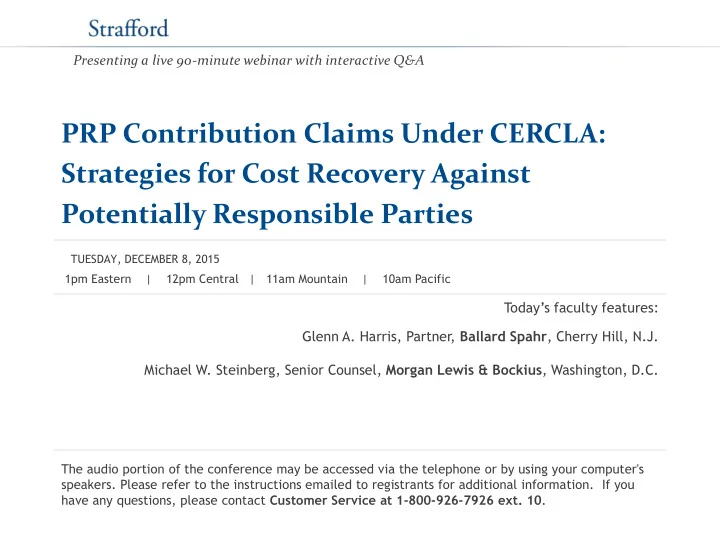
Presenting a live 90-minute webinar with interactive Q&A PRP Contribution Claims Under CERCLA: Strategies for Cost Recovery Against Potentially Responsible Parties TUESDAY, DECEMBER 8, 2015 1pm Eastern | 12pm Central | 11am


slide-1
SLIDE 1

The audio portion of the conference may be accessed via the telephone or by using your computer's

  • speakers. Please refer to the instructions emailed to registrants for additional information. If you

have any questions, please contact Customer Service at 1-800-926-7926 ext. 10.

Presenting a live 90-minute webinar with interactive Q&A

PRP Contribution Claims Under CERCLA: Strategies for Cost Recovery Against Potentially Responsible Parties

Today’s faculty features:

1pm Eastern | 12pm Central | 11am Mountain | 10am Pacific TUESDAY, DECEMBER 8, 2015

Glenn A. Harris, Partner, Ballard Spahr, Cherry Hill, N.J. Michael W. Steinberg, Senior Counsel, Morgan Lewis & Bockius, Washington, D.C.

slide-2
SLIDE 2

Tips for Optimal Quality

Sound Quality If you are listening via your computer speakers, please note that the quality

  • f your sound will vary depending on the speed and quality of your internet

connection. If the sound quality is not satisfactory, you may listen via the phone: dial 1-866-755-4350 and enter your PIN when prompted. Otherwise, please send us a chat or e-mail sound@straffordpub.com immediately so we can address the problem. If you dialed in and have any difficulties during the call, press *0 for assistance. Viewing Quality To maximize your screen, press the F11 key on your keyboard. To exit full screen, press the F11 key again.

FOR LIVE EVENT ONLY

slide-3
SLIDE 3

Continuing Education Credits

In order for us to process your continuing education credit, you must confirm your participation in this webinar by completing and submitting the Attendance Affirmation/Evaluation after the webinar. A link to the Attendance Affirmation/Evaluation will be in the thank you email that you will receive immediately following the program. For additional information about continuing education, call us at 1-800-926-7926

  • ext. 35.

FOR LIVE EVENT ONLY

slide-4
SLIDE 4

Program Materials

If you have not printed the conference materials for this program, please complete the following steps:

  • Click on the ^ symbol next to “Conference Materials” in the middle of the left-

hand column on your screen.

  • Click on the tab labeled “Handouts” that appears, and there you will see a

PDF of the slides for today's program.

  • Double click on the PDF and a separate page will open.
  • Print the slides by clicking on the printer icon.

FOR LIVE EVENT ONLY

slide-5
SLIDE 5

Glenn A. Harris, Esq. Michael W. Steinberg, Esq. Ballard Spahr Morgan Lewis

harrisg@ballardspahr.com msteinberg@morganlewis.com 856-761-3440 (202) 739-5141

slide-6
SLIDE 6

OVE VERVIE VIEW

Slide ide No. I. Cont ntribu ributio tion Claims ims *Varieties, ties, Availa ilabi bility lity, Pros ros & Cons ns 7 II. II. Rece cent nt Case Law aw Developme velopment nts s *Courts ts “Direc ecting ting Traffic ic” to § 107 or § 113 44 44 III. I. Discussi cussion of

  • f Curren

rent Issues ues 70 70

6

slide-7
SLIDE 7

What is “contribution”?

 “Contribution is defined as ‘the tortfeasor’s right to collect from others . . . after [paying] more than his . . . proportionate share . . . .’ Nothing in [CERCLA] § 113(f) suggests that Congress used the term ‘contribution’ in anything other than this traditional sense.”

  • U.S. v. Atlantic Research Corp., 551 U.S. 128, 138

(2007) (citation omitted)

 Usually contrasted with §107(a) cost recovery.  But today we will use “contribution” broadly to include any legal theory by which a PRP seeks to recovers any response costs from any other PRPs.

7

slide-8
SLIDE 8

Why y is is co contri ribu bution ion im impor

  • rtant?

tant?

 Vitally important to PRPs to mitigate the unfairness

  • f joint and several liability (to EPA or State)

 Other tools to mitigate this unfairness have limited availability or effectiveness:

  • Divisibility of harm (even after 2009 Supreme Court

ruling in Burlington Northern)

  • Mixed funding (CERCLA § 122(b))
  • EPA “interim” orphan share funding policy (1996)
  • De minimis settlements

8

slide-9
SLIDE 9

Why y is is co contri ribu bution ion im impor

  • rtant?

tant? (c (con

  • nt’d)

d)

 Vitally important to EPA because contribution is what facilitates the settlements needed to maintain the historic high rate (50% - 70%) of PRP-lead cleanups

  • Especially important now as EPA effectively has no

budget to perform or complete cleanups except at

  • rphan sites

 So EPA and the PRPs have a strong shared interest in an effective contribution framework  But don’t assume that EPA will help you obtain contribution from other PRPs at your site!

9

slide-10
SLIDE 10

Var arieties ieties of co contribut ribution ion cl clai aims

 CERCLA § 107(a) cost recovery claims

  • § 107(a)(4)(B) for “necessary” response costs

incurred that are “consistent with” the National Contingency Plan (“NCP”)

  • Recognized in U.S. v. Atlantic Research Corp., 551 U.S.

128 (2007), discussed infra

 CERCLA § 113(f) contribution claims

  • § 113(f)(1) for costs incurred during or following a

civil action under §§ 106 or 107; and

  • § 113(f)(3) for costs incurred in other administrative
  • r judicially approved settlements with EPA or a State

10

slide-11
SLIDE 11

Var arieties ieties of co contribut ribution ion cl clai aims (cont’d)

 State law

  • Statutory (e.g., New Jersey Spill Act, Minnesota

Environmental Response and Liability Act)

  • May be keyed to plaintiff’s compliance with state

cleanup procedures and/or standards

  • E.g., Massachusetts Contingency Plan (“MCP”)
  • Common law (e.g., equitable contribution among joint

tortfeasors, unjust enrichment, restitution, private nuisance, etc.)

11

slide-12
SLIDE 12

Avai ailabil lability ity

 Which of these claims are actually available to plaintiffs in the most common recurring scenarios?

  • PRPs performing an RI/FS
  • PRPs performing a removal action
  • PRPs performing RD/RA
  • PRPs performing work under a § 106 unilateral order

 >35 years after CERCLA was enacted, it remains surprisingly difficult to answer this basic question, despite 2 Supreme Court rulings and a host of appellate decisions.

12

slide-13
SLIDE 13

Avai ailabil lability ity (con

  • nt’d)

 2 recent decisions by the Second Circuit on the § 107/§ 113 split illustrate this problem:

  • In one case, decided in 2009, the court allowed a PRP

to bring a § 107 cost recovery claim but not a § 113 contribution claim

  • In the other case, decided in 2010, the court allowed a

similarly situated PRP to bring a § 113 contribution claim but not a § 107 cost recovery claim

 Let’s take a closer look

13

slide-14
SLIDE 14

W.R.

  • R. Grace

e v. Zot

  • tos,

, 59 F.3d 85 (2d Cir

  • ir. 2009)

Ni Niagara Mohawk k v. Chevron ron, , 596 F.3d 112 (2d Cir

  • ir. 2010

10) *suit by current owner following settlement with NY DEC; *DEC consent order obligated plaintiff to perform RI/FS and RD/RA; *orders released all claims under NY law, but made no mention of CERCLA *suit by former owner following settlement with NY DEC; *DEC consent orders obligated plaintiff to perform RI/FS and RD/RA; *order released all claims under both CERCLA and NY law

14

Avai ailabi labilit lity y (cont nt’d) d)

slide-15
SLIDE 15

W.R.

  • R. Grace

e v. Zot

  • tos,

, 559 F.3d 85 (2d Cir

  • ir. 2009)

Niagara a Mohawk wk v. Chevron ron, , 596 F.3d 112 (2d Cir

  • ir. 2010

10) § 113 claim rejected because AOC does not mention CERCLA, so “there is a risk the EPA will take later actions …that could expose the PRP to additional liabilities” [N.B.: 3d Circuit reached the

  • pposite conclusion in Trinity

Industries, discussed infra.] § 113 claim allowed because AOC recites that DEC releases its CERCLA claims against plaintiff upon completion of the work [N.B.: Isn’t there the same risk as in Zotos that “EPA will take later actions”?]

15

Avai ailabi labilit lity y (cont nt’d) d)

slide-16
SLIDE 16

W.R. Grace v. Zot

  • tos,

, 559 F.3d 85 (2d 2d Cir

  • ir. 2009)

Niagara a Mohawk wk v. Chevron ron, , 596 F.3d 112 (2d Cir

  • ir. 2010

10) § 107 claim allowed “even though its expenditures were made in compliance with a consent order”; because § 107(a) not limited to those who act “voluntarily”; “relevant inquiry . . . is whether [plaintiff acted without] the type of administrative or judicial action that would give rise to a contribution claim under section 113(f)” § 107 claim rejected because allowing it “would in effect nullify the SARA amendment and abrogate the requirements Congress placed on contribution claims under § 113” [N.B.: Court cites only to the CERCLA statute of limitations to support the reference to “requirements”]

16

Avai ailabi labilit lity y (cont nt’d) d)

slide-17
SLIDE 17

Avai ailabil lability ity (c (con

  • nt’d)

d)

 Shifting case law on basic availability of claims makes this terrain very difficult to navigate  In many cases, we can expect a battle over which type(s) of claims the plaintiff is entitled to assert.  The fight over which type of claim is available often decides the outcome of the litigation.

17

slide-18
SLIDE 18

Pros ros & C & Cons

 Let’s take a look at the major pros and cons of these legal theories. Obviously, some are more favorable to the plaintiff than others  As we will see, valid claims for contribution often founder on “procedural” issues, e.g., statute of limitations problems that no one anticipated  EPA/DOJ involvement in private-party litigation can also be a “wild card”

  • E.g., EPA/DOJ often seeks to block § 107 claims

against settling PRPs after the fact

18

slide-19
SLIDE 19

 CERCLA § 107(a) cost recovery

  • Pros:
  • Joint and several liability (subject to counterclaim for

equitable contribution)

  • Cf. Agere Systems v. AETC, 602 F.3d 204 (3d Cir. 2010)

(discussed infra)

  • Easier prima facie case and burden of proof (need not

delineate the equitable shares of each defendant

  • Defenses typically limited to those set forth in § 107(b)

(act of God, act of war, third-party defense)

  • “equitable” defenses may be stricken on Rule 12(f) motion

19

Pros ros & C & Cons: s: § 107

slide-20
SLIDE 20

 CERCLA § 107(a) cost recovery (cont’d)

  • Pros (cont’d):
  • Benefit of highly favorable case law built up by

EPA/DOJ over 30 years

  • Liability often resolved on motion for summary judgment
  • Longer statute of limitations than for § 113(f)

contribution claims (§ 113(g)(2)):

“(A) for removal action, within 3 years after completion of the removal action, …….; and (B) for a remedial action, within 6 years after initiation of physical on-site construction of the remedial action……”

  • Recovery may even include attorney’s fees as

“enforcement” cost (CERCLA § 101(25)).

20

Pros ros & C & Cons: s: § 107 7 (cont nt’d)

slide-21
SLIDE 21

 CERCLA § 107(a) cost recovery (cont’d)

  • Cons:
  • Courts are typically very reluctant to grant PRPs the

powerful weapon of joint and several liability.

  • Agere Systems v. AETC, 602 F.3d 204 (3d Cir. 2010) (discussed

infra) (no § 107(a) claim against defendant that could not counterclaim for equitable contribution because plaintiff had

  • btained contribution protection under consent decree)
  • Solutia, Inc. v. McWane, Inc., 672 F.3d 1230, 12367 (11th Cir.

2012)

  • “[W]e must deny the availability of a § 107(a) remedy

under these circumstances in order to ‘‘[t]o ensure the continued vitality of the precise and limited right to contribution.’’

21

Pros ros & C & Cons: s: § 107 (cont nt’d)

slide-22
SLIDE 22

 CERCLA § 107(a) cost recovery (cont’d)

  • Cons (cont’d):
  • Defendants may raise divisibility of harm as a defense,

based on Burlington Northern (2009), effectively turning plaintiff’s claim into one for contribution

  • EPA/DOJ may intervene seek to block § 107 claims

brought against other PRPs, especially against if those

  • ther PRPs have settled with EPA
  • Yet EPA/DOJ will not confer such “cost recovery protection” up

front in settlement agreements

22

Pros ros & C & Cons: s: § 107 7 (cont nt’d)

slide-23
SLIDE 23

 CERCLA § 107(a) cost recovery (cont’d)

  • Cons (cont’d):
  • EPA/DOJ argues that § 107 claims are available only

for “voluntary” cleanups, although the Supreme Court said nothing of the sort in Atlantic Research

  • Bernstein v. Bankert, 733 F.3d 190 (7th Cir. 2013) (limiting §107

claims to “voluntary” cleanups “has no basis in the text of [Atlantic Research]”).

  • Ashland v. Gar, 729 F. Supp. 2d 526 (D.R.I. 2010) (“clearly the

focus of the Supreme Court’s analysis [in Atlantic Research] was

  • n the type of recovery sought, not on the voluntariness of the

cleanup or the innocence of that party bringing the action.”) (emphasis supplied).

23

Pros ros & C & Cons: s: § 107 7 (cont nt’d)

slide-24
SLIDE 24

 CERCLA § 107(a) cost recovery (cont’d)

  • Cons (cont’d):
  • Statute of limitations, although long (6 years for

remedial action), remains a snare for the unwary

  • For statute of limitations purposes, most courts hold

that there can be only 1 remedial action per site. E.g., New York State Electric & Gas v. FirstEnergy Corp., 766 F.3d 212 (2d Cir. 2014) (collecting cases).

  • This means an otherwise viable claim may be time-

barred if any remedial work was begun at the site more than 6 years before the suit was filed.

  • Query:

y: What if the earlier remedial action was begun by a prior

  • wner? Is a claim by the next owner still time-barred?

24

Pros ros & C & Cons: s: § 107 7 (cont nt’d)

slide-25
SLIDE 25

 CERCLA § 107(a) cost recovery (cont’d)

  • Cons (cont’d):
  • EPA/DOJ contend that any PRP incurring costs under

government agency oversight is limited to a contribution claim under § 113

  • So if “worker” PRPs formerly had § 113 claims based
  • n the AOC they signed, then even if those claims are

now time-barred, EPA/DOJ maintain those PRPs may not pursue § 107 claims because they “had” § 113 claims for contribution

  • Example: Bernstein v. Bankert, 733 F.3d 190 (7th Cir.

2013) (on rehearing), discussed infra

25

Pros ros & C & Cons: s: § 107 7 (cont nt’d)

slide-26
SLIDE 26

 CERCLA § 113(f) contribution

  • Pros:
  • EPA/DOJ typically do not challenge the plaintiff’s ability

to proceed under section 113(f)

  • Although EPA/DOJ frequently claim that such § 113(f) claims

are barred by the statute of limitations

  • Cons:
  • Must be tied to a statutory “trigger” event, such as:
  • EPA (or State) § 107 cost recovery action
  • EPA § 106 civil action to compel performance of work
  • CERCLA complaint resolved through RD/RA consent decree;

26

Pros ros & C & Cons: : § 113(f) 3(f)

slide-27
SLIDE 27

 CERCLA § 113(f) contribution (cont’d) d)

  • Cons (cont’d)

d):

  • Must be tied to a statutory “trigger” event, such as:
  • Any other administrative or judicially approved “settlement” with

EPA or the State that resolves some or all response costs

  • Even a non-CERCLA settlement may suffice!
  • Trinity Industries, Inc. v. Chicago Bridge & Iron, 735

F.3d 131, (3d Cir. 2013) (AOC with Pennsylvania DEP for study/cleanup under state law)

  • ASARCO LLC v. Atlantic Richfield (D. Mont. Aug. 26,

2014) (1998 consent decree with EPA under RCRA & Clean Water Act)

  • But see W.R. Grace v. Zotos, 59 F.3d 85 (2d Cir.

2009) (no right of contribution for state AOC due to risk that EPA might later impose additional liability)

27

Pros ros & C & Cons: : § 113(f) 3(f) (cont nt’d) d)

slide-28
SLIDE 28

 CERCLA § 113(f) contribution (cont’d) d)

  • Cons (cont’d)

d):

  • Must be tied to a statutory “trigger” event, such as:
  • Any other administrative or judicially approved “settlement” with

EPA or the State that resolves some or all response costs

  • Maybe the settlement isn’t a “trigger” until the work

is complete and the covenant not to sue kicks in?

  • See Florida Power Corp. v. FirstEnergy Corp. (6th Cir.
  • Nov. 5, 2015), discussed infra
  • In recent years, EPA attempted to draft around this by

having the covenant not to sue take effect right away, “conditioned upon” completion of the work.

  • Query: May a § 113(f) plaintiff also seek other

response costs at the site that were not incurred pursuant to the same (or any) “trigger” event?

28

Pros ros & C & Cons: : § 113(f) 3(f) (cont nt’d) d)

slide-29
SLIDE 29

 CERCLA § 113(f) contribution (cont’d)

  • Cons (cont’d):
  • EPA Issuance of § 106 Unilateral Administrative Order?
  • NO

NO – see, e.g., Emhart Industries, Inc. v. New England Container Co., Inc., 478 F. Supp. 2d 199 (D.R.I. 2007); Raytheon Aircraft Co. v. United States, 435 F. Supp. 2d 1136 (D. Kan. 2006); Pharmacia Corp. v. Clayton Chemical Acquisition LLC, 382 F. Supp. 2d 1079 (S.D. Ill. 2005).

29

Pros ros & C & Cons: : § 113(f) 3(f) (cont nt’d)

slide-30
SLIDE 30

 CERCLA § 113(f) contribution (cont’d)

  • Cons (cont’d):
  • AOC for RI/FS?
  • NO

NO – Florida Power Corp. v. FirstEnergy Corp. (6th Cir. Nov. 5, 2015) (relying on 7th Circuit case law and distinguishing Hobart

  • Corp. below) (2-1 decision); ITT Indus.. Inc. v. BorgWarner. Inc.,

506 F.3d 452 (6th Cir. 2007).

  • YES – Hobart Corp. v. Waste Management, 758 F.3d 757 (6th Cir.

2014) (parsing EPA’s revised model “Administrative Settlement Agreement and Order on Consent” and distinguishing ITT Indus. above).

  • Practi

ctice ce Tip ip: Consider asking to perform RI/FS under a CERCLA consent decree instead, thereby automatically triggering the right to seek contribution.

30

Pros ros an and Cons: : § 113(f) 3(f) (cont nt’d)

slide-31
SLIDE 31

 CERCLA § 113(f) contribution (cont’d)

  • Cons (cont’d):
  • Even if plaintiff is entitled to seek contribution, that’s

definitely not the end of the story

  • Recall the Supreme Court’s 2009 admonition that

Congress used “contribution” in its traditional sense.

  • Traditional elements of contribution claims include

several common-law elements that can be difficult to prove in the CERCLA context:

  • common liability to a third party
  • complete discharge of that third party’s claim,
  • costs were incurred under compulsion of law

31

Pros ros & C & Cons: : § 113(f) 3(f) (cont nt’d)

slide-32
SLIDE 32

 CERCLA § 113(f) contribution (cont’d)

  • Cons (cont’d):
  • Although few cases have explored the issue, this

remains a major pitfall for the contribution plaintiff

  • For a good discussion of how this might play out, study

the 2003 district court opinion dismissing DuPont’s contribution claim against the United States.

  • See, e.g., Du Pont v. United States, 297 F. Supp. 2d 740, 751-55

(D.N.J. 2003), aff’d on other grounds, 460 F.3d 515 (3d Cir. 2006), vacated on other grounds, 127 S. Ct. 2971 (2007). See also BASF Catalysts LLC v. United States, 479 F. Supp. 2d 214 (D.Mass. 2007).

32

Pros ros & C & Cons: : § 113(f) 3(f) (cont nt’d)

slide-33
SLIDE 33

 CERCLA § 113(f) contribution (cont’d)

  • Cons (cont’d):
  • Recovery limited to the equitable share of each

defendant

  • Courts have very broad discretion to consider any

equitable factors (not just the Gore factors) in reaching allocations

  • Litgo New Jersey v. Commissioner, NJDEP, 725 F.3d 369, 388 (3d
  • Cir. 2013) (district courts are not “bound to consider each of the

Gore factors, nor are they limited to considering only the Gore factors”)

  • Allocation is reviewable on appeal only for abuse of

discretion

33

Pros ros & C & Cons: : § 113(f) 3(f) (cont nt’d)

slide-34
SLIDE 34

 CERCLA § 113(f) contribution (cont’d)

  • Cons (cont’d):
  • District court may find that defendants are technically

liable under CERCLA, but still equity dictates that no contribution should be allowed . . .

  • Appleton Papers Inc. v. George A. Whitting Paper Co., 2009 WL

5064049 (E.D. Wis. Dec. 16, 2009), rev’d, NCR Corp. v. George A. Whiting Paper Co., 2014 WL 4755491 (7th Cir. Sept. 25, 2014) (remanded for further explanation by district court)

  • r that defendants are technically liable under CERCLA

but should be assigned a “zero share” of liability . . .

  • Kalamazoo River Study Group v. Eaton Corp., 258. F. Supp. 2d

736 (W.D. Mich. 2002)

34

Pros ros & C & Cons: : § 113(f) 3(f) (cont nt’d)

slide-35
SLIDE 35

 CERCLA § 113(f) contribution (cont’d)

  • Cons (cont’d):
  • Statute of limitations is somewhat shorter and even less

predictable (§ 113(g)(3)):

“(3) Contr tribu buti

  • tion. — No action for contribution for any response costs or

damages may be commenced more than 3 years after— (A) the date of judgment in any action under this Act for recovery of such costs or damages, or (B) the date of an administrative order under section 122(g) (relating to de minimis settlements) or 122(h) (relating to cost recovery settlements)

  • r entry of a judicially approved settlement with respect to such costs or

damages.”

35

Pros ros & C & Cons: : § 113(f) 3(f) (cont nt’d)

slide-36
SLIDE 36

 CERCLA § 113(f) contribution (cont’d)

  • Cons (cont’d):
  • Because § 113(g)(3) is poorly drafted, many PRP contribution

claims have no statutory trigger for the statute of limitations.

  • So there is at least arguably no limitation period at all.
  • Example: Appleton Papers v. George A. Whiting Paper Co.,

776 F. Supp. 2d 857, 871-72 (E.D. Wis. 2011) (contribution claims were timely where neither of the statutory trigger events had occurred).

36

Pros ros & C & Cons: : § 113(f) 3(f) (cont nt’d)

slide-37
SLIDE 37

 CERCLA § 113(f) contribution (cont’d)

  • Cons (cont’d):
  • Defendants may argue no “common liability” if an EPA

claim against them at the time of plaintiff’s settlement would have been barred, e.g., by SOL or by discharge in bankruptcy

  • E.g., Agere Systems v. AETC, 602 F.3d 204 (3d Cir. 2010)

(discussed infra);

  • Attorney’s fees generally not recoverable
  • Litigation fees versus PRP search fees

37

Pros ros & C & Cons: : § 113(f) 3(f) (cont nt’d)

slide-38
SLIDE 38

 State law claims

  • Pros:
  • May cover petroleum or other substances not covered by

CERCLA

  • May impose liability on broader universe of “arrangers”
  • r generators
  • e.g., New Jersey Spill Act reaches “any person responsible for” a

discharge, whereas CERCLA reaches only persons that “arranged for” disposal)

  • May authorize recovery of plaintiff’s attorney’s fees

38

Pros ros & C & Con

  • ns:

: St Stat ate e La Law w Cla laim ims

slide-39
SLIDE 39

 State law claims (cont’d)

  • Cons:
  • May be preempted by CERCLA (e.g., if recovery would be

allowed where CERCLA would bar such recovery)

  • Exa

xample: e: Niagara Mohawk Power Corp. v. Chevron U.S.A., Inc., 596 F.3d 112, 138 (2d Cir. 2010) (“state law contribution claims for CERCLA response costs conflict with CERCLA contribution claims and therefore are preempted” )

  • This body of case law, rooted in the Second Circuit, is

not well-reasoned and leaves ample opportunities for creative advocacy to overcome adverse precedent

39

Pros ros & C & Con

  • ns:

: St Stat ate e La Law w Cla laim ims s (con

  • nt’d)
slide-40
SLIDE 40

 State law claims (cont’d)

  • Cons (cont’d):
  • Some courts distinguish between statutory claims and

common-law claims, holding only the latter preempted:

  • In re Reading Corp., 115 F.3d 1111, 1117 (3d Cir. 1997)

(“Permitting independent common law remedies would create a path around the statutory settlement scheme, raising an

  • bstacle to the intent of Congress.”)
  • Manor Care, Inc. v. Yaskin, 950 F.2d 122, 126 (3d Cir. 1991)

(upholding New Jersey DEP’s statutory authority to issue Spill Act directives: “Congress did not intend for CERCLA remedies to preempt complementary state remedies.”

40

Pros ros & C & Con

  • ns:

: St Stat ate e La Law w Cla laim ims (con

  • nt’d)
slide-41
SLIDE 41

 State law claims (cont’d)

  • Cons (cont’d):
  • Courts often find state-law contribution remedies are
  • preempted. E.g., NCR Corp. v. George A. Whiting Paper

Co., 2014 WL 4755491 (7th Cir. Sept. 25, 2014) (CERCLA preempted claims for negligence, strict liability, and public nuisance)

  • Results are difficult to reconcile with CERCLA’s

numerous savings clauses, including § 113(f)(1), § 114(a), § 302(d), and § 310(h), among others

  • Some courts reject preemption where costs were

incurred “outside of CERCLA.” See, e.g., MPM Silicones

  • v. Union Carbide, 931 F. Supp. 2d 387 (N.D.N.Y. 2013)

41

Pros ros & C & Con

  • ns:

: St Stat ate e La Law w Cla laim ims (con

  • nt’d)
slide-42
SLIDE 42

 State law claims (cont’d)

  • Cons (cont’d):
  • Claims may also be subject to state-specific

anomalies

  • Minnesota Environmental Response and Liability Act

allows PRPs to recover “removal” costs but not “remedial” costs

  • Statute is explicit, yet legislative intent is murky
  • New Jersey Spill Act allows PRPs to recover cleanup costs,

but not investigation costs (absent prior NJDEP approval)

  • Difficult to meet this condition after costs have

already been incurred.

42

Pros ros & C & Con

  • ns:

: St Stat ate e La Law w Cla laim ims (con

  • nt’d)
slide-43
SLIDE 43

OVE VERVIE VIEW

Slide ide No. I. Cont ntribu ributio tion Claims ims *Varieties, ties, Availa ilabi bility lity, Pros ros & Cons ns 7 II. II. Rece cent nt Case Law aw Developme velopment nts s *Courts ts “Direc ecting ting Traffic ic” to § 107 or § 113 44 44 III. I. Discussi cussion of

  • f Curren

rent Issues ues 70 70

43

slide-44
SLIDE 44

 Private party who has not first been sued under section 106 or 107 cannot seek contribution under section 113(f)(1) from other potentially responsible parties (“PRPs”) for remediation costs it incurred.  Supreme Court based its decision on the plain language of section 113(f)(1):

  • “Any person may seek contribution from any other

person who is liable or potentially liable under section 9607(a) of this title, during or following any civil action under section 9606 … or under section 9607(a).” (emphasis added).

Cooper er Industrie tries, s, Inc. . v. A . Avi viall ll Servi vices, es, Inc. . 543 43 U.S .S. . 157 7 (2 (2004 004)

44

slide-45
SLIDE 45

 PRPs who have themselves incurred remediation costs may bring cost recovery action against other PRPs under section 107(a)(4)(B) for “any other necessary costs of response incurred by any other person consistent with the national contingency plan.”

Unit ited d States es v. A . Atla lanti ntic c Rese searc arch h Corp rp. 551 1 U.S .S. . 128 8 (2 (200 007) 7)

45

slide-46
SLIDE 46

 “The phrase ‘any other person’ therefore means any person other than [the three identified in (A)] ... Consequently, the plain language of subparagraph (B) authorizes cost-recovery actions by any private party, including PRPs.”  The decision then harmonized section 107(a) cost recovery and 113(f) contribution:

  • “§ 107(a) permits cost recovery (as distinct from

contribution) by a private party that has itself incurred clean-up costs. . . . [C]osts of reimbursement to another person pursuant to a legal judgment or settlement are recoverable only under § 113(f).” (emphasis added)

Supreme preme Court’s s Rat atio ionale ale

46

slide-47
SLIDE 47

 “As a result, though eligible to seek contribution under § 113(f)(1), the PRP cannot simultaneously seek to recover the same expenses under § 107(a). Thus, at least in the case of reimbursement, the PRP cannot choose the 6-year statute of limitations for cost-recovery actions over the shorter limitations period for 113(f) contribution claims.”  “For similar reasons, a PRP could not avoid § 113(f)’s equitable distribution of reimbursement costs among PRPs by instead choosing to impose joint and several liability on another PRP in an action under § 107(a).”

Supreme preme Court’s s Rat atio ionale ale

47

slide-48
SLIDE 48

 We do not suggest that §§ 107(a)(4)(B) and 113(f) have no overlap at all. Key Tronic Corp. v. United States, 511 U.S. at 816 (stating the statutes provide “similar and somewhat overlapping remed[ies]”). For instance, we recognize that a PRP may sustain expenses pursuant to a consent decree following a suit under § 106 or § 107(a). In such a case, the PRP does not incur costs voluntarily but does not reimburse the costs of another

  • party. We do not decide whether these compelled costs
  • f response are recoverable under § 113(f), § 107(a),
  • r both. For our purposes, it suffices to demonstrate

that costs incurred voluntarily are recoverable only by way of § 107(a)(4)(B), and costs of reimbursement to another person pursuant to a legal judgment or settlement are recoverable only under § 113(f). Thus, at a minimum, neither remedy swallows the other, contrary to the Government's argument.

Footnot

  • tnote

e Six ix

48

slide-49
SLIDE 49

 Claims that must be brought under §107:

  • Costs incurred in cleanup undertaken without EPA
  • versight or involvement.

 Claims that must be brought under §113:

  • Claims against 3rd parties for costs incurred by others

where those others have conducted a cleanup and sued your client for cost recovery.

Cos

  • sts

ts Cle learly arly Reco coverable erable Under der Ei Either er §107 7 or

  • r §113

49

slide-50
SLIDE 50

 ISSUE # 1 – Can a PRP seek Footnote 6 costs pursuant to BOTH § 113(f) AND § 107(a)?  ISSUE # 2 – When does an Administrative Consent Order pursuant to which work was done and/or past costs reimbursed constitute “an administrative or judicially approved settlement” within the meaning

  • f § 113(f)(3)(B).

 All courts to date say “NO” to #1, so then focus analysis on #2 to determine if the PRP has (or had) a § 113(f) claim.  Statute of Limitations issues are key.

Footnot

  • tnote

e 6 in in Courts ts of A f Appea eal

50

slide-51
SLIDE 51

 Every Court of Appeals to date has held that a PRP cannot have both a § 113(f) claim and a § 107(a) claim for the same costs.  Is this correct?  Atlantic Research: “The phrase ‘any other person’ therefore means any person other than [the three identified in (A)] ... Consequently, the plain language of subparagraph (B) authorizes cost- recovery actions by any private party, including PRPs.”

IS ISSUE SUE #1

51

slide-52
SLIDE 52

 PRP would have contribution protection (from ACO

  • r Consent Decree), so should not be entitled to §

107 joint and several liability where no § 113(f) counterclaim for equitable allocation could be

  • asserted. Agere Systems, Inc., et al. v. Advanced

Environmental Technology Corp., et al.,602 F.3d 204 (3d Cir. 2010) (Plaintiffs on Consent Decree limited to § 113(f), Plaintiffs not on CD limited to § 107(a); Solutia, Inc. v. McWane, Inc., 672 F.3d 1230 (11th Cir. 2012).

Cour

  • urt s

s of

  • f Ap

Appeal eals s Rat atio ionales ales

52

slide-53
SLIDE 53

 Note statement in Atlantic Research after discussing contribution protection: “a PRP may trigger equitable apportionment by filing a § 113(f) counterclaim.”  NCR Corp, et al. v. George A Whiting Paper Co., et al, 768 F.3d 682 (7th Cir. 2014): “The defendant in a section 107(a) action can always bring a section 113(f) counterclaim if the plaintiff is a PRP,” citing that sentence in Atlantic Research.  Argument expressly rejected by Bernstein, et al. v. Bankert, et al., 733 F.3d 190 (7th Cir. 2013 (amended) (citing Burlington Northern re: “apportionment”).

Cour

  • urts

s of

  • f Ap

Appeals als Rat atio ionales ales

53

slide-54
SLIDE 54

 Undermine “structure” of CERCLA after addition of § 113 / “procedural distinctness” of two causes of

  • action. Solutia, Inc. v. McWane, Inc., 672 F.3d 1230

(11th Cir. 2012); Bernstein, et al. v. Bankert, et al., 733 F.3d 190 (7th Cir. 2013) (amended) (“If § 9607(a) already provided the rights of action contemplated by the SARA amendments, then the amendments were just so many superfluous words”); ITT Industries, Inc. v. BorgWarner, Inc., 506 F.3d 452 (6th Cir. 2009); Niagara Mohawk Power

  • Corp. v. Chevron U.S.A., Inc., et al., 503 F.3d 112

(2nd Cir. 2010).

Cour

  • urts

s of

  • f Ap

Appeals als Rat atio ionales ales

54

slide-55
SLIDE 55

 § 107(a) is available only for costs incurred “voluntarily,” and ACO / CD is not “voluntary.” Morrison Enterprises, LLC, et al. v. Dravo Corp., 638 F.3d 594 (8th Cir. 2011). Expressly rejected by: Bernstein, et al. v. Bankert, et al., 2013 WL 3927712 (7th Cir. 2013 (amended) (to do so would “impose a requirement that appears nowhere in the statutory text”); W.R. Grace & Co. –CONN. v. Zotos Int’l, Inc. 559 F.3d 85 (2d Cir. 2009) (§ 107(a) not limited to innocent parties or voluntary remediation).

Cour

  • urts

s of

  • f Ap

Appeals als Rat atio ionales ales

55

slide-56
SLIDE 56

 Issue = Is the AOC a § 113(f)(3)(B) administrative settlement, such that the PRP has a right of contribution?  Consent Decrees result from the filing of a civil action, so a right of contribution is certain pursuant to § 113(f)(1).  “A person who has resolved its liability to the United States or a State for some or all of a response action or for some or all of the costs of such action in an administrative or judicially approved settlement may seek contribution from any person who is not a party to a settlement ....”

IS ISSUE SUE #2

56

slide-57
SLIDE 57

 Did the AOC resolve some or all of the Plaintiff’s liability?  Are § 113(f)(3)(B) settlements limited to those under § 122(g) or (h)?  Is the AOC a CERCLA settlement (or only state law)?  Must the U.S. or a state be a party?

Cour

  • urts

s of

  • f Ap

Appeals als Rat atio ionales ales

57

slide-58
SLIDE 58

 New form Administrative Settlement Agreement and Order on Consent (8/3/05 EPA/DOJ changes to Model AOC) entered into on 8/15/06.  To conduct RI/FS and pay future EPA oversight costs only.  First civil action filed 5/24/10, asserting § 107(a), § 113(f)(3)(B), and unjust enrichment.  Second civil action filed 6/29/12.  Held – ASAOC was a § 113(f)(3)(B) settlement, such that Plaintiffs had been entitled to seek contribution only, but S/L had run, so actions dismissed.

Ho Hoba bart t Corp rp. . et al.

  • l. v.

. Waste e Mana nagement gement of Ohio io, , Inc nc., ., et al al., ., 758 8 F.3 .3d d 757 7 (6 (6th

th Cir

ir. . 2014) 4) , , cert t deni nied, , 135 35 U.S U.S. . 11 1161 1 (2 (2015) 5)

58

slide-59
SLIDE 59

 ASAOC resolved some liability – contract analysis, old form v. new form.  § 113(g)(3) provides the sole statute of limitations applicable to CERCLA contribution actions.  “No action for contribution for any response costs or damages may be commenced more than 3 years after – (A) the date of judgment in any action under this chapter for recovery of such costs or damages, or (B) the date of an administrative order under section 9622(g) of this title (relating to de minimis settlements)

  • r 9622(h) of this title (relating to cost recovery

settlements) or entry of a judicially approved settlement with respect to such costs or damages.”

Ho Hoba bart t Cor

  • rp.

(cont’d)

59

slide-60
SLIDE 60

 Two old form AOCs for RI/FS, EPA oversight costs, and EPA past response costs (2 related sites).  2009 Consent Decree fro RD/RA for one of two sites.  Reaffirms Hobart, whether some or all liability is resolved is matter of contract interpretation; S/L begins to run form date of settlement.  Repeats arguments that EPA reserved rights, CNS not immediately effective, no admission of liability.  Misunderstands past costs.  Provocative dissent.

Florida Power Corp. v. FirstEnergy Corp., 2015 WL 6743513 (6th Cir. 2015)

60

slide-61
SLIDE 61

 Wickland sues ASARCO and others in 1983 under § 107.  In 1989 Wickland, ASARCO, and another party enters into private party settlement, approved by the court in a Consent Judgment.  In 2011 ASARCO brings new § 113(f) action against CNA.  Held, entry of judicially approved private party settlement triggers S/L in § 113(g)(3)(B) – but see § 113(f)(3)(B) and Florida Power.  Held, new S/L trigger does not revive expired one.

ASARCO, LLC v. Celanese Chem. Comp., 792 F.3d 1203, (9th Cir. 2015)

61

slide-62
SLIDE 62

 Whether 1999 AOC was a § 113(f)(3)(B) settlement that “resolved” plaintiffs’ liability resolved by contract analysis -- CCNS was “conditioned upon the complete and satisfactory performance by Respondents of their obligations under this Order” and EPA had issued notice of approval for work – Plaintiffs did not admit liability.  § 113(f) only because of “procedural distinctness

  • f the remedies” – “contribution bar” argument

rejected, citing Burlington Northern.  2002 AOC was not a § 113(f)(3)(B) settlement -- Work not completed, CNS conditional; plaintiffs did not admit liability.  So, § 107(a) permitted.

Bernstein, in, et al.

  • l. v. B

. Bankert, t, et al. l. 733 33 F.3 .3d d 190 (7 (7th

th Cir

ir. . 2013) 3)

62

slide-63
SLIDE 63

 Note that under this logic completion of work would extinguish § 107(a) claim and create § 113(f) claim.  Rejects voluntary/compelled costs dichotomy, noting to do so would “impose a requirement that appears nowhere in the statutory text.”

Bernstein, in, et al.

  • l. v. B

. Bankert, t, et al. l. (c (conti tinue nued) d)

63

slide-64
SLIDE 64

 2001 Consent Decree limits plaintiff to § 113(f) because “during or following.”  2007 ACO costs limited to § 113(f) because US sued to enforce that order, thus “during or following.”  Whether 2004 AOC resolved liability is a question

  • f contract interpretation – “the consent order here

diverges in every meaningful way from the one in Bernstein.” CNS took effect “upon the effective date”; irrelevant that CNS was conditioned upon “satisfactory performance,” as such is a “standard arrangement.”

NCR R Corp.

  • rp. , e

, et al

  • al. v

. v. . Ge George e A. . Whit itin ing Pap Paper r Co., ., et et al al., ., 768 8 F.3 .3d d 682 2 (7 (7th

th Cir

ir. . 2014) 14)

64

slide-65
SLIDE 65

 Indemnitor stands in shoes of PRP for 107/113 purposes  Entity that contributed to costs of work pursuant to ACO, but then found not liable, because payments were “constructively voluntary.”  Entity not a joint tortfeasor, so contribution not applicable.

NCR R Corp. rp. (cont’d)

65

slide-66
SLIDE 66

 Yes – Consolidated Edison v. UGI Utils., Inc. 423 F.3d 90 (2d Cir. 2005), W.R. Grace & Co., v. Zotos Int’l, Inc. 559 F.3d 85 (2nd Cir. 2009).  No – Trinity Ind., Inc. v. Chicago Bridge & Iron Co., 735 F.3d 131 (3d Cir. 2013) – But, misreads Niagara Mohawk Power Corp. v. Chevron U.S.A., Inc., 596 F.3d 112 (2nd Cir. 2010) as “retreating” from those two opinions (Consent Decree there with State said it resolved CERCLA claims).

Must ust § 113(f)(3)( 3(f)(3)(B) ) be CERCLA ERCLA sett settlement? lement?

66

slide-67
SLIDE 67

 Three of five plaintiffs agreed in US Consent Decree to perform OU-1 Work.  Those three plus another plaintiff, TI, agreed in a second US Consent Decree to reimburse US past costs and to perform OU-2 Work.  TI joined OU-1 Group and Agere joined OU-1 and OU- 2 Groups.  Claims asserted under Section 107(a) and Section 113(f).

Agere e Systems, ems, Inc., ., et al.

  • l. v. A

. Advan vanced ced En Envi vironmental nmental Techno nolo logy gy Corp rp., ., et al. 602 02 F.3 .3d d 204 4 (3 (3d Cir ir. . 2010) 0)

67

slide-68
SLIDE 68

 Held --

1) Plaintiffs who if permitted to bring a Section 107(a) claim would be shielded from contribution counterclaims under Section 113(f)(2) do not have any 107(a) claims for costs incurred. 2) TI and Agere have 107(a) claims for “Work” costs, as they were never sued.

 Statutory language ignored, sole focus was perceived inequity of permitting joint and several liability without perceived possibility of equitable allocation counterclaims.

Age gere e System ems, s, Inc nc., ., et al.

  • l. v. A

. Advan vanced ced En Envi vironmental nmental Techno nolo logy gy Corp rp., ., et al. . (cont’d)

68

slide-69
SLIDE 69

OVE VERVIE VIEW

Slide ide No. I. Cont ntribu ributio tion Claims ims *Varieties, ties, Availa ilabi bility lity, Pros ros & Cons ns 10 10 II. II. Rece cent nt Case Law aw Developme velopment nts s *Courts ts “Direc ecting ting Traffic ic” to § 107 or § 113 44 44 III. I. Discussi cussion of

  • f Curren

rent Issues ues 70 70

69

slide-70
SLIDE 70

Di Discussion cussion of f Cur urrent ent Issues ues

70

slide-71
SLIDE 71

Glenn A. Harris, Esq. Michael W. Steinberg, Esq. Ballard Spahr Morgan Lewis

harrisg@ballardspahr.com msteinberg@morganlewis.com 856-761-3440 (202) 739-5141