Provocation #1 (by Frank van Harmelen, CIA-ws, Edinburgh, 11 Sep - - PDF document

provocation 1
SMART_READER_LITE
LIVE PREVIEW

Provocation #1 (by Frank van Harmelen, CIA-ws, Edinburgh, 11 Sep - - PDF document

Ontology, Scientific Method, and the Research Agenda: Two Provocations and One Argument ! o w T Hans Akkermans & Jaap Gordijn Hans A & Jaap G EKAW-06, Podebrady, CZ, 05 Oct 2006 1 Provocation #1 (by Frank van Harmelen,


slide-1
SLIDE 1

1

Hans A & Jaap G EKAW-06, Podebrady, CZ, 05 Oct 2006 1

Ontology, Scientific Method, and the Research Agenda: Two Provocations and One Argument Hans Akkermans & Jaap Gordijn T w

  • !

Hans A & Jaap G EKAW-06, Podebrady, CZ, 05 Oct 2006 2

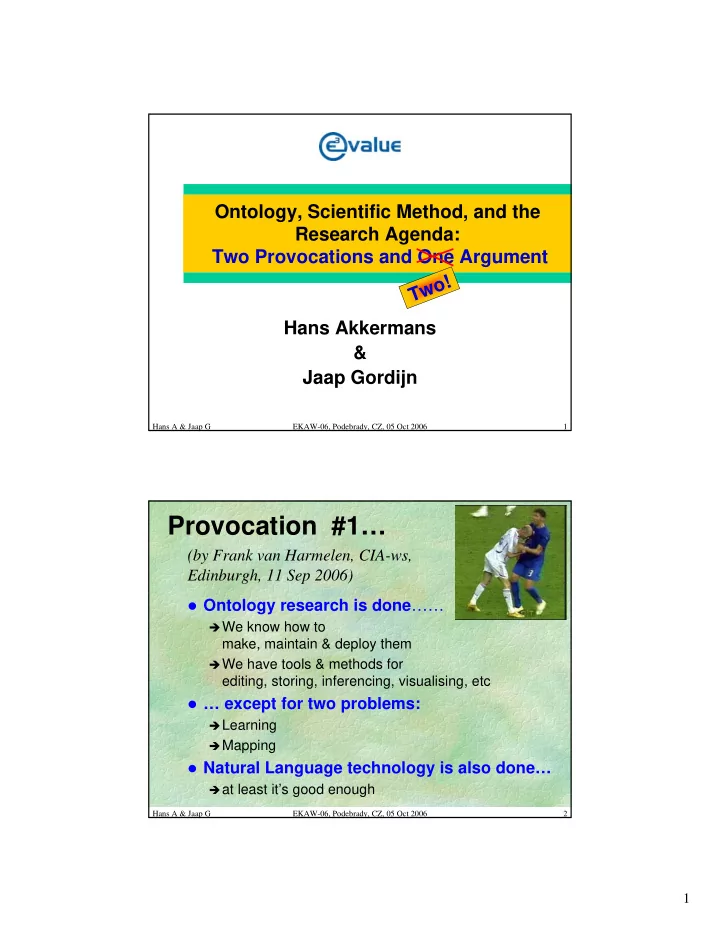
Provocation #1…

Ontology research is done……

We know how to

make, maintain & deploy them

We have tools & methods for

editing, storing, inferencing, visualising, etc

… except for two problems:

Learning Mapping

Natural Language technology is also done…

at least it’s good enough

(by Frank van Harmelen, CIA-ws, Edinburgh, 11 Sep 2006)

slide-2
SLIDE 2

2

Hans A & Jaap G EKAW-06, Podebrady, CZ, 05 Oct 2006 3

Ontology: The Traditional Definition

Research issue: Two legs, but they aren’t

equally long now!

An ontology = a formal specification of a shared

conceptualization of a certain domain

Goal: embed this semantic knowledge into

systems so that they better serve us:

must be (1) computer-processable and must be (2) human-understandable

Abelard & Heloise

Hans A & Jaap G EKAW-06, Podebrady, CZ, 05 Oct 2006 4

Ontology, the Conceptual Triangle, and the Two (Not Equally Long) Legs

Ontology Real- World Domain Computer Information System

Theoretical Model of Computational Specification for

slide-3
SLIDE 3

3

Hans A & Jaap G EKAW-06, Podebrady, CZ, 05 Oct 2006 5

Ontology: The Traditional Problem – Shared Understanding

Financial Times, Oct. 2000

Ontology: specifies shared

background knowledge

In fact, expresses some

conceptual domain theory

Theory implies use: Static

representation is not enough

Domain Inferencing (PSM,

domain-specific)

Domain Validation (external,

in-context: goal, situatedness)

No Ontology Without Methodology

Hans A & Jaap G EKAW-06, Podebrady, CZ, 05 Oct 2006 6

Ontology as Scientific Method

Ontology is (new!) scientific method for formal

conceptualization and theory formation

In-between logico-mathematical, and essayistic/natural language

Formal conceptual modelling

Provides ways for data reduction, abstraction, graphical models

Added value of computational paradigm

simulation, what-if scenario reasoning, coherence testing, etc.

But: evaluation ultimately has to be empirical

Ontology is domain theory (field/case studies, reflective practice) External validity is decisive, more than logical and computational

consistency and coherence:

(Formal) Pragmatics > Semantics

Pragmatic use cases, not representation will be decisive

slide-4
SLIDE 4

4

Hans A & Jaap G EKAW-06, Podebrady, CZ, 05 Oct 2006 7

Value Interface Value Offering Value Transfer Value Port Market Segment Value Object has has consists-of has- in

  • ffers-

requests 0..1 1..* 1..* 0..1 1 1..* 1..* 0..* 1 1 0..* 0..* 1 has-

  • ut

Actor in assigned- to-ac assigned- to-ms in

  • ffered-re-

quested-by in-connects

  • ut-connects

consists-of in 0..* 0..* consists-of 1 1..2 Value Transaction 1..n 1..n in consists-of

Example: What’s in a Business Model? The

  • ntology

www.e3value.com

Hans A & Jaap G EKAW-06, Podebrady, CZ, 05 Oct 2006 8

Inferencing, Validity, and the Structure of Argument

D + T ⇒R C - Core idea of scientific argument

Data plus Theory produce Claims through Reasoning

Toulmin: Reasoning is field-dependent (non-universal logic)

Practical reasoning: often no deductive validity

(e.g. Searle, Walton, argumentation theorists )

Scientific disciplines, and KE experience: yes,

but acceptable (domain) patterns do exist

slide-5
SLIDE 5

5

Hans A & Jaap G EKAW-06, Podebrady, CZ, 05 Oct 2006 9

KE: The Knowledge-Level Principle

  • f Rationality Needs Revision

Newell (1982): KL principle of rationality

Program (symbol) level (= what computer scientists normally do) KL hypothesis: there is a [conceptual] level above, “characterized

by knowledge as the medium and the principle of rationality as the law of behavior”

Rationality = “If an agent has knowledge that one of its actions will

lead to one of its goals, then the agent will select that action”

KL principle still of value to KE

Much of current Semantic Web KE is at programming / symbol

level (representation), not Knowledge Level

Learn from > 20 years of KE (incl. EKAW, K-CAP): e.g. KE

reusable patterns of expertise, knowledge structuring, …

But also: Newell’s Knowledge-Level principle is not

good enough anymore

Hans A & Jaap G EKAW-06, Podebrady, CZ, 05 Oct 2006 10

KE: Replace by Communicative Action Principle of Reasonableness

Why the KL principle of rationality is not good enough

It is inherently individualistic, cognitivist, a-social It ignores social nature of knowledge and rationality It does not work for distributed open systems, such as the Web

(e.g. Semantic Web Services, Social Networks, eBusiness, etc.)

Most practical reasoning is not deductively valid (Searle)

Foundation to be found not in formal logic, but in Speech Act

Theory (Austin, Searle) and in Universal Pragmatics (Habermas)

Progress in Argumentation theory (“Informal Logic”), Schemes

Hence: KL principle to be replaced by:

CA (Communicative Action) Principle of REASONABLENESS
slide-6
SLIDE 6

6

Hans A & Jaap G EKAW-06, Podebrady, CZ, 05 Oct 2006 11

Intelligent Agency in an Open Distributed Environment

Agent is IS

“situated in some environment, and capable of autonomous action

in this environment” to meet its goals (Wooldridge, Jennings)

Has capabilities: responsiveness (reactivity), social ability,

proactiveness

Reasoning related to such capabilities

Goal-oriented Practical (deciding about appropriate belief or action) Approximate, good enough, not deductively valid, etc. Role of patterns (work well as solutions, although fallible)

(cf. KE experience: predefined Task/PSM patterns)

Context inclusive

Hans A & Jaap G EKAW-06, Podebrady, CZ, 05 Oct 2006 12

Components of Agent Knowledge and Rationality (1/2)

Any communicative (speech) act raises some validity

claim C (to truth, normative rightness, truthfulness)

Agent “knows C” if C passes the test of the agent’s

(pragmatic) acceptability conditions for the validity of C

This acceptance test can be carried out by constructing

an argument that makes claim C reasonable to adopt

Agent rationality = ability to construct and provide a

defensible argument (if needed or requested)

Several (and interacting) sources of agent’s knowledge:

What it already knows as pre-established body of knowledge What it comes to know from experiencing/acting in its environment What it comes to know by communicating (and arguing) with other

agents (incl. Web info as background knowledge source)

What it can newly establish (from all of the above) by reasoning

slide-7
SLIDE 7

7

Hans A & Jaap G EKAW-06, Podebrady, CZ, 05 Oct 2006 13

Components of Agent Knowledge and Rationality (2/2)

Note 1: This is an inherently pragmatic theory

  • f (rationality in) knowing, communicating, and acting

Note 2: Rational argument has component structure

so multi-aspect model of validity is required

Note 3: Ontology: explicates assumptions that underlie

but usually are left implicit in argument establishing C

Shared background knowledge and/or Acceptability conditions

Note 4: Intelligence in IS ultimately has to involve forms of

self-organization, at different levels

Agent network adaptation (cf. semantic overlay networks,

gossiping) in reaction to openness/changes in environment

Agent goals (desires, intentions): in the end, not static input (as in

utility theory), but dynamic co-outcome of practical reasoning

Importance of reflection about strategic goals, values and context

Hans A & Jaap G EKAW-06, Podebrady, CZ, 05 Oct 2006 14

KE: The CA Principle

  • f Reasonableness

KL-revised: characterized by actionable

knowledge, set in environment as the medium

And the Communicative Action (CA) Principle of

Reasonableness as the law of behaviour:

Part A (warrant): If a [belief, goal, action] claim C

satisfies an agent’s acceptability conditions for its validity, the agent is warranted in adopting C

Part B (backing): An agent acts reasonably if it is able

(if so requested) to construct and provide a defensible argument showing that C is acceptable

A: test acceptance; B: justify test and its logic Note: Reasonableness is also law of social behaviour KL rationality principle is limiting case of CA principle, part A

A “Society” of Intelligent Devices

slide-8
SLIDE 8

8

Hans A & Jaap G EKAW-06, Podebrady, CZ, 05 Oct 2006 15

Provocation #1…

Ontology research is done……

We know how to

make, maintain & deploy them

We have tools & methods for

editing, storing, inferencing, visualising, etc

… except for two problems:

Learning Mapping

Natural Language technology is also done…

at least it’s good enough

(by Frank van Harmelen, CIA-ws, Edinburgh, 11 Sep 2006)

Hans A & Jaap G EKAW-06, Podebrady, CZ, 05 Oct 2006 16

Provocation #2…

KR research is done……

We know how to represent

  • ntologies and intell. IS components

We have tools & methods for

editing, storing, inferencing, visualising, etc

… except for two problems:

Dealing with pragmatic action context of systems Self-organizing features of intelligent IS

Formal Logic technology is also done…

at least it’s good enough (informal logic and formal pragmatics needed for real-

world applications)

(by HansA, EKAW-2006, Podebrady, 05 Oct 2006)

slide-9
SLIDE 9

9

Hans A & Jaap G EKAW-06, Podebrady, CZ, 05 Oct 2006 17

Argument #2: Why Ontology Research Isn’t Done (Yet) …..

Hans A & Jaap G EKAW-06, Podebrady, CZ, 05 Oct 2006 18

KE Research Agenda

  • 1. Use theory of meaning (pragmatics)

Web reality, social nature of K, goal/action orientation

  • 2. Evaluation and validation framework revised

Ontology as scientific method for (substantive) theory formation No ontology without methodology (PSM, Argument): from static

representation to dynamics

  • 3. “Good enough” reasoning

Stereotypical Patterns, Approximate, Collaborative, …

  • 4. Intelligent IS: Self-Organization, in open environment

(no deductive validity, but constructive validity)

  • 5. Revised Knowledge-Level principles of rationality

“being reasonable” as foundation for IS