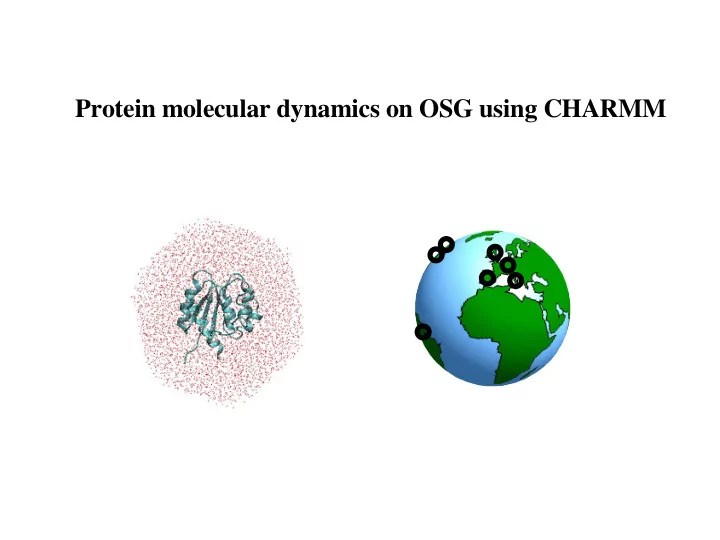
SLIDE 1
Protein molecular dynamics on OSG using CHARMM
SLIDE 2
Structure -> Dynamics -> Function
Timescales of protein motion:
femto-pico: bond vibrations, angle bending pico-nano: loop motions, surface sidechains, water penetration nano-micro: folding in small peptides, helix-coil transitions micro-seconds: conformational rearrangements, protein folding, catalysis Physical complexity: various shapes, sizes, bound non-protein molecules Environment: water, membrane, pH, ions, gases, small molecules, macromolecules
SLIDE 3 Molecular dynamics simulations
All atoms described explicitly (including water molecules, ions). Interaction between atoms through empirical potentials: bonded terms: bond vibrations, angle bending, dihedrals ... non-bonded terms: electrostatic, van der Waals. Time evolution of the system obtained through integration of Newton's equation of motion. Integration timestep is 1-2 fs. Motions at the order
- f ns, or 10-100 ns are accessible through MD
simulations.
SLIDE 4
Why we need the grid?
* Achieve statistically meaningful results (most experimental techniques deal with ensembles). This will become possible for processes that occur on timescales of 10-100 ns (water penetration). * Increase probability of observation of processes that occur on timescales longer than microseconds: protein folding, protein conformational transitions. * Simulate related proteins (comparative study) * Simulate proteins under slightly different conditions (e.g., with bound protons or small molecules)
SLIDE 5 Understand effects of long time dynamics on structure and function. Protein conformation can be changed through changes in environment (such as pH) or binding of small molecules. This can be used as a mechanism of CONTROL
Understanding protein conformations and protein conformational transitions
SLIDE 6 Conformational changes induced by phosphporylation
Phosphorylation Phosphorylation favors active vs inactive conformation. There are two NMR structures
Run simulations for: 1) active1, phosphorylated 2) active1, unphosphorylated 3) active2, phosphorylated 4) active2, unphosphorylated 5) inactive, phosphorylated 6) inactive, unphosphorylated
SLIDE 7
What is CHARMM?
CHARMM is a general and flexible software application for modeling the structure and behavior of molecular systems. More information is available at http://www.charmm.org. * variety of systems: small molecules - large oligomeric proteins in its solvent environment * QM/MM potentials * energy minimizations, molecular dynamics, vibrational analysis * variety of analysis tools
SLIDE 8
System setup
2,000 protein atoms +16,000 water atoms =18,000 atoms
heat equil run1 runN anal ...
Typical sequence of a CHARMM molecular dynamics job
SLIDE 9
SLIDE 10
With a software that can babysit the jobs while we sleep ... Input Output software managing your jobs
SLIDE 11 What do we need to have (requirements)?
- A way to set up various run parameters.
- Ability to submit and track many jobs.
- Easy access to input and output files from the grid.
Implementation of CHARMM on the OSG
What application specific challenges must we deal with?
- The framework must allow for maximum flexibility since CHARMM
can do many things.
- Efficient handling of many input and output files.
- Figuring out queue lengths and resource limitations and tailoring jobs
to them.
SLIDE 12 Solution: Use PanDA and a custom set of management scripts The Scheduler Interface
- We use the PanDA front end.
- We also use TestPilot and run our own pilot scheduler
for maximum control.
- Users can track jobs via a Web interface.
SLIDE 13 heat equil run1 runN anal ... I=1 heat equil run1 runN anal ... I=2 heat equil run1 runN anal ... I=M . . .
CHARMM Job Management
- Thread and wave model. Each independent case is a thread and each step in
the analysis is a wave. Each job can have many threads with the same waves.
- The individual jobs keep track of their state information and pass it to the
next wave in the thread.
- Each job automatically submits the next wave in the thread upon its
- wn completion.
SLIDE 14 Job definition from the researcher's point of view
The following steps are required to set up and submit a job:
- 1. Obtain CHARMM and the PandaForCharmm software.
- 2. Create the various input scripts needed for the jobs.
- 3. Pack these and other necessary files into a tar.gz to be extracted on the execution host.
- 4. Modify parameters in charmmJob.sh, example:
Example thread and wave parameters:
export tarball=ana2.tar.gz export exe=c33a2-lrg.one export jobname=ana3 export threadparams="I=[jobid]" export inpscripts="heat=heat.inp,equ=eq.inp,md=run.inp" export threaddef="heat,equ*2,md*2"
- 5. Run charmmJob.sh
- 6. Watch your jobs run!
SLIDE 15
The Web Interface (constructed by Torre Wenaus)
SLIDE 16 Where we are and where we want to go
Currently:
- Basic set up of the thread and wave model is completed and we've tested our
- wn scripts extensively.
- We have started production runs with fifty threads of twelve waves.
- 100K step jobs are taking about 1 day to finish. This means we can simulate
1 ns per thread in 180 to 300 hours of wall time!
Future Directions
- Ability to introduce “branches” in the script sequence, to allow, for example,
extra analysis of “interesting” structures.
- Better tracking of in-progress jobs along with failure detection and
possible correction.
- A graphical front-end for job definition and submission.
- Gaining a better understanding of various sites and queues so we can better
match jobs to resources.
SLIDE 17
Thank You!
NIH Bernard Brooks Fermilab/Johns Hopkins University Petar Maksimovic Open Science Grid Wensheng Deng (BNL) Torre Wenaus (BNL) Frank Wuerthwein (UCSD)