Protecting Our Protecting Our Introduction Family Family - - PDF document

protecting our protecting our
SMART_READER_LITE
LIVE PREVIEW

Protecting Our Protecting Our Introduction Family Family - - PDF document

Protecting Our Protecting Our Introduction Family Family Globally HIV/AIDS has left its mark on every continent, with its highest prevalence being in sub Saharan Africa 10% of the worlds population An Assessment of In 2008,


slide-1
SLIDE 1

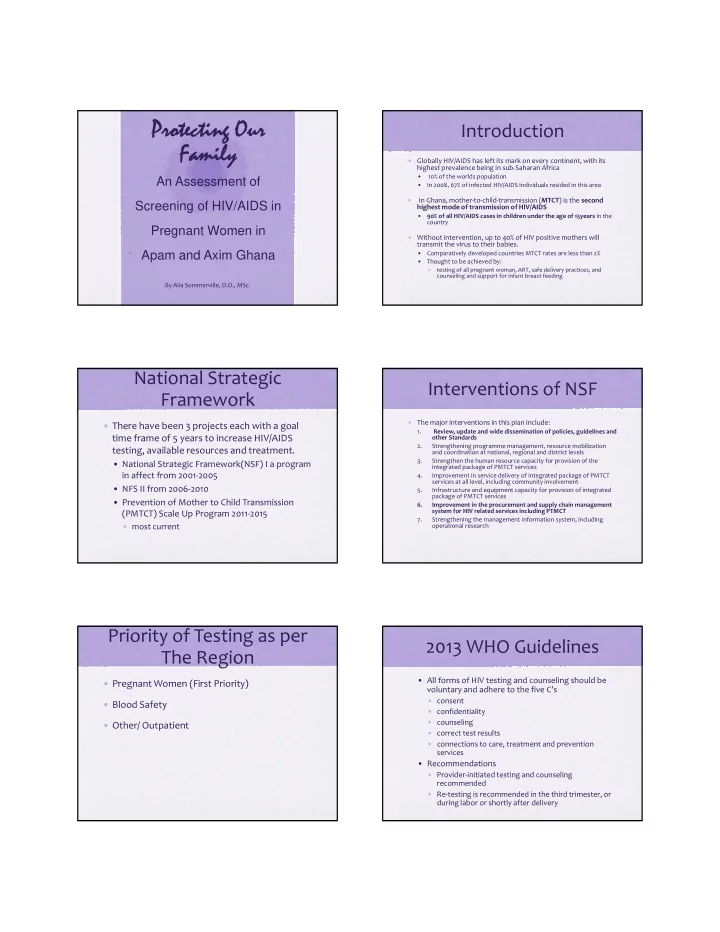
Protecting Our Protecting Our Family Family

An Assessment of Screening of HIV/AIDS in Pregnant Women in Apam and Axim Ghana

By Alia Sommerville, D.O., MSc.

Introduction

  • Globally HIV/AIDS has left its mark on every continent, with its

highest prevalence being in sub‐Saharan Africa

  • 10% of the worlds population
  • In 2008, 67% of infected HIV/AIDS individuals resided in this area
  • In Ghana, mother‐to‐child‐transmission (MTCT) is the second

highest mode of transmission of HIV/AIDS

  • 90% of all HIV/AIDS cases in children under the age of 15years in the

country

  • Without intervention, up to 40% of HIV positive mothers will

transmit the virus to their babies.

  • Comparatively developed countries MTCT rates are less than 2%
  • Thought to be achieved by:
  • testing of all pregnant woman, ART, safe delivery practices, and

counseling and support for infant breast feeding

National Strategic Framework

  • There have been 3 projects each with a goal

time frame of 5 years to increase HIV/AIDS testing, available resources and treatment.

  • National Strategic Framework(NSF) I a program

in affect from 2001‐2005

  • NFS II from 2006‐2010
  • Prevention of Mother to Child Transmission

(PMTCT) Scale Up Program 2011‐2015

  • most current

Interventions of NSF

  • The major interventions in this plan include:

1. Review, update and wide dissemination of policies, guidelines and

  • ther Standards

2. Strengthening programme management, resource mobilization and coordination at national, regional and district levels 3. Strengthen the human resource capacity for provision of the integrated package of PMTCT services 4. Improvement in service delivery of integrated package of PMTCT services at all level, including community involvement 5. Infrastructure and equipment capacity for provision of integrated package of PMTCT services 6. Improvement in the procurement and supply chain management system for HIV related services including PTMCT 7. Strengthening the management information system, including

  • perational research

Priority of Testing as per The Region

  • Pregnant Women (First Priority)
  • Blood Safety
  • Other/ Outpatient

2013 WHO Guidelines

  • All forms of HIV testing and counseling should be

voluntary and adhere to the five C’s

  • consent
  • confidentiality
  • counseling
  • correct test results
  • connections to care, treatment and prevention

services

  • Recommendations
  • Provider‐initiated testing and counseling

recommended

  • Re‐testing is recommended in the third trimester, or

during labor or shortly after delivery

slide-2
SLIDE 2

Maternal HIV Testing

  • Identification of infected pregnant women is critical to

control of perinatal transmission

  • The use of routine or "opt‐out" HIV rapid testing

strategy has proven highly effective

  • informs all pregnant women that they will be tested for

HIV unless they specifically decline

  • result in >95% same day HIV testing
  • “opt‐in” approach
  • individual pregnant women were counseled about HIV

testing and then had to consent in writing if they wished to be tested

  • Only two‐thirds of pregnant women receiving testing in

most antenatal settings

Goal

  • Reduce morbidity and mortality of mothers and

children due to vertical transmission of HIV/AIDS

  • Increase the number of women tested for HIV/AIDS

during pregnancy

  • Improve screening methods of early detection
  • Ensure safe delivery
  • Early treatment of mother and child and before

beginning to breast feed

  • Increasing Pre and Post Test Counseling
  • Help women stay negative decrease overall

transmission of virus

Methods

  • 2 Part Study
  • A retrospective review of the number of

pregnant women tested for HIV/AIDS from 2009‐2013 in Axim in comparison to the District as well as Apam in comparison to GOMAO West District

  • Survey performed in the antenatal clinic (ANC)

at St Luke’s Hospital in Apam and Axim Hospital in Axim

Apam Survey

  • 60 patients in Apam
  • Questions for pregnant Patients in Apam:
  • Patients Name, Age, Gestational Age, Parity
  • Have you been tested for HIV this pregnancy?
  • If no, do you plan on getting tested?
  • If no, would you get tested if recommended by a doctor or nurse?
  • Would stay to receive the result of your HIV test?
  • Are you aware that there is counseling at the hospital for those who test positive?
  • If tested positive would you be willing to come to monthly counseling/treatment sessions

at the hospital?

  • Are you aware that there is medication for patients that test positive?
  • Do you plan to deliver at the hospital?
  • How far do you have to travel to come to the hospital?
  • Do you know HIV can have an affect your health and the health of your baby?

Apam Demographics

Demographics Range Mean Mode Age: 19‐44 28 24 Gestational Age: 4‐9mo 6.7mo 8mo Gravid: 1‐6 3 2 Parity 0‐5 2 1 Distance from Hospital: 15min‐1hr 27.58min Mode of Transportation Walk, Taxi, Bus Taxi

Axim Survey

  • 116 patients in Axim
  • Same questions asked in Apam
  • Additional Questions:
  • What month were you tested?
  • Were you given a result?
  • Are you aware that HIV/AIDS can affect your

health as well the health of your baby? If yes what affect does it have?

slide-3
SLIDE 3

Axim Demographics

Demographics Range Mean Mode Age: 14‐41 26 25 Gestational Age: 2‐9mo 6.3mo 8mo Gravid: 1‐10 2.9 2 Parity: 0‐9 1.9 1 Distance from Hospital: <15 min to 3hours 26 min Mode of Transportation Walk, Bus, Taxi Taxi

Gestational Age Breakdown

Gestational Age: St LUKE’S HOSPITAL AXIM HOPSITAL 1st Trimester 3.3% 12% 2nd Trimester 35% 29% 3rd Trimester 58% 56%

Results

  • Data Analyzed from 2009‐2013 for ANC

Registrants, and PMTCT

  • 60 ANC Registrants Surveyed at Apam
  • 116 ANC Registrants Surveyed at Axim

Pregnancy Testing HIV Apam vs District

  • St. Lukes Hospital

Gomoa West District

St Luke’s Hospital

500 1000 1500 2000 2500 3000 3500 2009 2010 2011 2012 2013 ANC Tested Untested Positive

GOMA West District

1000 2000 3000 4000 5000 6000 2009 2010 2011 2012 2013 ANC Tested Untested Positive

slide-4
SLIDE 4

Apam Survey Results

  • 28/60 (46%) pts were not tested for HIV
  • Of the 28 pts not tested, 26 pts (92%) of pts

said they would if recommended by a Doctor Or Nurse

  • 58/60 (96%) pts stated if tested would be

willing to stay to know their result

  • 100% of women reported willing to go for

counseling/treatment if tested positive

What Apam Does Well

  • When test kits are available, every pregnant

woman receives testing

  • Those pregnant women being tested for

HIV/AIDS receive pre and post counseling

  • Patients tested were aware of results, and could

recall testing months

  • Privacy of testing and release of results

Apam Deviations from National Guidelines

  • Nationally the instruction for hospitals/clinics is

priority for testing of pregnant women

  • Priority used: Blood Safety, Clinical Suspicion,

and then Pregnant Woman

  • ANC HIV test kits are exhausted patients are not

referred to the main laboratory for testing unless clinical suspicion of HIV/AIDS

  • In absence of test kits all pregnant women are

not being referred for testing

Additional Concerns

  • Acquiring Test Kits Every month
  • System of retroactive testing for mothers who

are not tested to due to regional or national shortage

  • Standardized Pre and Post Counseling

information disseminated by HIV counselor

Pregnancy Testing HIV/AIDS Axim

Axim Hospital

Year 2009 2010 2011 2012 2013 ANC 1170 1119 1226 1465 1251 Tested 1358 979 1454 1235 1219 Untested ‐118 140 (12.5%) ‐228 230 (15.7%) 32 (2.5%) Positive 12 17 25 29 10

Axim Hospital

‐400 ‐200 200 400 600 800 1000 1200 1400 1600 2009 2010 2011 2012 2013 ANC Tested Untested Positive

slide-5
SLIDE 5

Pregnancy Testing HIV/AIDS for District

Year 2009 2010 2011 2012 2013 ANC 2412 2483 1750 1980 1309 Tested 616 1112 1907 1713 1270 Untested 1796 (74.5%) 1371 (55.2%) ‐157 267 (13.5%) 39 (2.9%) Positive 14 86 27 32 19

Nzema East Municipal

Nzema District

‐500 500 1000 1500 2000 2500 3000 2009 2010 2011 2012 2013 ANC Tested Untested Positive

Axim Hospital

  • 65 of the 116 ANC Registrants (56%) of women stated they

had received HIV/AIDS Testing this pregnancy

  • 42 if the 116 ANC Registrants (36.2%) of women stated they

had not received HIV/AIDS Testing this pregnancy

  • Of the 42 patients that had been tested 4 were actively being

tested and unaware of what test they were receiving (9%)

  • 24 of the 65 ANC Patients that answered “Yes” to Receiving

Testing Were not told the result (20.8%)

  • Mode for Patient knowledge testing 3 months
  • Average month tested about 4 months

What Axim Does Well

  • Every pregnant women is being tested
  • Testing twice during pregnancy
  • System in place to obtain ensure necessary

stock for test kits

  • Privacy in Patient Testing and Results (recent

improvement)

AXIM Deviation of National Guidelines

  • All patients are not receiving pre and post

counseling

  • Patients unaware being tested
  • Patients unaware of results

Additional Concerns

  • Pre‐counseling is given by one Nurse.
  • Counseling Session is once a day first thing in

the morning

  • No system ensuring the patient understands

and acknowledges pre and post counseling

slide-6
SLIDE 6

Apam Recommendations

  • Following Appropriate Priority Testing

Protocol

  • Pregnant Woman first
  • Referral system in place for when out of test kits
  • List of patients to be tested
  • In event of national shortage
  • Pre Counseling Outline of Topics Covered
  • Post Counseling Topics Covered
  • Making Patient aware of result

Axim Recommendations

  • Continue with Opt‐out approach of testing
  • Create a document with specific pre‐counseling

information needed to be disseminated to patients

  • Ensures standardization of information given
  • Multiple sessions versus 1 morning information

session

  • Increase the amount of HIV/AIDS counselors
  • Have healthcare work administering tests provide

information on the HIV tests prior to testing

  • State the purpose of the test
  • Ask pt if they have any questions
  • Have a place in the record that is for the patient to sign
  • r mark indicating they understand and acknowledge

result

Limitations

  • Would have verified every patients status
  • Books often don’t accompany the patient

during interview

  • Larger sample size
  • Time constraints due to stay and interpreter

availability

  • Would have asked the exact same questions at

each sight to be able to do a cross comparison

Resources

  • 2013 World Health Organization Guidelines.

The Use of Antiretroviral Drugs for Treating and Preventing HIV Infection. June 2013

  • Ghana Aids Commission. Prevention of Mother‐

to‐Child Transmission of HIV Transmission in

  • Ghana. Scale Up Plan 2010.
  • National Guidelines for Prevention of Mother

to Child Transmission of HIV AIDS. 2008

Thank You!

QUESTIONS?