Propositional models Start with a fixed number of boolean variables - - PDF document

propositional models
SMART_READER_LITE
LIVE PREVIEW

Propositional models Start with a fixed number of boolean variables - - PDF document

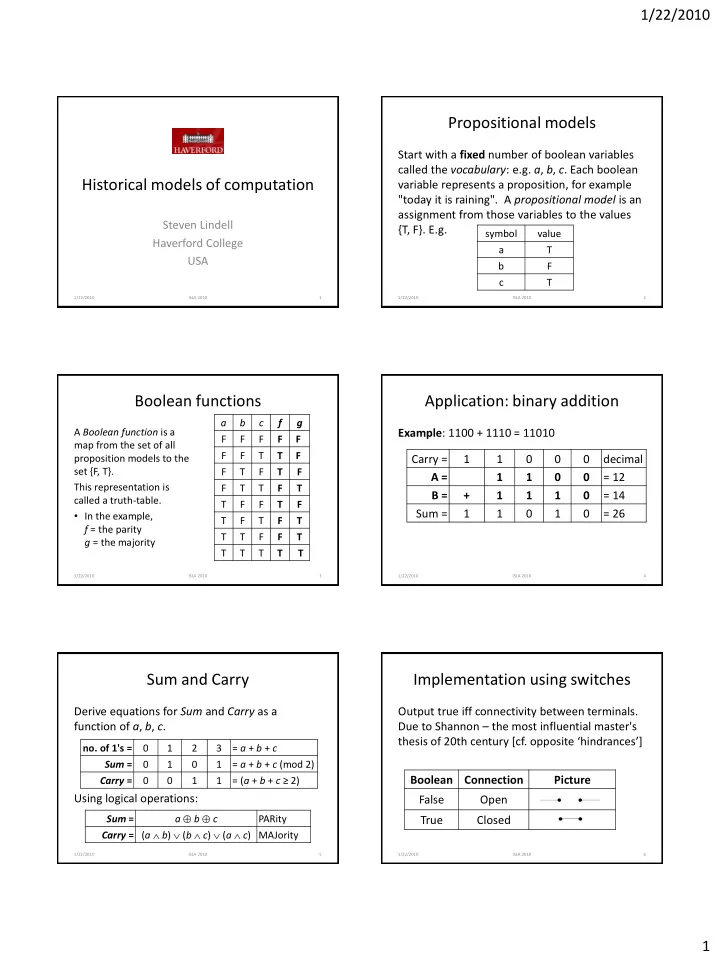
1/22/2010 Propositional models Start with a fixed number of boolean variables called the vocabulary : e.g. a , b , c . Each boolean Historical models of computation variable represents a proposition, for example "today it is raining".


slide-1
SLIDE 1

1/22/2010 1

Historical models of computation

Steven Lindell Haverford College USA

1/22/2010 ISLA 2010 1

Propositional models

Start with a fixed number of boolean variables called the vocabulary: e.g. a, b, c. Each boolean variable represents a proposition, for example "today it is raining". A propositional model is an assignment from those variables to the values {T, F}. E.g.

symbol value a T b F c T

1/22/2010 ISLA 2010 2

Boolean functions

A Boolean function is a map from the set of all proposition models to the set {F, T}. This representation is called a truth-table.

  • In the example,

f = the parity g = the majority a b c f g F F F F F F F T T F F T F T F F T T F T T F F T F T F T F T T T F F T T T T T T

1/22/2010 ISLA 2010 3

Application: binary addition

Example: 1100 + 1110 = 11010 Carry = 1 1 decimal A = 1 1 = 12 B = + 1 1 1 = 14 Sum = 1 1 1 = 26

1/22/2010 ISLA 2010 4

Sum and Carry

Derive equations for Sum and Carry as a function of a, b, c. Using logical operations:

  • no. of 1's = 0

1 2 3 = a + b + c Sum = 0 1 1 = a + b + c (mod 2) Carry = 0 1 1 = (a + b + c ≥ 2) Sum = a  b  c PARity Carry = (a  b)  (b  c)  (a  c) MAJority

1/22/2010 ISLA 2010 5

Implementation using switches

Output true iff connectivity between terminals. Due to Shannon – the most influential master's thesis of 20th century [cf. opposite ‘hindrances’] Boolean Connection Picture False Open True Closed

1/22/2010 ISLA 2010 6

slide-2
SLIDE 2

1/22/2010 2

Normally Open SPST relay

N.O. relay Boolean input 2-way switch diagram Connection Off (de-energized) False Open On (energized) True Closed function formula gate diagram switching circuit ID a

a

1/22/2010 ISLA 2010 7

Monotone Boolean functions

functional connection formula gate diagram switching circuit OR is parallel a  b AND is series a  b

a b a b 1/22/2010 ISLA 2010 8

Majority

gate diagram switching circuit function formula MAJ(a, b, c) (a  b)  (b  c)  (a  c)

a b b c a c

a c b

1/22/2010 ISLA 2010 9

Normally Closed SPST relay

N.C. relay Boolean input 2-way switch diagram Connection Off (de-energized) False Closed On (energized) True Open function formula gate diagram switching circuit NOT

  • a

a

1/22/2010 ISLA 2010 10

3-way (changeover) switch

An SPDT relay equivalent to an N.O. and an N.C. relay mechanically ganged together.

relay position Boolean input 3-way switch diagram N.O. N.C. Up (de-energized) False Open Closed Down (energized) True Closed Open

NC NO common

NC NO common NC NO common

1/22/2010 ISLA 2010 11

Exclusive-OR

function formula gate diagram switching circuit XOR 𝑏 ⊕ 𝑐 XNOR 𝑏 ⊕ 𝑐

a b a b

1/22/2010 ISLA 2010 12

slide-3
SLIDE 3

1/22/2010 3

Majority revisited

There are four monotone symmetric functions

  • f three variables:

size: O(kn) k fixed O(n) depth n

f0(a, b, c) = f1(a, b, c) = f2(a, b, c) = f3(a, b, c) = f4(a, b, c) = a + b + c ≥ 0 a + b + c ≥ 1 a + b + c ≥ 2 a + b + c ≥ 3 a + b + c ≥ 4 always True same as OR the majority same as AND always False

a b c b c c

1 2 3

1/22/2010 ISLA 2010 13

4-way switch

Two 3-way switches combined together to form a 4-way switch.

NO NC Input A Input B Output A Output B

relay position Boolean input 4-way switch diagram straight-thru (de-energized) False cross-over (energized) True

NO NC Input A Input B Output A Output B NO NC Input A Input B Output A Output B

1/22/2010 ISLA 2010 14

Parity

Multiple-input XOR

  • Practical use: control light on stairway

Use this circuit to solve later problems.

function formula gate diagram switching circuit PAR(a, b, c) a  b  c

a b c

1/22/2010 ISLA 2010 15

4-bit adder

Diagram of 4-bit full adder Sumi = si = PAR(ai, bi, ci) Carryi = ci+1 = MAJ(ai, bi, ci)

1/22/2010 ISLA 2010 16

Carry look-ahead

si = PAR(ai, bi, ci) and all ci computed simultaneously

carry generate 1 + 1 𝑕𝑗 = 𝑏𝑗 ∧ 𝑐𝑗 carry propagate 0 + 1 = 1 + 0 𝑞𝑗 = 𝑏𝑗 ⊕ 𝑐𝑗 carry terminate 0 + 0 𝑢𝑗 = 𝑏𝑗 ∨ 𝑐𝑗

1/22/2010 ISLA 2010 17

Manchester Chain

𝑑𝑗 = ∃𝑘 < 𝑗 [𝑏𝑘 ∧ 𝑐

𝑘] ∧ (∀𝑙, 𝑗 > 𝑙 > 𝑘)[𝑏𝑙 ⊕ 𝑐𝑙]

+

ci . . . . . . gi−1 . . . . pi−1 pj+1 gj

·

constant depth circuit

1 G = 𝑏𝑗 ∧ 𝑐𝑗 c T = 𝑏𝑗 ∨ 𝑐𝑗 P = 𝑏𝑗 ⊕ 𝑐𝑗

1/22/2010 ISLA 2010 18

slide-4
SLIDE 4

1/22/2010 4

Read-once sequential computation

Reason: careful measure of read/write storage Memory: read-only; write-only; oblivious cursor Concept: reads are destructive for working memory (not input); sort of no-cloning property Example: carry computation

  • re-parenthesization

c := ab + bc + ac = ab + c(a + b)

1/22/2010 ISLA 2010 19

Validity

True in all (propositional) models: trivial

  • Form implication consisting of the conjunction
  • f the premises arrows the conclusion. This is

a Boolean function too. Example: premises a, b; conclusion c (carry-out).

  • Check to see if all rows of the truth-table are

true.

1/22/2010 ISLA 2010 20

Summary

  • Switching circuits are a computational model for

propositional Boolean logic

  • Propositional validity is a finite procedure. I.e. in

a fixed vocabulary V, there are finitely many propositional models, and finitely many Boolean

  • functions. It is a simple matter to determine

which of them are tautologies (just try out 2|V|).

  • However, parameterized by the vocabulary, this is

co-NP-complete (the opposite of satisfiability).

1/22/2010 ISLA 2010 21

Predicate models for term logic

  • Fix a vocabulary of predicates: e.g. A, B, C.

Each predicate represents some class of elements, such as "the set of all students". A predicate model consists of a domain (sometimes called the universe) along with an assignment which interprets each of the predicates as a subset of the domain.

  • If the domain is all people, then one of the

predicates could represent the set of students.

1/22/2010 ISLA 2010 22

Example

Consider the model M = <D, S, M, W, L> given by

Domain Students Men Women Logicians Ed Tanvi John Anuj Jane Lisa Ashok Mollie Bob Mary Tanvi Anuj Ashok Mollie Ed John Anuj Ashok Bob Tanvi Jane Lisa Mollie Mary Ed Tanvi Anuj Lisa Bob

1/22/2010 ISLA 2010 23

Terms & Propositions

Term: Take a model and return a derived predicate. male students: {Anuj, Ashok} non-logicians: {John, Jane, Ashok, Mollie, Mary} Proposition: compare two terms Technically, a proposition could be any function from constants and terms to {True, False}. Statement Equation All P are Q P  Q Some P are Q P  Q  No P are Q P  Q  No Women are Logicians W  L =  False Mollie is a student Mollie  S True

1/22/2010 ISLA 2010 24

slide-5
SLIDE 5

1/22/2010 5

Validity

  • Can use Ladd-Franklin's Rule of Syllogism

Syllogism Example Symbolically Major premise No healthy food is fattening. No P are M. Minor premise All cakes are fattening. All S are M. Conclusion No cakes are healthy. No S are P.

1/22/2010 ISLA 2010 25

Terms

  • Simple terms
  • Joining them together

Example: W  −L = women non-logicians Atomic predicates A, B, … in original vocabulary Complement −T T is a simple term Union T1  T2 T1 and T2 are terms Intersection T1  T2 T1 and T2 are terms

1/22/2010 ISLA 2010 26

Basic Statements

Given subject and predicate terms S and P: If P is negated, we get the other two forms:

I $S · P Some S are P. A "S · P All S are P. O $S · −P Some S are not P. E "S · −P No S are P.

1/22/2010 ISLA 2010 27

Compound statements

Example: consider T1 and T2 to be the statements  "S · (W  L) All students are women or logicians. $L · (M S) Some logicians are male students.

  • Can combine statements with disjunction and

conjunction to form: T1  T2 and T1  T2. Exercise (negation unnecessary): Show O and E forms are unnecessary. Hint: push negations down.

1/22/2010 ISLA 2010 28

Numerical quantifiers

Definition: A quantifier is a monotone symmetric function from sets to a Boolean.

  • $

kS · P

there are at least k S’s which are P

  • "

kS · P all except at most k−1 S’s satisfy P

Example: k = 1 is ordinary $ / " quantification Exercise: show there are no more

1/22/2010 ISLA 2010 29

Threshold gates

  • k or more inputs are one:
  • for k = 1 this is OR.
  • for k = n this is AND.

Exercise : Show that for a fixed k, they can be implemented by depth 2, size nk circuits. Hint: use multiple input AND/OR gates. However, Shannon’s ladder diagram: linear depth and size.

k : n :

1/22/2010 ISLA 2010 30

slide-6
SLIDE 6

1/22/2010 6

Complexity of evaluation

  • Given a predicate model M and formula φ, ask

if M satisfies φ. The size of the input is |M|, or O(|D|), proportional to size of the domain.

  • 1. Evaluate all terms using −, , .
  • 2. Quantify:

numerical

  • rdinary

∃𝑙𝑇 ∙ 𝑄 |𝑇 ∩ 𝑄| ≥ 𝑙 𝑇 ∩ 𝑄 ≠ ∅ ∀𝑙𝑇 ∙ 𝑄 |𝑇 − 𝑄| < 𝑙 𝑇 − 𝑄 = ∅

  • 3. Compute Boolean combinations

1/22/2010 ISLA 2010 31

Where do we go from here?

  • Extend vocabulary, preserving linear size.

How? allow monadic functions (invertible)

  • Chase the lure of linear-time computation.

Insure: compositionality with queries of arity > 1

  • Find efficient normal forms for logic formulae.

Use: numerical quantifiers that are not nested

1/22/2010 ISLA 2010 32