
SLIDE 1
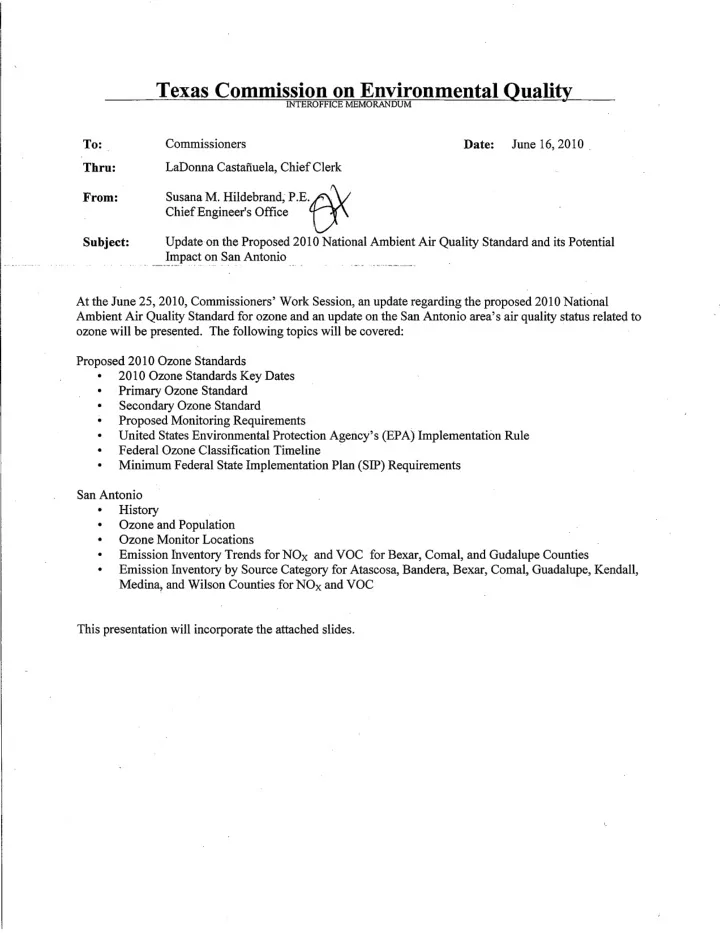
Proposed 2010 Ozone Standards and an Update on the San Antonio Areas - - PDF document
Proposed 2010 Ozone Standards and an Update on the San Antonio Areas Air Quality Status Related to Ozone Commissioners Work Session June 25, 2010 Air Quality Division June 2010 Air Quality Division June 2010 Page 1 Proposed
Air Quality Division June 2010 • Page 1
Air Quality Division June 2010
Air Quality Division June 2010 • Page 2
Air Quality Division June 2010 • Page 3
March 2011 EPA intending to have letters to states on recommended designations Spring 2011 EPA intending an informal proposal of recommendation of designations June – July 2010 TCEQ Public Meetings
EPA proposed revision to the ozone standards January 6, 2010 EPA signature of revised ozone standards final rule August 31, 2010 Tentative date for TCEQ work session for designation recommendation November 19, 2010 (backup available by November 9 afternoon) Designation recommendation due from governor to EPA January 7, 2011 Final ozone nonattainment designations by the EPA effective August 31, 2011 State Implementation Plan (SIP) revisions due to the EPA December 31, 2013 Attainment deadlines August 2014-August 2031
Air Quality Division June 2010 • Page 4
Air Quality Division June 2010 • Page 5
Air Quality Division June 2010 • Page 6
2007 2008 2009 Maximum Peak Eight-Hour Ozone 87 85 86 2nd Highest Peak Eight- Hour Ozone 85 83 80 3rd Highest Peak Eight- Hour Ozone 70 78 75 4th Highest Peak Eight- Hour Ozone 69 73 72
*Note that all units in this example are in parts per billion (ppb)
Air Quality Division June 2010 • Page 7
*Brewster County monitor is maintained by the United States National Park Service and reported in EPA AQS. Region County 8hr Ozone DV (ppb)
DFW Tarrant 86 DFW Denton 85 HGB Brazoria 84 HGB Harris 84 DFW Johnson 83 DFW Dallas 81 DFW Parker 81 DFW Collin 79 BPA Jefferson 77 DFW Hood 77 HGB Galveston 77 ARR Travis 75 DFW Rockwall 75 ELP El Paso 75 NETX Gregg 75 NETX Smith 74 SAN Bexar 74 DFW Ellis 73 WACO McLennan 72 HGB Montgomery 71 BPA Orange 70 DFW Kaufman 70 CC Nueces 69 NETX Harrison 68 DFW Hunt 66 BIG BEND Brewster 66* ARR Hays 65 VIC Victoria 65 LRGV Cameron 62 LRGV Hidalgo 57 LAR Webb 51
Air Quality Division June 2010 • Page 8
(from EPA’s December 2008 Guidance)
Air Quality Division June 2010 • Page 9
CSA 2009 8-Hr Ozone DV (ppb)
DFW 86 HGB 84 BPA 77 NETX 75 ELP 75 ARR 75 SAN 74 WACO 72 CC 69 Big Bend* 66 VIC 65 LRGV 62 LAR 55
*Brewster County monitor is maintained by the United States National Park Service and reported in EPA AQS.
Air Quality Division June 2010 • Page 10
The 1997 Ozone Standard
The 2008 Ozone Standard
The 2010 Proposed Revisions to 2008 Standard
http://www.epa.gov/air/ozonepollution/actions.html#jan10s
Air Quality Division June 2010 • Page 11
Air Quality Division June 2010 • Page 12
Region County W126 DV (ppm-hrs)
DFW Tarrant 18 DFW Denton 17 DFW Colin 15 DFW Parker 12 DFW Johnson 12 ELP El Paso 13 DFW Dallas 12 HGB Harris 11 DFW Rockwall 10 BPA Jefferson 10 BIG BEND Brewster 10* SAN Bexar 10 ARR Travis 9 NETX Smith 9 DFW Kaufman 9 DFW Hood 9 NETX Gregg 9 HGB Montgomery 8 HGB Galveston 8 DFW Ellis 8 HGB Brazoria 8 WACO McLennan 8 BPA Orange 7 CC Nueces 6 DFW Hunt 6 NETX Harrison 6 VIC Victoria 5 ARR Hays 5 LRGV Cameron 4 LRGV Hidalgo 3 LAR Webb 2
Brewster County monitor is maintained by the United States National Park Service and reported in EPA AQS. .
Air Quality Division June 2010 • Page 13
CSA
W126 DV (ppm-hrs) DFW 18 ELP 13 HGB 11 BPA 10 Big Bend** 10 SAN 10 ARR 9 NETX 9 WACO 8 CC 6 VIC 5 LRGV 4 LAR 2
*Brewster County monitor is maintained by the United States National Park Service and reported in EPA AQS.
There is currently no guidance indicating that the EPA will consider the CSA as the presumptive nonattainment boundary for the secondary standard.
Air Quality Division June 2010 • Page 14
Air Quality Division June 2010 • Page 15
Air Quality Division June 2010 • Page 16
Air Quality Division June 2010 • Page 17
Emissions Inventory and Emissions Statements New Source Review/Emission Offsets (NSR) Marginal (3 years) Basic Vehicle Inspection and Maintenance Reasonably Available Control Technology and Measures Reasonable Further Progress Emissions Reductions Attainment Demonstration, Contingency Measures Moderate (6 years) Stage II Gasoline Vapor Recovery Enhanced Monitoring and Enhanced Vehicle Inspection and Maintenance (I/M) Demonstration of Required Emission Reductions Serious (9 years) Offset Vehicle Miles Traveled (VMT) Growth Major Source Fee if Area Fails to Attain Severe (15 – 17 years) Clean Fuels and Controls for Boilers Extreme (20 years) Requirements Classification/Years to Attain
Air Quality Division June 2010 • Page 18
The Federal Clean Air Act requires each state to submit to the United States Environmental Protection Agency a list of areas to be designated attainment, nonattainment, or unclassifiable for new or revised air quality standards. The state recommendation on the 2010 ozone standards is due by January 7, 2011. You are invited to submit comments by September 3, 2010. Please submit your comments to:
Air Quality Division, Chief Engineer’s Office By e-mail mmcallis@tceq.state.tx.us By mail Post Office Box 13087, Mail Code 164 Texas Commission on Environmental Quality Austin, Texas 78711-3087 By delivery 12100 Park Circle Drive, Building E, 3rd floor Texas Commission on Environmental Quality Austin, Texas 78753 By fax 512-239-1500 For More Information: http://www.tceq.state.tx.us/implementation/air/aqps/eighthour.html
Air Quality Division June 2010 • Page 19
Air Quality Division June 2010 • Page 20
Ambient Air Quality Standard (NAAQS), local elected officials and air quality planners in the San Antonio “near-nonattainment” area proposed the Accelerated Attainment Area concept to the TCEQ and the EPA.
Early Action Compact (EAC) agreement with the TCEQ and the EPA making it the first area in the nation to begin the EAC process.
effective date of air quality designations. In exchange for a deferred effective date of the 1997 eight-hour ozone designation, the San Antonio Early Action Compact members agreed to take action to achieve clean air earlier than required under the eight-hour standard—no later than December 31, 2007.
San Antonio) as attainment for the 1997 eight-hour ozone standard, as they met all milestones of the EAC program and demonstrated attainment of the standard by December 31, 2007. The effective date of this final action is April 15, 2008.
Air Quality Division June 2010 • Page 21
0.0 0.5 1.0 1.5 2.0 2.5 20 40 60 80 100 1991 1992 1993 1994 1995 1996 1997 1998 1999 2000 2001 2002 2003 2004 2005 2006 2007 2008 2009 Population (Millions) Design Values (ppb)
Population Eight-Hour Design Value Eight-Hour NAAQS (1997): 84 ppb 2010 Proposed NAAQS: 70 ppb to 60 ppb
*Source: Ozone -- EPA's AQS database. Population -- U.S. Census Bureau, Population Division
Air Quality Division June 2010 • Page 22
Air Quality Division June 2010 • Page 23
Total 2008 NOX emissions : 210 tons per day (tpd)
*Atascosa, Bandera, Bexar, Comal, Guadalupe, Kendall, Medina, and Wilson Counties
Point, 68.38 tpd Area, 20.13 tpd Nonroad Mobile, 31.51 tpd
Onroad Mobile, 90.19 tpd
Air Quality Division June 2010 • Page 24
Air Quality Division June 2010 • Page 25