Proposal Request: Form an ALS advisory committee to the board I am - - PDF document

proposal request form an als advisory committee to the
SMART_READER_LITE
LIVE PREVIEW

Proposal Request: Form an ALS advisory committee to the board I am - - PDF document

Proposal Request: Form an ALS advisory committee to the board I am requesting the formation of an advisory committee to the White Lake Township Board to review the need for, and obligations related to a White Lake Township fire based ALS service.


slide-1
SLIDE 1

1

Proposal Request: Form an ALS advisory committee to the board

I am requesting the formation of an advisory committee to the White Lake Township Board to review the need for, and obligations related to a White Lake Township fire based ALS service. It is proposed that this committee consist of at least 2 township board members, Fire Chief Gurka, myself (David Mills), 2 other firefighter paramedics, the Oakland County Medical Control Authority Executive Director, Bonnie Kincaid, Ph.D., and Medical Control Physician, Tressa Gardner, DO.

What is Advanced Life Support (ALS)?

Advanced life support or ALS consists of a collection of advanced skills, procedures, and equipment that a paramedic working for a licensed ALS agency is authorized to perform or use by protocol.

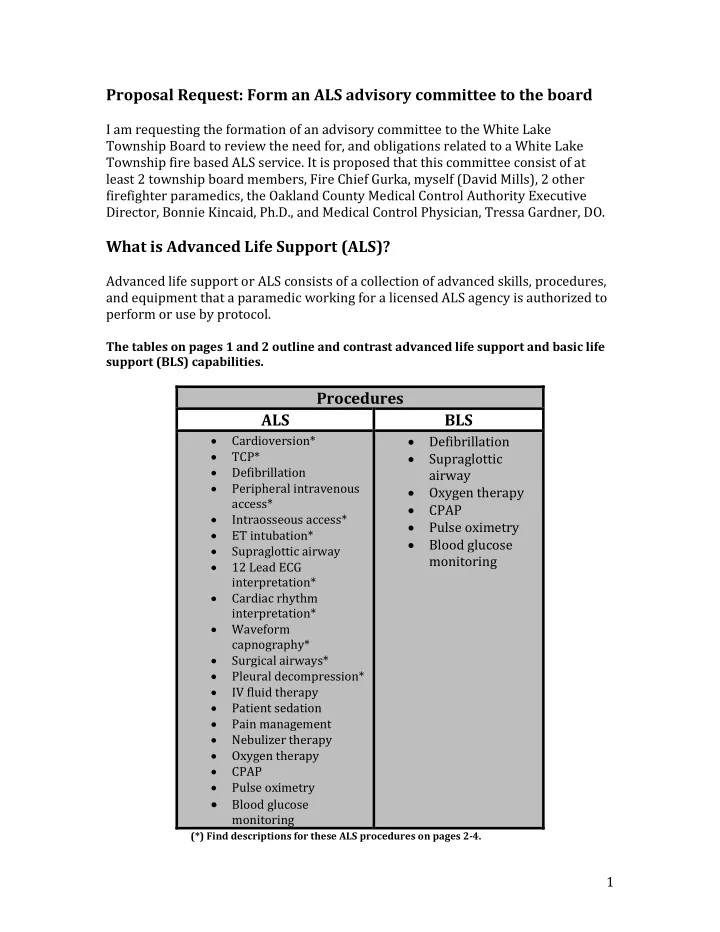
The tables on pages 1 and 2 outline and contrast advanced life support and basic life support (BLS) capabilities.

Procedures ALS BLS

 Cardioversion*  TCP*  Defibrillation  Peripheral intravenous access*  Intraosseous access*  ET intubation*  Supraglottic airway  12 Lead ECG interpretation*  Cardiac rhythm interpretation*  Waveform capnography*  Surgical airways*  Pleural decompression*  IV fluid therapy  Patient sedation  Pain management  Nebulizer therapy  Oxygen therapy  CPAP  Pulse oximetry

Blood glucose monitoring

 Defibrillation  Supraglottic airway  Oxygen therapy  CPAP  Pulse oximetry  Blood glucose monitoring

(*) Find descriptions for these ALS procedures on pages 2-4.

slide-2
SLIDE 2

2

Medications ALS BLS

 Acetaminophen  Adenosine  Albuterol  Amiodarone  Aspirin  Atropine  Calcium chloride  Dextrose  Diphenhydramine  Epinephrine 1mg/10mL  Epinephrine 1mg/1mL  Fentanyl  Ipraptropium bromide  Ketamine  Toradol  Lidocaine  Magnesium sulfate  Methylprednisolone  Midazolam  Morphine  Naloxone  Nitroglycerin  Zofran  Zofran ODT  Prednisone  Racepinephrine  Sodium bicarbonate  Sodium chloride  Naloxone kit  BEES kit (IM epinephrine)  Oral glucose See below for a description of several of the ALS procedures listed in the tables on pages 1 and 2.

 Advanced electrical therapies, including:

  • Cardioversion
  • Transcutaneous pacing (TCP)

These electrical therapies are delivered with the use of a cardiac monitor/defibrillator and allow a paramedic to treat life threatening heart arrhythmias related to extremely slow or fast heartbeats.  Vascular access with intravenous and/or intraosseous (bone) catheters. Vascular access allows paramedics to deliver saline infusions to support and stabilize blood pressures. More importantly, vascular access also provides paramedics with a route to deliver critical lifesaving medications. Intra

slide-3
SLIDE 3

3

  • sseous access is vascular access established by using a device to place a

catheter in the medullary space within a long bone. This is used when intravenous access is delayed or unavailable.  Endotracheal (ET) intubation ET intubation is the gold standard for advanced airway stabilization and

  • access. ET intubation provides definitive airway security that is unmatched

by other advanced airway options. ET intubation provides paramedics with direct access to the patient’s lower airway. This procedure allows for the removal of foreign body airway obstructions that are not cleared by abdominal thrusts or chest compressions. ET intubation also allows for deep tracheal suctioning, and the ability to secure the airway of a patient with special challenges, like a patient with a tracheostomy.  Medications ALS agencies throughout the Southeast Michigan region carry medication boxes that allow paramedics to deliver medications in the field. These medications treat a wide-ranging set of critical and life threatening conditions, including:

  • Cardiac arrest
  • Life threatening electrolyte abnormalities
  • Heart attacks
  • Seizures
  • Diabetes (severe hypoglycemia)
  • Severe pain
  • Opioid overdose
  • Septic shock
  • Anaphylactic shock
  • Cardiogenic shock
  • Bradycardia
  • Tachycardia
  • Severe nausea/vomiting
  • Severe respiratory distress
  • Severe croup in pediatrics
  • Allergic reactions
  • Severe asthma attacks
  • Congestive heart failure
  • Eclampsia

The bulleted list above does not cover all of the conditions paramedics are capable of effectively treating with medications in the prehospital setting. However, it should provide an understanding of the scope of conditions paramedics are capable of treating, when authorized to provide ALS care. In contrast, a basic life support agency is unable to even offer an aspirin to a patient suffering from a heart attack.

slide-4
SLIDE 4

4  Surgical airway In the event of a severe foreign body airway obstruction or in the presence

  • f severe upper airway trauma, paramedics working for an ALS agency can

perform a lifesaving surgical procedure on adults and pediatrics to establish an open airway and breathing.  Pleural decompression This procedure allows paramedics working for an ALS agency to perform a critical intervention for those patients who have suffered a collapsed lung and hypotension due to blunt or penetrating trauma to the chest.  12-lead ECG, cardiac rhythm interpretation, and waveform capnography 12-Lead ECG capability and interpretation allow paramedics working for an ALS agency to recognize life threatening heart attacks and administer critical medications as well as provide early notification to the receiving emergency cardiac interventional center. Advanced cardiac monitors allow paramedics working for an ALS agency to identify potentially fatal cardiac arrhythmias and perform lifesaving interventions in the field. Waveform capnography offers numerous benefits to patients suffering from a range of conditions including severe respiratory distress due to asthma or COPD, cardiac arrest, and intubated patients. Waveform capnography allows paramedics working for an ALS agency to confirm advanced airway placement, monitor the quality of chest compression during CPR, immediately detect the return of spontaneous circulation for patients resuscitated from cardiac arrest, screen for pulmonary embolisms, and immediately detect signs of respiratory depression.

Why is a fire department based ALS service needed in White Lake Township now more than ever before?

Staffing shortage and increasing call volume Life support agencies across the United States report a critical labor shortage of paramedics and EMTs. As a result, it has never been more challenging for these agencies to meet the growing demand for emergency medical services and keep life support units on the road. The field of private EMS has always dealt with challenges regarding staffing and employee turnover. The rigors of the job, it’s exhausting schedule, and low wages have made it difficult to retain people in the field of EMS. In many cases, individuals working for private EMS agencies use their education and experience as EMTs and paramedics as a stepping-stone into a more advanced field of medicine. Another reason for losing EMS providers prematurely is on the job injuries. One report states, 1 and 4 EMS providers leave the field within the first 4 years of employment due to injury.

slide-5
SLIDE 5

5 These issues and others have always challenged EMS systems to keep enough life support units on the road to match demand. An insufficient number of ALS units results in prolonged 911 response times as these units are spread thinly across their service areas. However, in recent years new daunting challenges have presented

  • themselves. Educational institutions and life support agencies across the country

report a significant reduction in the number of people entering the field of EMS. The Director of the Bureau of EMS and Trauma for the State of Michigan recently presented state data that demonstrated a lack of young adults entering the field of

  • EMS. This is likely due to the growing tech field job market and its appeal among the

majority of millennia’s. The combination of these old and new staffing challenges

  • ccurs while call volumes continue to trend upwards. In just a three year span, from

2015 to 2018, Oakland County has seen a greater than 10% increase in call volume. This amounts to an increase of more than 20,000 dispatched medical calls over that 3-year period. This growing demand is only expected to rise as the average age of the US population increases in the coming years. An aging population is leading to an increase in age related health emergencies and a greater demand for the services

  • f paramedics. Based on this data, the US Bureau of Labor and Statistics predicts the

need for EMTs and paramedics will grow by 15% in the next 7 years, resulting in 37,000 new jobs in the field of EMS. These two trends are heading in alarmingly different directions and must be taken seriously and addressed by utilizing all the resources available to the White Lake Township community. Staffing shortage leads to protocol changes The effects of the staffing shortage have led to changes in the required staffing on ALS units in Oakland County. In response to this critical shortage of paramedics, in 2017 the Oakland County Medical Control Authority reduced its minimum staffing requirement for ALS units from 2 paramedics to 1 paramedic and 1 basic EMT. It is important to put this change into the proper context by understanding the EMS law that dictates what an EMS provider legally can and cannot not do. The statute and protocol state that each EMS provider is not authorized to operate above the level of his or her agency’s license regardless of his or her individual license level. Meaning the 11 White Lake Township career firefighters who are currently licensed as paramedics are prohibited by law from performing any ALS procedures. So what does this mean for White Lake citizens? It means that on the scene of a critical emergency, for example a cardiac arrest, you may have as many as 6 paramedics on scene (5 from WLTFD and 1 from a private ALS service) capable of performing advanced skills that are time sensitive and critical to a patient’s survival, but only the one paramedic from the private ALS service is legally authorized to perform ALS

  • procedures. A call of this nature is so dynamic and time sensitive it is impossible for

1 paramedic to effectively perform all of the required ALS procedures on his or her

  • wn. Compounding this problem is a staffing shortage. This staffing shortage has led

to an increasing likelihood that White Lake Township citizens will have to wait for an ALS unit to respond from a location outside of White Lake Township, many times from Pontiac, due to a reduced number of units on the road.

slide-6
SLIDE 6

6

How can White Lake Township citizens benefit from a fire department ALS service?

 A White Lake Township fire department based ALS service allows for the immediate provision of ALS care to its citizens and visitors.  It legally permits the 11 White Lake Township firefighters who are currently licensed as paramedics to perform ALS procedures.

It legally permits state licensed White Township fire department apparatus to carry ALS equipment and medications that are solely dedicated to the welfare of its citizens.

It places ALS capabilities in the hands of an agency whose purpose is to solely serve the emergency needs of its community.

It reduces the time to the initiation of time sensitive ALS procedures that can reduce morbidity and mortality for White Lake Township citizens and visitors.

It decreases pain and suffering for White Lake Township citizens and visitors following both critical and non-critical injuries.

Increases the availability of ALS equipment and medications to White Lake Township citizens and visitors.

How could a small fire department like White Lake FD offer ALS to its community?

There are currently 21 fire based ALS transport agencies based in Oakland County. Several of these departments cover communities comparable in size or smaller than White Lake Township. These comparable communities include:  Holly Township  Rose Township  Groveland Township  Brandon Township  Holly Village  Addison Township  Oxford Township The majority of these fire based ALS transport agencies transitioned from basic life support to advanced life support 20 years ago, beginning in the late 1990s. Many of these agencies began offering ALS care to their communities by obtaining a non- transport ALS agency license. A non-transport ALS agency license allows for the provision of advanced life support care in the field, while utilizing a private ALS service to facilitate transport of the patient to an emergency facility. An ALS non- transport license gives small municipal fire departments like ours the ability to provide timely ALS care to the citizens of its community (see bulleted list at the top

  • f this page). In addition, an ALS non-transport license gives small fire departments

the ability to retain the BLS transport capability of its ambulances. Retaining this

slide-7
SLIDE 7

7 BLS transport capability is especially important in those cases where initiating rapid transport to an emergency facility is more important than ALS care in the field i.e. serious multisystem trauma, or stroke. Retaining the services of a private ALS transport agency allows a small department like White Lake Township FD to keep its limited life support resources in its community assuring a continuous, and immediate ALS response for its citizens. A non-transport ALS agency license would come with the following minimum agency requirements:  1 non-transporting fire department vehicle to be licensed as an advanced life support unit. In addition, any non-transporting vehicles licensed to a BLS level could be upgraded to ALS, as needed at any time as long as it was staffed with a paramedic and the equipment was available on the truck. (When not in use, the equipment would need to be secured on the vehicle.)  The 1 licensed ALS unit must be attended by at least 1 paramedic every time it responds to an emergency call.  White Lake fire department would need to assure at least 1 paramedic is on duty 24/7.  Under no circumstances could a patient who has had ALS procedures initiated in the field be transported in a BLS unit. There are absolutely no exceptions to this rule. An ALS agency model like the one presented above should illustrate how much a fire based ALS service is within reach for the citizens of White Lake Township. Other

  • ptions exist, and it is with great humility that I request the participation from

township board members to form a special advisory committee to the board dedicated to the review of a fire based ALS program in White Lake Township. This committee would consist of at least 2 township board members, the Fire Chief, myself and 2 other firefighter paramedics, the Oakland County Medical Control Authority Executive Director, Bonnie Kincaid, Ph.D., and Medical Control Physician, Tressa Gardner, DO. The proposed objectives for this committee consist of:

  • 1. Review, define and describe the need for a fire based ALS program in

White Lake Township.

  • 2. Review and discuss the obligations associated with instituting a fire based

ALS program in White Lake Township.

  • 3. Review, discuss, and provide recommendations to the board regarding a

fire based ALS program in White Lake Township. Thank you for the time you have spent carefully reviewing this document. I will be available to answer questions and formally request the formation of this committee during my brief presentation at the March 12, 2019 Township Board Meeting. The request to form an ALS advisory committee to the board is being made with the full expressed support of the White Lake Township Career Firefighters Union.

slide-8
SLIDE 8

8 Thank you for your consideration of my request. Sincerely, David Mills Firefighter/Paramedic White Lake Township Fire Department