
SLIDE 1
Capability through collaboration
April 7, 2009
Project 7.1.3 – Low profile body armour
Huijun Li University of Wollongong
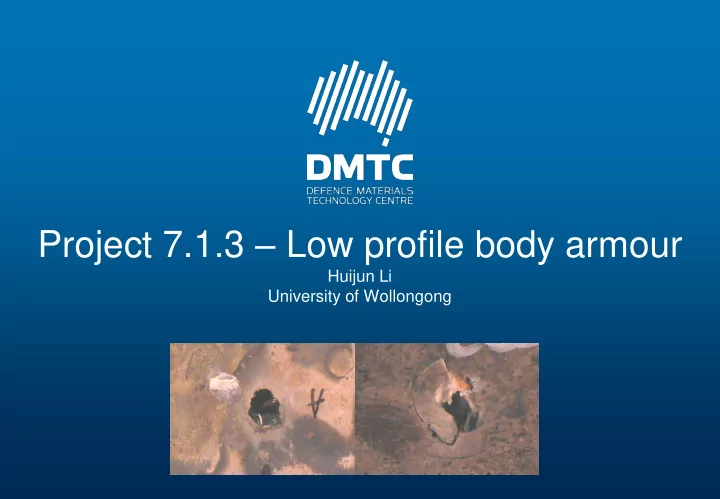
Project 7.1.3 Low profile body armour Huijun Li University of - - PowerPoint PPT Presentation
Project 7.1.3 Low profile body armour Huijun Li University of Wollongong April 7, 2009 Capability through collaboration 2 Company overview 3 Company overview 4 Business model and governance 5 Personnel survivability DMTC - Program 7
Capability through collaboration
April 7, 2009
Huijun Li University of Wollongong
2
3
4
5
6
7
8
9
10
11
12
13
14
15
16
17
18
19
20
21
22
23
24
25
Design and develop a fitted smart- textiles compression layer to enhance comfort, breathability and overall muscle recovery. For female personnel, this layer will also include built breast support. Use a 3D body scanner to inform 3D printer designs: Namely, design and develop computational program capabilities to convert a 3D body scan into a 3D printed Advanced Armour Lining. Design and develop a 3D printed Advanced Armour Lining and integrate with a Low Profile Steel Plate, to create a light-weight, functionally flexible, Advanced Personnel Armour System, which offers the ultimate in next-generation ballistic protection. End Product: A layered system comprising of smart-textiles for comfort and support, and a light-weight, functionally flexible, 3D printed Advanced Armour Lining with a Low Profile Steel Plate, custom designed to each soldier’s individual body scan specifications.
26
BIOMECHANICAL ASSESSMENT OF THE ADVANCED PERSONNEL ARMOUR SYSTEM Once developed, the “bio-impact” of the Advanced Personnel Armour System will be tested using an integrative biomechanical analysis to ascertain: (i) maneuverability in the Advanced Personnel Armour System while performing functional tasks; and (ii) (ii) the physiological and biomechanical responses of a soldier while wearing the Advanced Personnel Armour System to ballistic impact (with different projectiles and speeds). This will be done by integrating high speed camera footage; 3D motion analysis; physiological responses (heart rate, blood pressure and thermoregulation); pressure measurements between the soldier and armour system interface; and mathematical modelling.
27
Female-specific Body Armour: The role of women in the military is substantially increasing. In both Australia and the USA the ban for women serving in frontline combat roles was lifted on1st January 2013; opening for the first time in history, options for women in the artillery, armoured, infantry and engineering units of the Army. By utilising the proposed body scan techniques for an Advanced Armour Lining, this project will ensure women moving into combat roles have the ultimate in body protection, without compromising fit due to their significantly different anthropometric structure relative to their male counterparts.
28
29