Progress report of development of a Skyrme QRPA code for deformed - - PowerPoint PPT Presentation

progress report of development of a skyrme qrpa code for
SMART_READER_LITE
LIVE PREVIEW

Progress report of development of a Skyrme QRPA code for deformed - - PowerPoint PPT Presentation

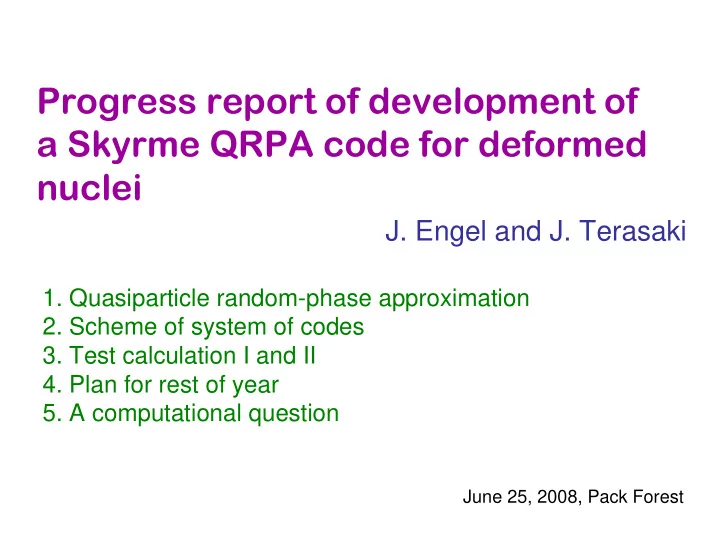
Progress report of development of a Skyrme QRPA code for deformed nuclei J. Engel and J. Terasaki 1. Quasiparticle random-phase approximation 2. Scheme of system of codes 3. Test calculation I and II 4. Plan for rest of year 5. A


slide-1
SLIDE 1

Progress report of development of a Skyrme QRPA code for deformed nuclei

  • J. Engel and J. Terasaki
  • 1. Quasiparticle random-phase approximation
  • 2. Scheme of system of codes
  • 3. Test calculation I and II
  • 4. Plan for rest of year
  • 5. A computational question

June 25, 2008, Pack Forest

slide-2
SLIDE 2

− =

+ + + ij i j ij j i ij

a a Y a a X O ˆ

HFB calculation Introduce a creation operator of an excited state:

ij

X

ij

Y

creation operator of quasiparticle and QRPA equation Eigenvalue equation linear in and . eigenvalue = excitation energy

ij

X

ij

Y

Quasiparticle random-phase approximation

slide-3
SLIDE 3

Scheme of system of codes

HFB calculation with HFBTHO, M. Stoitsov et al., Computer Physics Communications 167 (2005) 43.

We use HO basis for our tests.

Interface code to convert output of HFBTHO to input for our code

quasiparticle wave functions, energies, and auxiliary information

Calculation of interaction matrix elements Diagonalization of QRPA-Hamiltonian matrix

with ScaLAPACK

slide-4
SLIDE 4

Test calculation I

Comparison of interaction energies produced by HFBTHO and those by our code Our code has subprograms to calculate matrix elements of interactions from quasiparticle wave functions developed independently of HFBTHO

16O, SkP, 20 spherical HO shells, no deformation, no pairing gap

Components of energy in MeV

Et0 Et1 Et2 Et3

HFBTHO –1476.285 83.596 –39.177 1075.713 Our code –1476.285 83.595 –39.176 1075.713

slide-5
SLIDE 5

ESO ECoul-dir ECoul-ex Eint

HFBTHO –0.662 16.261 –2.776 –343.331 Our code –0.662 16.176 –2.776 –343.415

slide-6
SLIDE 6

Test calculation II

Separation of spurious states from real excited states

  • Rotation, Kπ=±1+ (J=2)
  • Rotation in a gauge space (particle number), Kπ=0+ (J=0)
  • Translation, Kπ=0–, ±1– (J=1)

Spurious states (E=0) appear in solutions of QRPA, and real excited states do not have the spurious components, if

  • HFB state breaks symmetries,
  • wave-function space conserves the symmetries,
  • HFB and QRPA equations are solved accurately

with the same H and quasiparticle wave-function space. Test calculations are in small spaces;

  • dim. of QRPA Hamiltonian matrix < 700

We can check spurious states with Kπ =0+ and Kπ =±1+ in spaces of this size.

slide-7
SLIDE 7

26Mg, SkP, volume-type pairing, 3 spherical HO shells

β=0, ∆p=1.681 MeV, ∆n= 1.426 MeV Kπ=0+ Eigenvalues of QRPA (MeV) 0.008 0.024 2.582 3.330 3.444 3.649 … “Particle-number transition strength”

slide-8
SLIDE 8

24Mg, SkP, volume-type pairing, 5 spherical HO shells

β=0.28, ∆p=0.034 MeV, ∆n= 0.131 MeV Kπ=1+ Eigenvalues of QRPA (MeV) 0.045 2.672 2.696 2.877 3.359 4.119 … Strength function not quite ready Code passes all these tests.

slide-9
SLIDE 9

Plan for rest of year

  • Parallelize calculation of interaction matrix elements

Dimension of QRPA Hamiltonian matrix for 24Mg, Kπ=1+ was 700, and it took 24 hours to get interaction matrix elements with a single processor.

  • Implement calculation of strength functions.
  • Prepare systematic calculations of even-even nuclei

across the entire table of isotopes.

Is it possible without sacrificing accuracy?

After that

See talk by M. Horoi

slide-10
SLIDE 10

A computational question

QRPA equation

∑ ∑

⎟ ⎟ ⎠ ⎞ ⎜ ⎜ ⎝ ⎛ ⎟ ⎟ ⎠ ⎞ ⎜ ⎜ ⎝ ⎛ − = ⎟ ⎟ ⎠ ⎞ ⎜ ⎜ ⎝ ⎛ ⎟ ⎟ ⎠ ⎞ ⎜ ⎜ ⎝ ⎛ ′

ςξ ςξ ςξ µν ςξ ςξ ςξ µν

ω Y X I O O I Y X A B B A

T ? ?

h

A and A´ are Hermitian; all are real.

ScaLAPACK diagonalization subroutine pdsygvx solves

x x U T λ = matrix definite positive and symmetric : matrix symmetric : U T

A T ⎟ ⎟ ⎠ ⎞ ⎜ ⎜ ⎝ ⎛ − = I O O I with subroutine this use We We would like a better method.