Program-level Assessment Committee (PAC) Meeting Minutes April 1, - - PDF document

program level assessment committee pac meeting minutes
SMART_READER_LITE
LIVE PREVIEW

Program-level Assessment Committee (PAC) Meeting Minutes April 1, - - PDF document

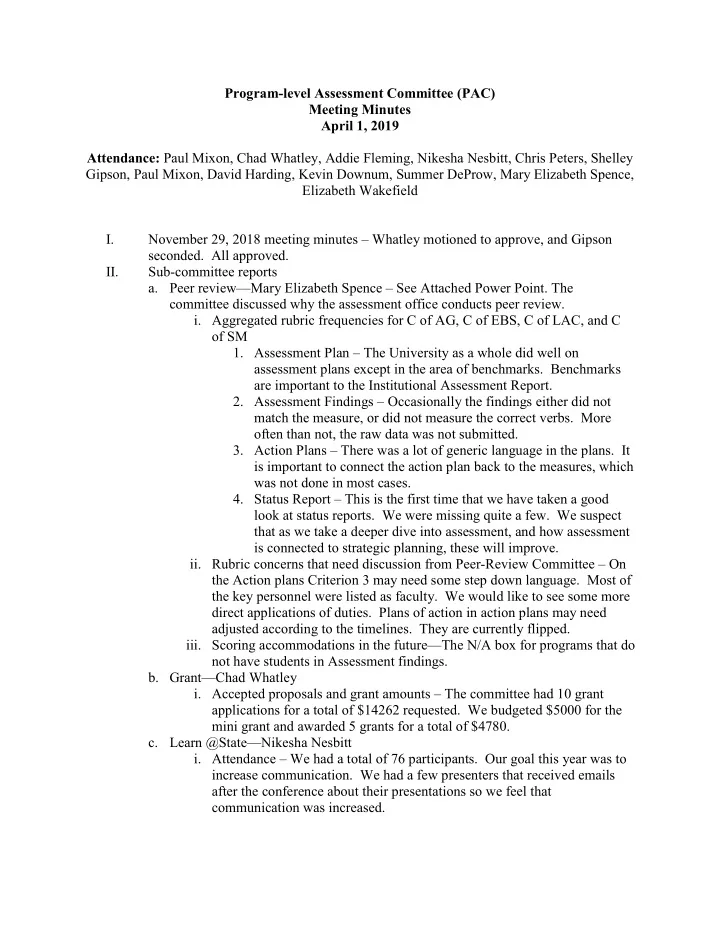
Program-level Assessment Committee (PAC) Meeting Minutes April 1, 2019 Attendance: Paul Mixon, Chad Whatley, Addie Fleming, Nikesha Nesbitt, Chris Peters, Shelley Gi p son, Paul Mixon, David Harding, Kevin Downum, Summer DeProw, Mary Elizabeth


slide-1
SLIDE 1

Program-level Assessment Committee (PAC) Meeting Minutes April 1, 2019 Attendance: Paul Mixon, Chad Whatley, Addie Fleming, Nikesha Nesbitt, Chris Peters, Shelley Gipson, Paul Mixon, David Harding, Kevin Downum, Summer DeProw, Mary Elizabeth Spence, Elizabeth Wakefield I. November 29, 2018 meeting minutes – Whatley motioned to approve, and Gipson

  • seconded. All approved.

II. Sub-committee reports a. Peer review—Mary Elizabeth Spence – See Attached Power Point. The committee discussed why the assessment office conducts peer review.

  • i. Aggregated rubric frequencies for C of AG, C of EBS, C of LAC, and C
  • f SM
  • 1. Assessment Plan – The University as a whole did well on

assessment plans except in the area of benchmarks. Benchmarks are important to the Institutional Assessment Report.

  • 2. Assessment Findings – Occasionally the findings either did not

match the measure, or did not measure the correct verbs. More

  • ften than not, the raw data was not submitted.
  • 3. Action Plans – There was a lot of generic language in the plans. It

is important to connect the action plan back to the measures, which was not done in most cases.

  • 4. Status Report – This is the first time that we have taken a good

look at status reports. We were missing quite a few. We suspect that as we take a deeper dive into assessment, and how assessment is connected to strategic planning, these will improve.

  • ii. Rubric concerns that need discussion from Peer-Review Committee – On

the Action plans Criterion 3 may need some step down language. Most of the key personnel were listed as faculty. We would like to see some more direct applications of duties. Plans of action in action plans may need adjusted according to the timelines. They are currently flipped.

  • iii. Scoring accommodations in the future—The N/A box for programs that do

not have students in Assessment findings.

  • b. Grant—Chad Whatley
  • i. Accepted proposals and grant amounts – The committee had 10 grant

applications for a total of $14262 requested. We budgeted $5000 for the mini grant and awarded 5 grants for a total of $4780. c. Learn @State—Nikesha Nesbitt

  • i. Attendance – We had a total of 76 participants. Our goal this year was to

increase communication. We had a few presenters that received emails after the conference about their presentations so we feel that communication was increased.

slide-2
SLIDE 2
  • ii. General impressions of the event – The event went smoothly, and the food

was good. Next year, we hope to partner with Dr. Jill Simons to include Teaching and Learning in the conference.

  • d. Professional Development—Summer DeProw
  • i. Wolves in Action summer program – The Office of Assessment would like

to develop a program to fund and facilitate curriculum and co-curricular changes on campus. We need faculty and staff that are willing and ready to make changes. Important Dates June 15, 2019:

  • Check outcome rotation—Are your programs going to assess all outcomes in four years

beginning in 2015-16 through 2018-19?

  • Update programs’ curriculum maps
  • Report 2018-19 assessment data in the “Assessment Findings” section of Taskstream
slide-3
SLIDE 3

Peer Review 2017-2018

Spring 2019 Presentation

Office of Assessment Program Assessment Committee

slide-4
SLIDE 4

Why Were the Assessment Reports Peer Reviewed?

 Check the Assessment Office’s work

 Taskstream setup  Assessment reporting

 Ensure the effectiveness of communication regarding assessment efforts  Confirm substantiating evidence supported assessment findings  Offer constructive criticism where the faculty believed it was needed  Accountability and transparency

slide-5
SLIDE 5

What Was Peer Reviewed?

 2017-18 Assessment Reports

 Assessment Plans – 88 Workspaces  Assessment Findings (including Data) – 84 Workspaces  Action Plans – 82 Workspaces

 2016-17 Assessment Reports

 Status Reports – 62 Workspaces

slide-6
SLIDE 6

Who Were the Peer Reviewers?

 Program Assessment Committee (PAC) was divided into four sub-committees:

 Professional Development Committee  Grant Committee  Peer Review Instrument Committee  Learn@State Committee

 Conflict of interest was avoided  Each sub-committee member is faculty from another college/unit

slide-7
SLIDE 7

How Were the Assessment Reports Reviewed?

 Rubrics were developed and a revised rubric implemented for the plan, findings (data), action plan and status report  Four-point scale was used  Overall score for each rubric was calculated  Group scored so the rubric was normed during the scoring and any disagreements were discussed and reconciled

slide-8
SLIDE 8

Scores: When to Act?

 Goal: To score a 4 on all rows of the rubrics  Please read all comments regardless of score  Scores of 3 should be taken into consideration  Scores of 1 or 2 should be taken seriously and improvements implemented as quickly as possible  Please consider using the Assessment Office Grant if you need financial assistance  Please reach out to the Assessment Office for advice  If the program has a specialized accreditor, consider hiring an expert consultant for additional review

slide-9
SLIDE 9

Campus Summary- Assessment Plan

Criterion 1: Alignment between Outcome and Measure Criterion 2: Measures Criterion 3: Benchmark

Percentages at 4 61.36%

54/88

22.73%

20/88

26.14%

23/88

Percentages at 3 15.91%

14/88

39.77%

38/88

15.91%

14/88

Percentages at 2 15.91%

14/88

27.27%

24/88

9.09%

8/88

Percentages at 1 6.82%

6/88

6.82%

6/88

48.86%

43/88

slide-10
SLIDE 10

Campus Summary- Assessment Findings

Criterion 1: Data Reported Criterion 2: Substantiating Evidence Criterion 3: Analysis/ Interpretation Percentages at 4 41.67%

35/84

35.71%

30/84

19.04%

16/84

Percentages at 3 20.24%

17/84

21.43%

18/84

44.05%

37/84

Percentages at 2 19.04%

16/84

16.67%

14/84

14.29%

12/84

Percentages at 1 19.04%

16/84

26.19%

22/84

22.62%

19/84

slide-11
SLIDE 11

Campus Summary-Action Plans

Criterion 1: Recommendations Criterion 2: Plans for Action Criterion 3: Faculty Involvement Percentages at 4 40.24%

33/82

39.02%

32/82

79.27%

65/82

Percentages at 3 25.61%

21/82

23.17%

19/82

X Percentages at 2 13.41%

11/82

17.07%

14/82

X Percentages at 1 20.73%

17/82

20.73%

17/82

20.73%

17/82

slide-12
SLIDE 12

Campus Summary-Status Report

Scenario A: Met Scenario B: Not Met Scenario C: Process Percentages at 4 50.00%

12/24

57.14%

4/7

51.61%

16/31

Percentages at 3 16.67%

4/24

0.00%

0/7

22.58%

7/31

Percentages at 2 29.17%

7/24

14.29%

1/7

12.90%

4/31

Percentages at 1 4.17%

1/24

28.57%

2/7

12.90%

4/31

slide-13
SLIDE 13

Potential Rubric Changes

 Plan

 Alignment from Measure to Outcome difficult in some Education Unit and potentially in CNHP programs where workspaces are “flipped”  Others?

 Findings

 Addition of ”N/As” for those who report no students/graduates  Others?

 Action Plan

 Timeline language step-down in “Plan for Action” row  More clearly defined language in “Faculty Involvement” row, rather than just delineated/not delineated  Others?

slide-14
SLIDE 14

Next Steps

 Program workspaces with majority of 1s and 2s will be contacted by Assessment Office to discuss results, implications and how to move forward  Program workspaces that are excellent will also be notified (publicly?) to be recognized for their work  Assessment Office will continue to add the general findings of the reviews to “tips” documents and face-to-face meetings to improve Assessment reporting across campus