PROFILING STUDENTS AT RISK FOR ACADEMIC Retention = Early - - PDF document

profiling students at risk for academic
SMART_READER_LITE
LIVE PREVIEW

PROFILING STUDENTS AT RISK FOR ACADEMIC Retention = Early - - PDF document

SDS Assessment Centre Seidmans (2005) formula for student success PROFILING STUDENTS AT RISK FOR ACADEMIC Retention = Early


slide-1
SLIDE 1
  • PROFILING STUDENTS AT

RISK FOR ACADEMIC UNDERACHIEVEMENT

Seidman’s (2005) formula for student success

Retention = Early Identification + (Early + Intensive + Continuous) Intervention

SDS Assessment Centre

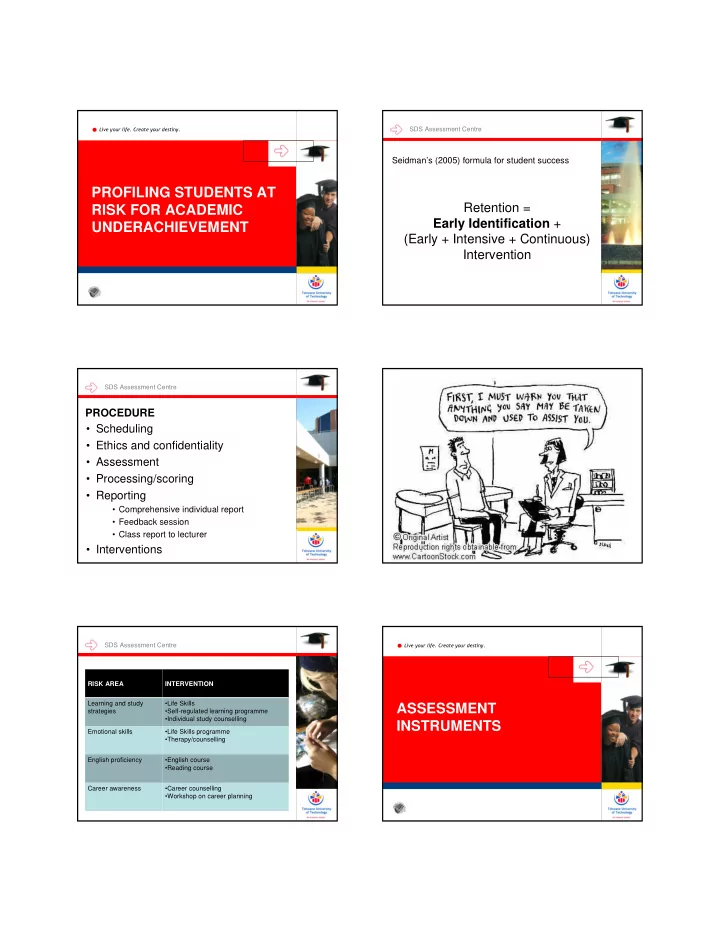
PROCEDURE

SDS Assessment Centre

  • Scheduling
  • Ethics and confidentiality
  • Assessment
  • Processing/scoring
  • Reporting
  • Comprehensive individual report
  • Feedback session
  • Class report to lecturer
  • Interventions

SDS Assessment Centre RISK AREA INTERVENTION Learning and study strategies

  • Life Skills
  • Self-regulated learning programme
  • Individual study counselling

Emotional skills

  • Life Skills programme
  • Therapy/counselling

English proficiency

  • English course
  • Reading course

Career awareness

  • Career counselling
  • Workshop on career planning
  • ASSESSMENT

INSTRUMENTS

slide-2
SLIDE 2

Assessment Battery

  • Learning and Study Strategies Inventory (LASSI)

Weinstein & Palmer

  • Emotional Skills Assessment Process (ESAP)

Nelson & Low

  • English Literacy Skills Assessment (ELSA)

Hough & Horne

  • Career choice questionnaire

SDS Assessment Centre

LASSI

SDS Assessment Centre

Skill Will Self-regulation Information Processing Anxiety Concentration Selecting Main Ideas Attitude Self-testing Test Strategies Motivation Study Aids Time Management

LASSI SCORES

SDS Assessment Centre

0 - 50 Need to improve skills to avoid serious problems in succeeding at TUT 50 - 75 Consider improving strategies for that scale 75 - 100 Do not have to prioritise improving strategies in that area

Emotional Skills Assessment Process (ESAP)

SDS Assessment Centre

EMOTIONAL SKILLS PROBLEM AREAS Interpersonal Leadership Self- management Intrapersonal Self- management Assertion Comfort / Social Awareness Drive Strength Self Esteem Aggression Empathy Time Management Stress Management Deference Decision Making Commitment Ethic Change

  • rientation

Positive Influence

Emotional Skills Profile

  • Develop
  • Strengthen
  • Enhance

>2 skill areas in the “Develop” area, a student will require assistance Potential problem areas profile

  • Low
  • Normal
  • High

ESAP SCORES

SDS Assessment Centre

  • Knowledge about the course
  • Careers
  • Choice
  • Fit
  • General satisfaction

CAREER CHOICE QUESTIONNAIRE

SDS Assessment Centre

slide-3
SLIDE 3

ENGLISH LITERACY SKILLS ASSESSMENT (ELSA)

SDS Assessment Centre

  • ELSA Scanner Intermediate
  • Abridged version of the ELSA intermediate
  • Two scales
  • Cloze procedures
  • Vocabulary in context

ELSA SCORES

SDS Assessment Centre

  • Below Grade 8
  • Grade 8 or 9
  • Grade 10 or 11
  • Grade 12 or 12+
  • RESULTS

AVERAGE LASSI SCORES

SDS Assessment Centre

ESAP Emotional Skills

SDS Assessment Centre

24 13 18 18 16 37 16 18 35 22 10 20 30 40 50 60

ASSERTION COMFORT EMPATHY DECISION MAKING POSITIVE INFLUENCE DRIVE STRENGTH TIME MANAGEMENT COMMITMENT ETHIC SELF-ESTEEM STRESS MANAGEMENT

ENHANCE STRENGTHEN DEVELOP Average

slide-4
SLIDE 4

ESAP Potential Problem Areas

SDS Assessment Centre

English Literacy Skills Assessment (ELSA)

SDS Assessment Centre

LASSI Students at risk

SDS Assessment Centre

ESAP Students at risk

SDS Assessment Centre

FUTURE DIRECTIONS

SDS Assessment Centre

  • Standardisation – TUT norms
  • Determine risk profiles
  • Financial utility

SDS Assessment Centre

SHAFEEKA DOCKRAT dockrats@tut.ac.za 012 382 5076