Proficiency and Depiction entity or event (the signer uses space, - - PowerPoint PPT Presentation

proficiency and depiction
SMART_READER_LITE
LIVE PREVIEW

Proficiency and Depiction entity or event (the signer uses space, - - PowerPoint PPT Presentation

Depiction (Dudis 2011, 2007) The visual (spatial) representation of an entity or event ~ by using something other than the actual Proficiency and Depiction entity or event (the signer uses space, articulators, face, body...) (See also Liddell


slide-1
SLIDE 1

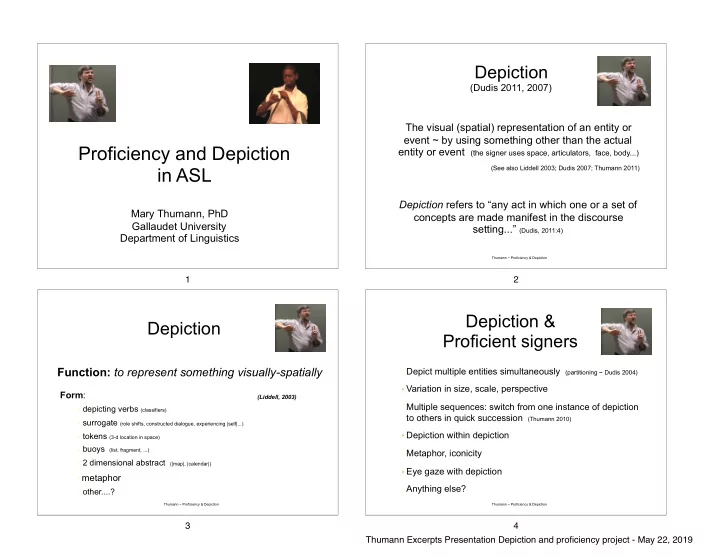
Proficiency and Depiction in ASL

Mary Thumann, PhD Gallaudet University Department of Linguistics

1

Thumann ~ Proficiency & Depiction

Depiction

(Dudis 2011, 2007)

The visual (spatial) representation of an entity or event ~ by using something other than the actual entity or event (the signer uses space, articulators, face, body...)

(See also Liddell 2003; Dudis 2007; Thumann 2011)

Depiction refers to “any act in which one or a set of concepts are made manifest in the discourse setting...” (Dudis, 2011:4)

2

Thumann ~ Proficiency & Depiction

Depiction

Form:

  • depicting verbs (classifiers)
  • surrogate (role shifts, constructed dialogue, experiencing |self|...)
  • tokens (3-d location in space)
  • buoys (list, fragment, ...)
  • 2 dimensional abstract (|map|, |calendar|)
  • metaphor
  • other....?

Function: to represent something visually-spatially

(Liddell, 2003)

3

Thumann ~ Proficiency & Depiction

  • Depict multiple entities simultaneously (partitioning ~ Dudis 2004)
  • Variation in size, scale, perspective
  • Multiple sequences: switch from one instance of depiction

to others in quick succession (Thumann 2010)

  • Depiction within depiction
  • Metaphor, iconicity
  • Eye gaze with depiction
  • Anything else?

Depiction & Proficient signers

4 Thumann Excerpts Presentation Depiction and proficiency project - May 22, 2019

slide-2
SLIDE 2

Thumann ~ Proficiency & Depiction

*Examining the Use of Depiction across American Sign Language Proficiency Interview (ASLPI) Assessment Levels The aim of this pilot project is to compare depiction usage between groups

  • f signers at various levels of proficiency

*This project approved by Gallaudet University IRB

5

Thumann ~ Proficiency & Depiction

Research Questions

1) What types of depiction occur in the language use of signers at various levels of proficiency? 2) What is the frequency of occurrence of these types of depiction in the language use of signers at various levels of proficiency on the ASLPI? 3) How does depiction usage compare among signers of different ASLPI levels?

Examining the Use of Depiction across ASLPI Assessment Levels 6

Thumann ~ Proficiency & Depiction

Methodology

Qualitative

  • describe differences in types of depiction and form of

depiction Quantitative

  • # of instances of depiction identified in each sample
  • # of types of depiction identified in each sample
  • compare the number of instances of each type of depiction

ELAN

Depiction Identification Flow Chart 4.9.2 Using ELAN and Dudis’ Depiction Identification Flow Chart 4.9.2, analyze the occurrence of depiction in signers at each level of ASLPI

7

Thumann ~ Proficiency & Depiction

Organized based on a series of questions:

  • is there an experiencing |self| in the depiction
  • is an event depicted without a |self|
  • are 3-d relationships or dimensions of concrete objects

depicted

  • are timelines, buoys, tokens or vertical planes depicted

(see Depiction Identification Flowchart 4.9.2)

Categories of Depiction

Flowchart 4.9.2 (Dudis, 2014, p.c.) 8 Thumann Excerpts Presentation Depiction and proficiency project - May 22, 2019

slide-3
SLIDE 3

Thumann ~ Proficiency & Depiction

Possible differences between ASLPI levels

  • Frequency of depiction
  • Whether or not signer “takes advantage of”
  • pportunities to make things visual/spatial (to

depict)

  • Number of switches between depiction and

depiction types

  • Partitioning
  • Use of metaphor
  • ...

9

PROFICIENT SIGNERS

High number of instances of depiction: 18 - 23 DPMs Frequent variation in types of depiction variation in vantage point variation in size, scale varying types of depiction Efficiency & creativity with depictions (e.g. personification) Easily and frequently switches between tokens, surrogates, buoys, etc. More sequences of depiction; subtle switches, efficient movements and sign production

10

Average number of instances of depiction

at various levels of proficiency in @ 15 - 18 minutes of signing

Depiction ASLPI 0, 1 and 2 ASLPI 2+ and 3 ASLPI 3+ and 4 Level 4+ and 5 average # instances 66 in 15 minutes 126 in 16 minutes 205 in 17 minutes

397

(18 minutes) average DPM 3.9 7.7 11.5

22

Depiction & Proficiency pilot study ASLPI Level 4+ and 5

397

(18 minutes)

22

11

Type of depiction

ASLPI 0, 1 and 2 ASLPI 2+ and 3 ASLPI 3+ and 4

ASLPI Level 4+ and 5 tokens

18 32 80

162 buoys

11 11 20

32 surrogates

11.3 27 50

121 depicting verbs

20 27 25

71.5 2-d**

0.5 3 5

3**

PRELIMINARY NUMBERS

TYPES AND NUMBER OF INSTANCES OF DEPICTION

@ 15 - 18 minutes of signing

12 Thumann Excerpts Presentation Depiction and proficiency project - May 22, 2019

slide-4
SLIDE 4

PRELIMINARY TRENDS IDENTIFIED

Average #s 0, 1 and 2 2+ and 3 3+ and 4 4+ and 5 average # instances of depiction 66 in @15 minutes 126 in @ 16 minutes 205 in @ 17 minutes 397 in @ 18 minutes average DPM 3.9 7.7 11.5 22 # sequences of depiction 7.3 (sequence

  • f 4)

10 (sequence

  • f 5)

29 (sequence

  • f 5)

75 (sequence

  • f 12- 15)

surrogate 11.3 27 50 121 token space 18 32 80 162 dv 20 27 25 71.5 buoys 11 11 20 32

13

SEQUENCES OF DEPICTION

ASLPI Level Total # longest sequence 2 in row 3 in row 4 in row 5 in row 6 - 12 in row

6 4 3 1

  • 1

13 3 11 2

  • 2

10 5 7 1 2

  • 3

19 4 13 4 2

  • 4

40 5 31 7 1 1

  • 5

69 12 11 8 2 2 1

14

Thumann ~ Proficiency & Depiction

Preliminary Observations

Even someone assessed at ASLPI 0+ had instances

  • f depiction
  • list buoy
  • depicting verbs (e.g. |pyramid|)
  • role shift (e.g. |teacher|)
  • appropriate eye gaze (not consistent)
  • produce signs in locations in space (DIFFERENT ++)

Depiction produced by signers assessed at every level

  • f proficiency.

15

Thumann ~ Proficiency & Depiction

Levels 0 - 1

Fewer instances of depiction

  • in @ 13 minutes of signing, one signer produced 55 instances that could

be counted as depiction = DPM of 4 per minute

  • DPM ranges 15 - 20 (Dudis, pc; Thumann, 2010) in 12 minutes = 195 - 260

Types of depiction

  • tokens, depicting verbs (classifiers), role shift, list buoy, 2-d map

Differences

  • efficiency of depiction, # of different types, switches...
  • memorized constructions rather than spontaneous depictions?

Preliminary observations

16 Thumann Excerpts Presentation Depiction and proficiency project - May 22, 2019

slide-5
SLIDE 5

Thumann ~ Proficiency & Depiction

Levels 2 - 3

Differences in

  • frequency of depiction
  • varying types of depiction
  • use of eye gaze (not consistent)
  • partitioning
  • efficiency (e.g., role shifts)

Preliminary observations

17

Thumann ~ Proficiency & Depiction

Levels 4 - 5

  • both have high DPMs
  • frequent switches, varying types, etc.

Difference in their ASLPI levels might be due to something completely unrelated to depiction.

Preliminary observations

18

Thumann ~ Proficiency & Depiction

ASLPI level 0 - 1

Depiction appears to be limited, perhaps “memorized” constructions

  • f the type learned in beginning ASL

classes: classifiers/depicting verbs, some use of space (pointing) and role shifting.

19

Thumann ~ Proficiency & Depiction

*Examining the Use of Depiction across ASLPI Assessment Levels

Special thanks to

Participants wiling to share their ASLPI videos

  • Dr. Paul Dudis

Gallaudet University - The ASLPI Gallaudet University Priority Research Grant Research Assistants

*This project approved by Gallaudet University IRB

20 Thumann Excerpts Presentation Depiction and proficiency project - May 22, 2019

slide-6
SLIDE 6

Thumann ~ Proficiency & Depiction

Thank you!

mary.thumann@gallaudet.edu Department of Linguistics Gallaudet University

21

Thumann ~ Proficiency & Depiction

The ASLPI website: http://www.gallaudet.edu/asldes.html Clark, H. & Gerrig, R. (1990). Quotations as demonstrations. Language, Volume 66, Issue 4, pp. 764 – 805. Coulson, S. (2001). Semantic leaps, frame shifting and conceptual blending in meaning

  • construction. Cambridge: Cambridge University Press. P. 267 – 282.

Dudis, P. (2002). Grounded blends as a discourse strategy. In Ceil Lucas, (ed.), Turn taking, fingerspelling, and contact in signed languages. Washington, DC: Gallaudet University Press, 53-72. Dudis, P. (2004). Body partitioning and real-space blends. Cognitive Linguistics 15-2, 223-238. Dudis, P. (2007). Types of depiction in ASL. Downloaded from http://drl.Gallaudet.edu Dudis, P. (2011). The body in scene depictions. In C. Roy (Ed.) Discourse in signed languages (pp. 46-66). Washington, DC: Gallaudet University Press. Fauconnier, G. (1994). Mental spaces aspects of meaning construction in natural language. Cambridge: Cambridge University Press. Janzen, T. (2004). Space rotation, perspective shift, and verb morphology in ASL. Cognitive Linguistics, 15-2, pp. 149 - 174. Liddell, S. (2003). Grammar, gesture, and meaning in American Sign Language. Cambridge: Cambridge University Press.

Nilsson, A. (2010). Real space blends in Swedish Sign Language as an indicator of discourse complexity in relation to interpreting. Unpublished dissertation chapter. Stockholm University.

Reference List

22

Thumann ~ Proficiency & Depiction

Taub, Sarah (2001). Language from the body: Iconicity and Metaphor in American Sign

  • Language. New York, NY: Cambridge University Press.

Thumann, M. (2013). Identifying recurring depiction in ASL presentations. Sign Language Studies, Volume 13, #3, pp. 316-339. Thumann, M. (2011). Identifying depiction: Constructed action and constructed dialogue in ASL

  • presentations. In C. Roy (Ed.) Discourse in signed languages (pp. 46-66). Washington, DC:

Gallaudet University Press. Thumann, M. (2010). Identifying depiction in ASL presentations. Unpublished Doctoral

  • Dissertation. Gallaudet University, Washington D.C.

Van Hoek, K. (1996). Conceptual locations for reference in American Sign Language. In Fauconnier and Sweetzer, Spaces, worlds and grammar, Chicago: The University of Chicago Press, pp. 334-350. Wilcox, Phyllis P. (2000). Metaphor in American Sign Language. Washington DC: Gallaudet University Press. Winston, E. (1995). Spatial mapping in comparative discourse frames. In Language, gesture, and space, Karen Emmorey, and Judy S. Reilly (Eds.), 87-114. Hillsdale, NJ: Lawrence Erlbaum. Winston, E (1991a). Spatial referencing and cohesion in an American Sign Language text. Sign Language Studies, 73: 397-409. Winston, E. (1991b). Space and involvement in an American Sign Language lecture. In Jean Plant-Moeller (ed.) Expanding horizons: Proceedings of the twelfth national convention of the Registry of Interpreters for the Deaf August 6-11, 1991. Silver Spring, MD: RID Publications, pp. 93-105.

Reference List

23 Thumann Excerpts Presentation Depiction and proficiency project - May 22, 2019