nationalism and describe the Catholic Churchs role during the Middle - - PowerPoint PPT Presentation

nationalism and describe the catholic church s role
SMART_READER_LITE
LIVE PREVIEW

nationalism and describe the Catholic Churchs role during the Middle - - PowerPoint PPT Presentation

Students will be able to describe the transition from feudalism to nationalism and describe the Catholic Churchs role during the Middle Ages. Far Proficiency Exceeds Proficiency Approaching Proficiency Below Proficiency Bel Level 4


slide-1
SLIDE 1

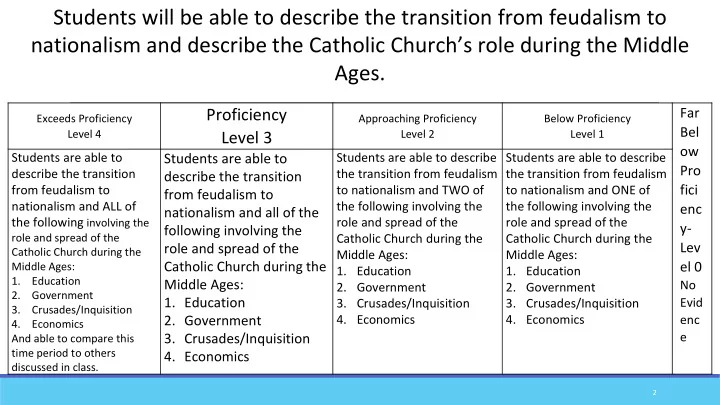
Students will be able to describe the transition from feudalism to nationalism and describe the Catholic Church’s role during the Middle Ages.

Exceeds Proficiency Level 4

Proficiency Level 3

Approaching Proficiency Level 2 Below Proficiency Level 1

Far Bel

  • w

Pro fici enc y- Lev el 0

No Evid enc e Students are able to describe the transition from feudalism to nationalism and ALL of the following involving the

role and spread of the Catholic Church during the Middle Ages: 1. Education 2. Government 3. Crusades/Inquisition 4. Economics And able to compare this time period to others discussed in class.

Students are able to describe the transition from feudalism to nationalism and all of the following involving the role and spread of the Catholic Church during the Middle Ages:

  • 1. Education
  • 2. Government
  • 3. Crusades/Inquisition
  • 4. Economics

Students are able to describe the transition from feudalism to nationalism and TWO of the following involving the role and spread of the Catholic Church during the Middle Ages:

  • 1. Education
  • 2. Government
  • 3. Crusades/Inquisition
  • 4. Economics

Students are able to describe the transition from feudalism to nationalism and ONE of the following involving the role and spread of the Catholic Church during the Middle Ages:

  • 1. Education
  • 2. Government
  • 3. Crusades/Inquisition
  • 4. Economics

2

slide-2
SLIDE 2

ISN: 4th Quarter Table of Contents

Left Side Page Right Side Page

Ancient Rome Study Guide

40

Ancient Rome Test

41

Middle Ages Learning Goal & Scales 42 Anticipatory Guide for Feudal Europe 43 The Emergence of Feudalism 44 Feudal Pyramid of Power 45 Personal Coat of Arms Directions 46 FINAL Coat of Arms 47 The Transition from Feudalism to Nationalism 48 Feudalism to Nationalism Partner Paragraph 49 Concept Map- Edu & Gov’t 50 Christianity- Edu/Gov’t 51 Christianity, Crusades/Econ, Inq. 52 Middle Ages Test 53

4

slide-3
SLIDE 3

Students will be able to describe the transition from feudalism to nationalism and describe the Catholic Church’s role during the Middle Ages.

MIDDLE AGES LEARNING GOAL

5

slide-4
SLIDE 4

Today’s Learning Target to Reach Our Goal!

Students will be able to describe the transition from feudalism to nationalism.

6

slide-5
SLIDE 5

Anticipatory Guide for Feudal Europe- Changes to Europe after the Fall of Rome

Directions: Number your ISN , on PAGE 43 , from #1-5 and write agree or disagree next to each statement if you think it was a change that occurred after the Fall of Rome.

  • 1. Increase in the size and power of government
  • 2. Reduction in the long-distance trade
  • 3. Increase in learning and devotion to Greek and Roman

culture

  • 4. Rise of cities and disappearance of rural villages and

farms

  • 5. Political disorder and constant warfare led to the

development of feudalism in Europe

7

slide-6
SLIDE 6

The Middle Ages Begin

Middle Ages-1,000 year period ( 500-1450)in Europe after the fall of Rome, it is also called the medieval period.

Changes to Europe after the Fall of Rome- Answers

1. DISAGREE, a DECLINE in the size and power of government 2. AGREE, REDUCTION in the long-distance trade 3. DISAGREE, a DECLINE in learning and devotion to Greek and Roman culture 4. DISAGREE, a DISAPPEARANCE of cities and a RISE of rural villages and farms 5. AGREE, Political disorder and constant warfare led to the development of feudalism in Europe

All of these changes led to the rise of feudalism; the need for kings and nobles to secure their land amidst instability and warfare.

8

slide-7
SLIDE 7

Big Ideas about Feudal Europe

❖After the fall of Rome, a political and social system called feudalism developed in Europe. ❖Many societies rely on family roles and social classes to keep order. ❖Feudal society was divided into well–defined classes.

❖At the top were kings and wealthy landowners. ❖At the bottom were peasants, many of whom worked for the landowners.

9

slide-8
SLIDE 8

The Emergence of Feudalism Notes for ISN p. 44

▪Warfare and the constant threat of invasion led to the creation of a political and social system known as feudalism. Feudalism emerged largely as a way for kings and nobles to hold onto their land and power during so much warfare. ▪Feudalism was based on an agreement between two groups of nobles—lords and vassals. A lord was a powerful noble who owned land. Lords gave pieces of their land to lesser nobles called vassals. These plots of land were called fiefs. In return for the land, the vassal owed his lord service in his court and army. Many vassals were warriors known as knights. Thus, they fought on behalf of the lord. Other vassals hired knights to defend the lord and his property. Vassals also paid taxes to their lord in return for their fief (land).

10

slide-9
SLIDE 9

Copy information on handout- ISN P.45

12

slide-10
SLIDE 10

➢Kings and nobles created a new system to keep their power during all of the chaos/war ➢New system known as feudalism; based on agreements between two groups of nobles: lords and vassals ➢Lords – powerful land owning nobles; gave land to vassals (lesser nobles) ➢In return, vassals defended lords’ property, many were knights ➢Vassals also paid lords’ taxes for their fief, or piece of land

13

slide-11
SLIDE 11

Fun Facts about the Middle Age’s Feudal System

  • Around 90 percent of the people worked the land as peasants.
  • Peasants worked hard and died young. Most were dead before they reached 30

years old.

  • The kings believed they were given the right to rule by God. This was called

"divine right.”

  • The Lord held absolute power over the fief or manor including holding court

and deciding punishments for crimes.

14

slide-12
SLIDE 12

The Transition from Feudalism to Nationalism Copy ALL this information IN ORDER on ISN Page 48

▪Feudalism is a political and social system for kings and nobles to hold on to their land and

power during warfare. ▪Because of famine and disease (Black death), there was a decrease in workers. ▪Because there was a decrease in workers, they demanded more power and rights. ▪Because they demanded more power and rights, the people were able to become merchants and craftsmen known as the middle class. ▪Because of the middle class, towns and cities began to grow. ▪Because of this growth, power changed from owning land to having money. ▪Because of success of the middle class, people had a feeling of pride and belonging to their country which is known as Nationalism.

16

slide-13
SLIDE 13

The Transition from Feudalism to Nationalism

✓Nationalism: A belief in the importance of your country or a feeling that you are proud to belong to your country. Devotion to their country and patriotism. ✓The feudal society of Europe left the ideals of loyalty and honor which remain strong to this day. ✓Another legacy of the European Middle Ages is surnames, or family names. Many European family names have medieval origins. For example, a person took a family name from his or her job. Family names such as Baker, Carpenter, Cook, and Taylor are still common today. ✓Many medieval structures such as churches and castles still stand in Europe. One of the most powerful institutions during this time was the Catholic Church, which remains very active to this day.

17

slide-14
SLIDE 14

The Transition from Feudalism to Nationalism

SMALL GROUP/PARTNER ACTIVITY

Activity #1- Ordering of Details Directions: Organize the details describing the transition from Feudalism to Nationalism in correct order with your partner(s). Once in order, verify against your ISN notes on page 48. If correct, proceed to the following assignment. Activity #2- Composing a Paragraph Directions: Compose a paragraph using specific key vocabulary terms describing the transition from Feudalism to

  • Nationalism. With your partner(s), compose a complete paragraph using ALL of the following key vocabulary

terms explaining the transition from Feudalism to Nationalism on a rough draft lined paper. Once a paragraph has been developed, each student must copy the paragraph into their ISN on page 49. MUST USE THESE KEY VOCABULARY TERMS:

money towns Nationalism workers Feudalism merchants disease growth transition rights Middle famine land craftsmen Ages power

18

slide-15
SLIDE 15

During the Middle Ages, knights used a coat of arms to identify themselves. One man in armor looked a lot like another, so the coat of arms was used to identify a knight in battle. In a society where few people could read and write, pictures were very important. Only the oldest son would inherit his family’s coat of arms unchanged; his younger brothers would usually add a symbol to show who they were. The symbol a younger son added was

  • ften a smaller picture placed in the middle of the shield. When a woman married, the coat
  • f arms of her family was often added to her husband’s arms. Sometimes the arms were

quartered, or divided into parts. In this case, the man’s family coat of arms was in the upper left quarter and lower right, while the woman’s family’s arms were in the other two quarters. Shields are “read” like a book, starting at the upper left, going across and then down.

Coat of Arms

20

slide-16
SLIDE 16

Examples of

Coat of Arms

21

slide-17
SLIDE 17

Personal Coat of Arms Directions

You will be creating your own Coat of Arms based on your hobbies, personality, character, and family. Make sure that you choose colors, animals, images and symbols which represent

  • you. You should refer back to the notes in your ISN for specific colors, animals and symbols.

The following information must be included on your Coat of Arms: ➢A symbol/picture to represent an important place to you. ➢A symbol/picture to represent a hobby or activity that represents you. ➢Select a color that best represents your character and personality (refer to ISN p.46) ➢An animal that represents you (refer to ISN p.46) ➢Another symbol/picture that represents you (refer to ISN p.46) ➢Include a personal motto (words or phrase that represents you) at the top.

22

slide-18
SLIDE 18

23

slide-19
SLIDE 19

Coat of Arms

For ISN Page 46 Identify the COLORS, ANIMALS, and SYMBOLS that best represents you and your family in each “charge” or section of the arms. You will use these “charges” on your final Coat of

  • Arms. You will attach/glue the Personal Coat of Arms directions sheet in your ISN on page 46.

For ISN Page 47 You will attach/glue your FINAL Personal Coat of Arms with the following: 1. A symbol/picture to represent an important place to you. 2. A symbol/picture to represent a hobby or activity that represents you. 3. Select a color that best represents your character and personality (refer to ISN p.46) 4. An animal that represents you (refer to ISN p.46) 5. Another symbol/picture that represents you (refer to ISN p.46) 6. Include a personal motto (words or phrase that represents you) at the top.

24

DUE FRIDAY, MAY 18th

slide-20
SLIDE 20

Students will be able to describe the transition from feudalism to nationalism and describe the Catholic Church’s role during the Middle Ages.

Exceeds Proficiency Level 4

Proficiency Level 3

Approaching Proficiency Level 2 Below Proficiency Level 1

Far Bel

  • w

Pro fici enc y- Lev el 0

No Evid enc e Students are able to describe the transition from feudalism to nationalism and ALL of the following involving the

role and spread of the Catholic Church during the Middle Ages: 1. Education 2. Government 3. Crusades/Inquisition 4. Economics And able to compare this time period to others discussed in class.

Students are able to describe the transition from feudalism to nationalism and all of the following involving the role and spread of the Catholic Church during the Middle Ages:

  • 1. Education
  • 2. Government
  • 3. Crusades/Inquisition
  • 4. Economics

Students are able to describe the transition from feudalism to nationalism and TWO of the following involving the role and spread of the Catholic Church during the Middle Ages:

  • 1. Education
  • 2. Government
  • 3. Crusades/Inquisition
  • 4. Economics

Students are able to describe the transition from feudalism to nationalism and ONE of the following involving the role and spread of the Catholic Church during the Middle Ages:

  • 1. Education
  • 2. Government
  • 3. Crusades/Inquisition
  • 4. Economics

26

slide-21
SLIDE 21

Today’s Learning Target to Reach Our Goal!

Students will be able to describe the role of the Catholic Church during the Middle Ages.

27

slide-22
SLIDE 22

28

slide-23
SLIDE 23

The Role of the Catholic Church during the Middle Ages

Why was the Church so powerful?

FOCUS ON & DISCUSS (don’t copy) the UNDERLINED information (this and next slide)

  • 1. It owned land. The Church owned many large areas of farmland. People who

grew crops on this land had to give one tenth of everything they grew to the Church, this was called the Tithe. Therefore, the Tithe caused hardships for the poor.

  • 2. Center of town life: Christianity and the Catholic Church played a major role

in Europe during the Middle Ages. The local church was the center of town life. People attended weekly ceremonies, were married, baptized, confirmed, and buried at the church. The church even confirmed kings on their throne giving them the divine right to rule.

29

slide-24
SLIDE 24

The Role of the Catholic Church during the Middle Ages

Why was the Church so powerful?

FOCUS ON & DISCUSS (don’t copy) the UNDERLINED information (this and next slide)

  • 3. Rich and Powerful: The Catholic Church became very rich and powerful during

the Middle Ages. Eventually, the church owned about one third of the land in Western Europe. They did not have to pay the king any tax for their land, therefore the leaders of the church became rich and powerful.

  • 4. It wasn’t controlled by a king: The Church was Roman Catholic and therefore

was lead by the Pope.

30

slide-25
SLIDE 25

The Spread of Christianity Through Education

COPY ALL UNDERLINED information in your ISN on page 51 (this and next slide) RED=TEST

The Spread of Christianity Through Education

  • The Church 1. played a dominate role in education by helping to establish
  • universities. As cities grew, Catholic schools expanded into early forms of

universities.

  • During the Middle Ages, religious structures known as monasteries arose

across Europe. 2. Monasteries were places where religious followers called monks practiced a life of prayer and worship. In monasteries, 3. monks studied Christian works and made copies of the Bible. By doing so, they 4. preserved and promoted the ideals and beliefs of Christianity.

32

slide-26
SLIDE 26

The Spread of Christianity Through Government

Copy ALL UNDERLINED information in ISN on page 51 (previous and this slide) RED=TEST

The Spread of Christianity Through Government

▪The 1. Church, as a political institution, in Medieval Europe was powerful and

  • rganized. The 2. men who filled important positions in the church had strong

social and political ties to Europe’s nobility. ▪3. Many Church officials helped European political leaders run their kingdoms. ▪4. The King could not tell anyone from the Church what to do since the Pope led the Church. ▪New political ideas changed the structure of England's government.

33

slide-27
SLIDE 27

Directions p. 50 ISN. Make two small concept maps and write the main idea in the center of each

  • ne. The spread of Christianity through EDUCATION and one for the spread of Christianity through GOVERNMENT.

For each topic that is connected to the main idea write it in a bubble and make an illustration. Use a different color for each topic. You must have at least 3 topics that support each main idea.

34

slide-28
SLIDE 28

The Spread of Christianity Through The Crusades and Inquisition

Copy ALL UNDERLINED information -ISN page 52 (this and next slide) RED=TEST

The Spread of Christianity Through The Crusades and Inquisition

❖From 1096-1279, Christians including Catholics, launched the Crusades, military expeditions, from Christian/Catholic Europe to Palestine. ❖Christians and Catholic leaders wanted access to the sacred sites in the Holy Land (Jerusalem and the area around it) and hoped to gain power through warfare. ❖Crusades failed to take control of the Holy Land. ❖Crusades led to the Inquisition, a court used by Church officials to punish people

  • pposed to Church teachings.

35

slide-29
SLIDE 29

Spread of Christianity- Economics

Copy ALL UNDERLINED information in ISN page 52 (previous and this slide) RED= TEST

Spread of Christianity- Economics

  • The Crusades enhanced existing trade.
  • The Crusades brought more goods, spices, and textiles to Europe.
  • Increase in trade added to changing European Economy.
  • The government, known as Parliament, would eventually control the

collection of taxes by the laws they passed.

36

slide-30
SLIDE 30

Spread of Christianity Acrostic Poem

On a lined piece of paper and with a partner, create an acrostic poem using the words: Spread of Christianity. From your ISN notes, describe the spread of Christianity in the areas of education, government, Crusades, Inquisition, and economics. To earn full credit, make sure to include 4 details from each area:

education, government, Crusades, Inquisition, & economics.

Your poem is due at the end of class tomorrow, Friday, May 18th.

37