Productivity What explains total diversity in a community? amount - - PDF document

productivity what explains total diversity in a community
SMART_READER_LITE
LIVE PREVIEW

Productivity What explains total diversity in a community? amount - - PDF document

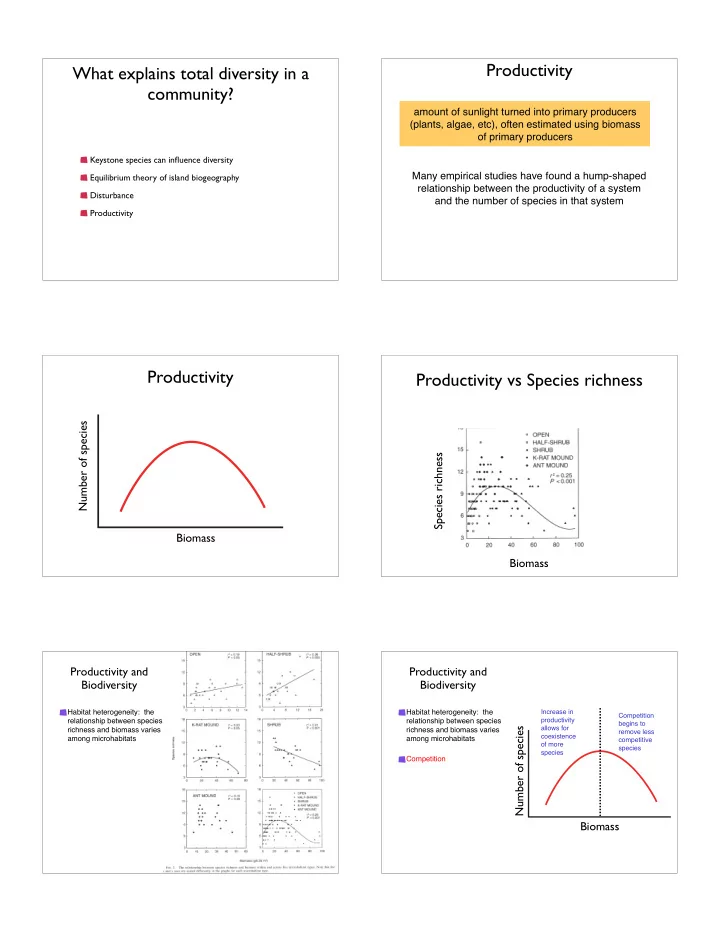
Productivity What explains total diversity in a community? amount of sunlight turned into primary producers (plants, algae, etc), often estimated using biomass of primary producers Keystone species can influence diversity Many empirical


slide-1
SLIDE 1

What explains total diversity in a community?

Keystone species can influence diversity Equilibrium theory of island biogeography Disturbance Productivity

Productivity

amount of sunlight turned into primary producers (plants, algae, etc), often estimated using biomass

  • f primary producers

Many empirical studies have found a hump-shaped relationship between the productivity of a system and the number of species in that system

Productivity

Number of species Biomass

Productivity vs Species richness

Biomass Species richness

Habitat heterogeneity: the relationship between species richness and biomass varies among microhabitats

Productivity and Biodiversity

Habitat heterogeneity: the relationship between species richness and biomass varies among microhabitats Competition

Productivity and Biodiversity Number of species Biomass

Increase in productivity allows for coexistence

  • f more

species Competition begins to remove less competitive species

slide-2
SLIDE 2

What explains total diversity in a community?

Keystone species can influence diversity Equilibrium theory of island biogeography Disturbance Productivity Habitat heterogeneity

Habitat heterogeneity and Biodiversity

Ecosystems with more heterogeneous habitats have more potential niches, allowing the coexistence of more species.

Habitat heterogeneity Number of species

Habitat heterogeneity and Biodiversity

Foliage height diversity Bird species diversity

  • MacArtur and MacArthur (1961)

found that the bird diversity of a habitat increased with the complexity of the habitat’s vegetation

  • Similar relationships have been

demonstrated in other taxa

What explains total diversity in a community?

Keystone species can influence diversity Equilibrium theory of island biogeography Disturbance Productivity Habitat heterogeneity

Is biodiversity important for ecosystem structure and function?

Do ecosystems with high species diversity “function” better? Are ecosystems with high species diversity more stable? Species richness Ecosystem function Species richness Ecosystem function Species richness Ecosystem function Species richness Ecosystem function

No relationship More diversity is more stable Redundancy Idiosyncratic

slide-3
SLIDE 3

Do ecosystems with more species function better?

Empirical evidence shows that in many ecosystems there is a positive relationship between productivity and species

  • richness. But some studies show that

there is either no correlation or a negative correlation.

Are ecosystems with more species more stable

Time Productivity

Are ecosystems with more species more stable

Time Productivity

Are ecosystems with more species more stable

Time Productivity

Are ecosystems with more species more stable?

Species richness Variance of Productivity

Ecosystems with more species should be more resistant to disturbances and will recover faster than species poor communities Hypothetical relationship between productivity and species richness

Are ecosystems with more species more stable?

Species richness Resource availability Species richness Resistance to invasions Hypothetical relationship between species richness and invasion resistance Species rich communities are less susceptible to invasion because they use more of the available resources.

slide-4
SLIDE 4

Do ecosystems with high species diversity “function” better ?

What do the empirical data tell us?

  • 1. Experiments in The Ecotron:

The Ecotron is facility designed to establish simplified experimental communities

Do ecosystems with high species diversity “function” better ?

What do the empirical data tell us?

  • 1. Experiments in The Ecotron

Naeem et al. (1994) created communities with 3 levels of biodiversity (low, medium, and high) and examined the relationship between biodiversity and ecosystem function in these artificial communities.

Do ecosystems with high species diversity “function” better ?

What do the empirical data tell us?

  • 1. Experiments in The Ecotron

low medium high

Time % Change in vegetation cover

  • High biodiversity communities

had denser canopies and higher photosynthetic rates

  • low diversity communities also

consumed less CO2

Are ecosystems with more species more stable?

Tilman and Downing (1994) Biodiversity and stability in grassland. Nature 367: 363-365.

METHODS

Experimental design. In a 7-ha field at Cedar Creek Natural History Area, Minnesota, USA, we controlled the number of plant species in 168 plots, each 9 m £ 9 m. Plots were randomly assigned to be seeded with 1, 2, 4, 8 or 16 perennial grassland species, with 39, 35, 29, 30 and 35 replicates, respectively, of the diversity levels. The composition of each plot was randomly chosen from a set of 18 perennials (four C4 grasses, four C3 grasses, four legumes, four non- legume forbs and two woody species). All plots received 10 g m22 of seed in May 1994 and 5 g m22 in May 1995, with seed mass divided equally between species.

Are ecosystems with more species more stable?

Biomass varies less from year to year in plots with high species richness

Minnesota grassland plot experiment

Coefficient of variation = standard deviation mean

Are ecosystems with more species more stable?

Minnesota grassland plot experiment

Relationship between drought resistance of vegetation in a Minnesota grassland and plant species richness prior to the

  • drought. Drought resistance was

measured as the log of the ratio

  • f plant biomass at the height of

the drought to plant biomass before the drought. Data are shown as means + SE (redrawn from Tilman and Downing 1994).
slide-5
SLIDE 5

Are ecosystems with more species more stable?

Minnesota grassland plot experiment: resource usage

Species richness Resource availability

Tilman et al (1996, 1997) examined the effect of species diversity on productivity and soil nutrients.

Are ecosystems with more species more stable?

Minnesota grassland plot experiment: resource usage Plots with more species less nitrogen in their soil lower resource availability

Figure 1 | Dependence of temporal stability of each plot on experimentally imposed species-number treatment. a, Ecosystem temporal stability for the decade from 1996 to 2005 was an increasing function of the number of planted species. Ecosystem stability is the ratio of mean plot total biomass to its temporal standard deviation, determined after detrending. The regression line and its 95% confidence interval are shown (untransformed data: F1, 159 ¼ 43.7, P , 0.0001). To reduce the difference in y axis scale between the two parts of this figure, a single data point (species number of 16, ecosystem stability of 15.76) is not shown but was included in all

  • analyses. b, Plot-average species temporal stability, determined with species

biomass data for 2001–2005, was a declining function of the number of planted species. The regression curve and 95% confidence intervals are based on a fit of log(species stability) on log(species number), with F1, 159 ¼ 72.3, P , 0.0001.

Tilman et al 2006, nature

Are ecosystems with more species more resistant to invaders?

Species Diversity and Invasion Resistance in a Marine Ecosystem

John J. Stachowicz, Robert B. Whitlatch, Richard W.

  • Osman. 1999. Science 286:1577-1579

Theory predicts that systems that are more diverse should be more resistant to exotic species, but experimental tests are needed to verify this. In experimental communities of sessile marine invertebrates, increased species richness significantly decreased invasion success, apparently because species-rich communities more completely and efficiently used available space, the limiting resource in this system. Declining biodiversity thus facilitates invasion in this system, potentially accelerating the loss of biodiversity and the homogenization of the world's biota.

Is biodiversity important for ecosystem function?

Some studies show that species rich communities are more productive, but some other studies show alternative interpretation. Some studies show that species rich communities are more stable and recover from disturbances faster and are less vulnerable to invasive species. More studies are needed to allow generalizations beyond some model systems.