Production process press for reliable efficiency 160 m BCP and - - PowerPoint PPT Presentation

production process press for reliable efficiency
SMART_READER_LITE
LIVE PREVIEW

Production process press for reliable efficiency 160 m BCP and - - PowerPoint PPT Presentation

12 GeV Upgrade Cavities Production process press for reliable efficiency 160 m BCP and pre-tuned by vendor Receipt inspection mechanical and rf US >> Bake: 600 C, 10 hrs US >> EP: 30 m, @20 C regulated


slide-1
SLIDE 1

12 GeV Upgrade Cavities

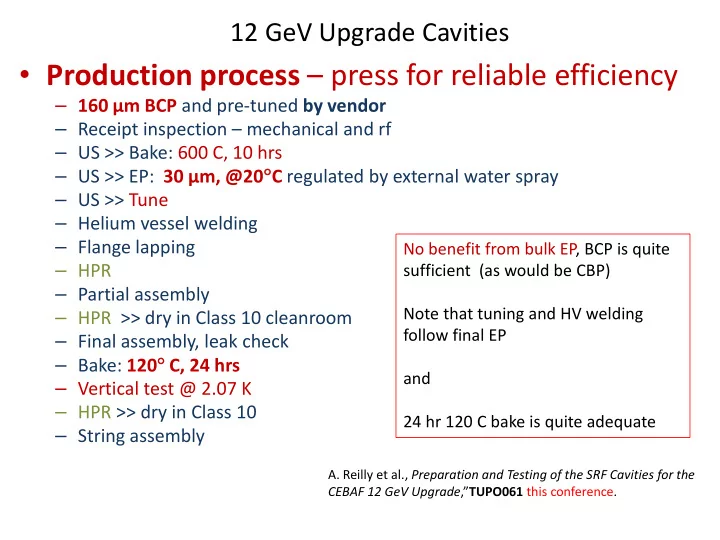
  • Production process – press for reliable efficiency

– 160 µm BCP and pre-tuned by vendor – Receipt inspection – mechanical and rf – US >> Bake: 600 C, 10 hrs – US >> EP: 30 µm, @20°C regulated by external water spray – US >> Tune – Helium vessel welding – Flange lapping – HPR – Partial assembly – HPR >> dry in Class 10 cleanroom – Final assembly, leak check – Bake: 120° C, 24 hrs – Vertical test @ 2.07 K – HPR >> dry in Class 10 – String assembly

  • A. Reilly et al., Preparation and Testing of the SRF Cavities for the

CEBAF 12 GeV Upgrade,”TUPO061 this conference.

No benefit from bulk EP, BCP is quite sufficient (as would be CBP) Note that tuning and HV welding follow final EP and 24 hr 120 C bake is quite adequate

slide-2
SLIDE 2

10 20 30 40 50 60 70 20 40 60 80 100 Current density (mA/cm

2)

Temperature (

  • C )

0.2 0.4 0.6 0.8 1.0 5 10 15 20 25 30 Current density (mA/cm

2)

23.44 mA/cm

2

Concentration of HF ( by volume )

5.27 mA/cm

2

Anode Current Density Strongly Depends

  • n Local Electrolyte Temperature & HF

Concentration

The Nb anode plateau current density is directly proportional to the bulk F concentration, increases with temperature, and is independent of the amount of dissolved Nb.

Courtesy of 1) F. Eozénou et al. CARE-report-2008-022-SRF, 2) H. Tian, C. Reece, et al. J. Electochem. Soc. 155(2008), p. D563

slide-3
SLIDE 3

Implications of basic understanding of EP Positive Results from Controlled Light EP After BCP

For a well controlled, high reproducibility, efficient, reliable EP process. Control and “minimize” the temperature as much as is practical. Minimize cathode current density, and

  • ver-potential (increase cathode surface

area, improve reaction kinetics for hydrolysis). Start with surfaces that are consistently smooth below the scale of diffusion layer thickness, such as CBP (if objective is maximally smooth surfaces with minimum chemistry). Manage hydrogen bubbles and other forced or natural convection for maintaining a controlled local surface flow dynamics .

12 GeV Upgrade Project adopts it as an alternated baseline for the 80 cavities, the on- going production progresses steadily.

“Preparation and Testing of the SRF Cavities for the CEBAF 12 GeV Upgrade”, A. Reilly, T. Bass, A. Burrill, K. Davis, F. Marhauser, C.E. Reece and M. Stirbet.

slide-4
SLIDE 4

FE limited – to be HPR and retested

Production results to date for 12 GeV Upgrade