Production in the Southern Great Plains Under Changing Climate, Land - - PowerPoint PPT Presentation

production in the southern great plains under
SMART_READER_LITE
LIVE PREVIEW

Production in the Southern Great Plains Under Changing Climate, Land - - PowerPoint PPT Presentation

Resilience and Vulnerability of Beef Cattle Production in the Southern Great Plains Under Changing Climate, Land Use and Markets Program Area A3101: Regional Approaches for Adaptation to and Mitigation of Climate Variability and Change Team:


slide-1
SLIDE 1

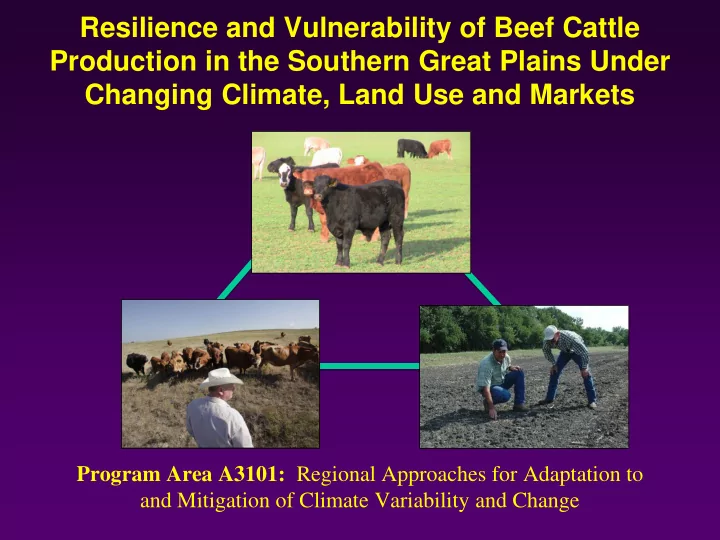
Resilience and Vulnerability of Beef Cattle Production in the Southern Great Plains Under Changing Climate, Land Use and Markets

Program Area A3101: Regional Approaches for Adaptation to and Mitigation of Climate Variability and Change

slide-2
SLIDE 2

Team:

  • Dan Devlin, Project Director, Extension Coordinator
  • Kansas State University
  • Jean Steiner, Co-Project Director, Research Coordinator
  • USDA-ARS Grazinglands Research Laboratory
  • Xiangming Xiao, Footprint Analysis, Citizen Science
  • University of Oklahoma
  • Ali Saleh, Life Cycle Analysis, Decision Support
  • Tarleton State University
  • Charles Rice, Footprint Analysis, International Linkage
  • Kansas State University

http://www.greatplainsgrazing.org/

slide-3
SLIDE 3

Long-Term Goals:

  • 1. better understand

vulnerability and enhance resilience of beef-grazing systems through diversified forages, improved management, strategic drought planning, and improved decision support systems for evaluation of alternative options

  • 2. safeguard and strengthen

production and ecosystem services while mitigating GHG emissions.

Central Great Plains (Rolling Wheat and Range) Land Resource Area MLRA 78C Central Rolling Red Plains MLRA 80A Central Rolling Red Prairies

  • f central Oklahoma
slide-4
SLIDE 4

Research and Extension

Research Themes

  • Develop and implement a functional network of monitoring sites to measure

and monitor storage and flux of water, C, and N in cattle production systems utilizing combinations of winter wheat, pasture, and rangeland forages.

  • Develop standardized methodologies for estimating C, N, and H2O footprints of

beef cattle farms and for evaluating feedback linkage between changes in the agricultural product or production system with human behavior and decision making.

  • Establish baselines for C fluxes and energy, N, and H2O use and storage
  • Develop a suite of existing or novel approaches and management practices that

leads to a net decrease in the footprints or increased C sequestration in mixed beef-forage farms.

  • Conduct comprehensive life cycle analyses (LCAs).

Extension Plan

  • Beef cattle producer targeted programming activities
  • Consumer targeted programming activities
slide-5
SLIDE 5

K-State Libraries

Vision:

  • Open access database of the literature

about agricultural greenhouse gases in croplands

slide-6
SLIDE 6
slide-7
SLIDE 7

Croplands Literature Database

  • We are nearing 6,000 items in the database
  • Searchable and browsable by country,

climate, and cropping system

– Facets available to refine the search results

  • http://www.lib.k-state.edu/gracroplands/
slide-8
SLIDE 8
  • To gather the items I have set up notifications for

key word searches and relevant journals in the following databases:

– Web of Science Core Collection

– Scopus

– CAB Abstracts

– Biological Abstracts

slide-9
SLIDE 9
  • One problem is that some disreputable
  • pen access journals are indexed in

some of the databases

  • looking up publications from

journals/publishers in Beall's list

– Jeffrey Beall is a librarian at UC-Denver and keeps a list of predatory journals and

  • publishers. It is available on his web site:

http://scholarlyoa.com/

slide-10
SLIDE 10
  • One thing that I started doing this year

is following people on ResearchGate and uploading things they add to their profile when they are relevant.

  • If I could get a list of names of people I

should be following, that would be great

  • r they could follow me and I will follow

them back. Here is my profile https://www.researchgate.net/profile/Livi a_Olsen

slide-11
SLIDE 11
  • After I add items to the database, they

need to be processed.

  • The entries need to be checked for

accuracy;

– have links to free full-text added when it is available; and – have information about country, climate, and cropping system added.

slide-12
SLIDE 12
  • Argentina [54]
  • Australia [311]
  • Brazil [419]
  • Canada [353]
  • Chile [11]
  • China [438]
  • Colombia [15]
  • Costa Rica [10]
  • Denmark [39]
  • Finland [32]
  • France [72]
  • Germany [91]
  • Ghana [6]
  • India [305]
  • Indonesia [19]
  • Ireland [14]
  • Italy [66] Japan [33]
  • Malaysia [6]
  • Mexico [48]
  • Netherlands [23]
  • New Zealand [42]
  • Norway [17]
  • Pakistan [51]
  • Peru [9]
  • Philippines [14]
  • Republic of Korea [13]
  • Russia [39]
  • South Africa [52]
  • Spain [117]
  • Sweden [29]
  • Switzerland [24]
  • Thailand [12]
  • UK [104]
  • USA [1525]
  • Uruguay [12]
  • Vietnam [6]
slide-13
SLIDE 13
  • If there are things that people would like

to see added or if they find mistakes, they are welcome to contact me. Also, if there are other databases they think would be useful to search for items to add, I'm happy to receive suggestions

  • Livia Olsen <livia@ksu.edu>
slide-14
SLIDE 14