Product Rule MCV4U: Calculus & Vectors Recap x . Determine the - - PDF document

product rule
SMART_READER_LITE
LIVE PREVIEW

Product Rule MCV4U: Calculus & Vectors Recap x . Determine the - - PDF document

f u n d a m e n t a l r u l e s o f d e r i v a t i v e s f u n d a m e n t a l r u l e s o f d e r i v a t i v e s Product Rule MCV4U: Calculus & Vectors Recap x . Determine the derivative of f ( x ) = ( x 4 3 x 2 + 7 x ) 3 Let p (


slide-1
SLIDE 1

f u n d a m e n t a l r u l e s o f d e r i v a t i v e s

MCV4U: Calculus & Vectors

Chain Rule of Derivatives

  • J. Garvin

Slide 1/15

f u n d a m e n t a l r u l e s o f d e r i v a t i v e s

Product Rule

Recap

Determine the derivative of f (x) = (x4 − 3x2 + 7x) 3 √x. Let p(x) = x4 − 3x2 + 7x and q(x) = x

1 3 .

Then p′(x) = 4x3 − 6x + 7 and q′(x) = 1

3x− 2

3 .

f ′(x) =

  • 4x3 − 6x + 7

x

1 3

  • +
  • 1

3x− 2

3

x4 − 3x2 + 7x

  • r 13

3 x

10 3 − 7x 4 3 + 28

3 x

1 3

  • J. Garvin — Chain Rule of Derivatives

Slide 2/15

f u n d a m e n t a l r u l e s o f d e r i v a t i v e s

Chain Rule

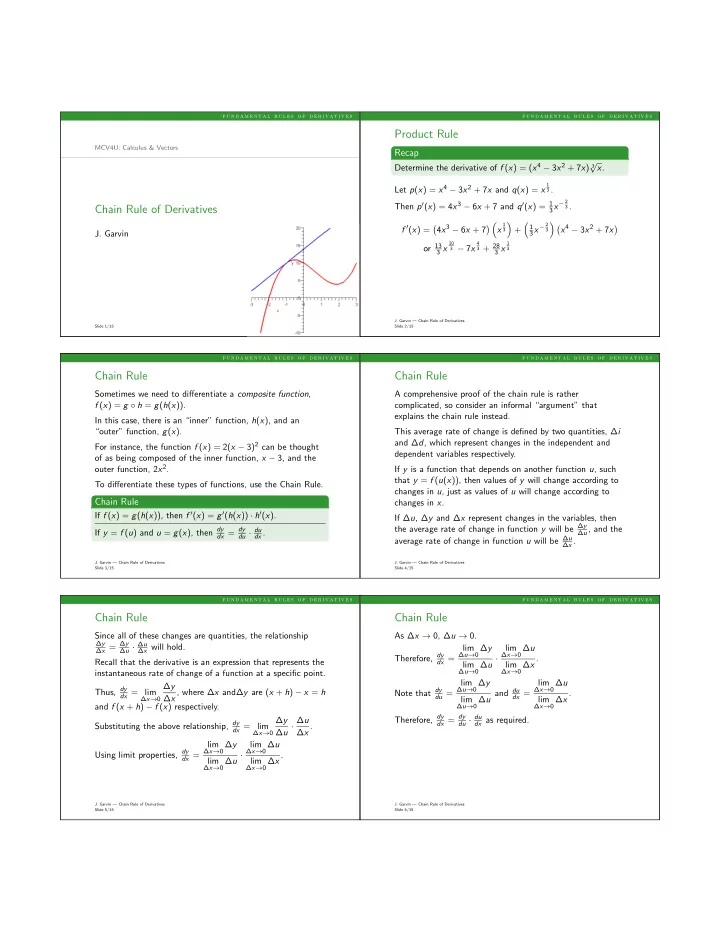
Sometimes we need to differentiate a composite function, f (x) = g ◦ h = g(h(x)). In this case, there is an “inner” function, h(x), and an “outer” function, g(x). For instance, the function f (x) = 2(x − 3)2 can be thought

  • f as being composed of the inner function, x − 3, and the
  • uter function, 2x2.

To differentiate these types of functions, use the Chain Rule.

Chain Rule

If f (x) = g(h(x)), then f ′(x) = g′(h(x)) · h′(x). If y = f (u) and u = g(x), then dy

dx = dy du · du dx .

  • J. Garvin — Chain Rule of Derivatives

Slide 3/15

f u n d a m e n t a l r u l e s o f d e r i v a t i v e s

Chain Rule

A comprehensive proof of the chain rule is rather complicated, so consider an informal “argument” that explains the chain rule instead. This average rate of change is defined by two quantities, ∆i and ∆d, which represent changes in the independent and dependent variables respectively. If y is a function that depends on another function u, such that y = f (u(x)), then values of y will change according to changes in u, just as values of u will change according to changes in x. If ∆u, ∆y and ∆x represent changes in the variables, then the average rate of change in function y will be ∆y

∆u, and the

average rate of change in function u will be ∆u

∆x .

  • J. Garvin — Chain Rule of Derivatives

Slide 4/15

f u n d a m e n t a l r u l e s o f d e r i v a t i v e s

Chain Rule

Since all of these changes are quantities, the relationship

∆y ∆x = ∆y ∆u · ∆u ∆x will hold.

Recall that the derivative is an expression that represents the instantaneous rate of change of a function at a specific point. Thus, dy

dx = lim ∆x→0

∆y ∆x , where ∆x and∆y are (x + h) − x = h and f (x + h) − f (x) respectively. Substituting the above relationship, dy

dx = lim ∆x→0

∆y ∆u · ∆u ∆x . Using limit properties, dy

dx =

lim

∆x→0 ∆y

lim

∆x→0 ∆u ·

lim

∆x→0 ∆u

lim

∆x→0 ∆x .

  • J. Garvin — Chain Rule of Derivatives

Slide 5/15

f u n d a m e n t a l r u l e s o f d e r i v a t i v e s

Chain Rule

As ∆x → 0, ∆u → 0. Therefore, dy

dx =

lim

∆u→0 ∆y

lim

∆u→0 ∆u ·

lim

∆x→0 ∆u

lim

∆x→0 ∆x .

Note that dy

du =

lim

∆u→0 ∆y

lim

∆u→0 ∆u and du dx =

lim

∆x→0 ∆u

lim

∆x→0 ∆x .

Therefore, dy

dx = dy du · du dx as required.

  • J. Garvin — Chain Rule of Derivatives

Slide 6/15

slide-2
SLIDE 2

f u n d a m e n t a l r u l e s o f d e r i v a t i v e s

Chain Rule

Example

Determine the derivative of f (x) = 3(4x2 − 3x)5. While the function could be expanded using the Binomial Theorem, it is faster to use the chain rule. Let the inner function be h(x) = 4x2 − 3x, with derivative h′(x) = 8x − 3. The outer function g(h) = 3h5, with derivative g′(h) = 15h4. f ′(x) = g′(h(x)) · h′(x) = 15(4x2 − 3x)4(8x − 3)

  • J. Garvin — Chain Rule of Derivatives

Slide 7/15

f u n d a m e n t a l r u l e s o f d e r i v a t i v e s

Chain Rule

Example

Determine the derivative of f (x) = 2 (x3 − 5x2)3 . Rewrite the function as f (x) = 2(x3 − 5x2)−3. The inner function is h(x) = x3 − 5x2, with derivative h′(x) = 3x2 − 10x. The outer function is g(h) = 2h−3, with derivative g′(h) = −6h−4. f ′(x) = −6(x3 − 5x2)−4 · (3x2 − 10x)

  • r 60 − 18x

(x − 5)4x7

  • J. Garvin — Chain Rule of Derivatives

Slide 8/15

f u n d a m e n t a l r u l e s o f d e r i v a t i v e s

Chain Rule

Example

Determine the value of f ′(−1) if f (x) = (5x3 − 1)(2x2 + x)4. In this example, we need to use both the product rule and the chain rules. f ′(x) =15x2(2x2 + x)4 + (5x3 − 1)(4)(2x2 + x)3(4x + 1) f ′(−1) =15(−1)2(2(−1)2 + (−1))4+ (5(−1)3 − 1)(4)(2(−1)2 + (−1))3(4(−1) + 1) =87

  • J. Garvin — Chain Rule of Derivatives

Slide 9/15

f u n d a m e n t a l r u l e s o f d e r i v a t i v e s

The Chain Rule with Leibniz Notation

Using Leibniz notation, the chain rule is dy

dx = dy du · du dx where y

is a function of u and u is a function of x. Thus, u is the inner function, and y is the outer function. In cases where functions are (or can be) broken down into such relationships, it may be easier to find the individual derivatives dy

du and du dx separately, then multiply and

substitute.

  • J. Garvin — Chain Rule of Derivatives

Slide 10/15

f u n d a m e n t a l r u l e s o f d e r i v a t i v e s

The Chain Rule with Leibniz Notation

Example

If y = 2u4 + 5u and u = 5x2 + 1, determine dy

dx .

The derivative of u with respect to x is du

dx = 10x.

The derivative of y with respect to u is dy

du = 8u3 + 5.

Therefore, the derivative of the composite function is

dy dx = dy du · du dx

= (8u3 + 5)(10x) = (8(5x2 + 1)3 + 5)(10x) This can probably be simplified, but is in a workable state.

  • J. Garvin — Chain Rule of Derivatives

Slide 11/15

f u n d a m e n t a l r u l e s o f d e r i v a t i v e s

The Chain Rule with Leibniz Notation

Example

Determine the equation of the tangent to y = √u, if u = 3x2 + 4, when x = 2. The derivative of u with respect to x is du

dx = 6x.

The derivative of y with respect to u is dy

du = 1 2√u.

Therefore, the derivative of the composite function is

dy dx = dy du · du dx

= 1 2√u · 6x = 6x 2 √ 3x2 + 4

  • J. Garvin — Chain Rule of Derivatives

Slide 12/15

slide-3
SLIDE 3

f u n d a m e n t a l r u l e s o f d e r i v a t i v e s

The Chain Rule with Leibniz Notation

At x = 2, y =

  • 3(2)2 + 4 = 4. Therefore, the point of

tangency is (2, 4). Calculate the slope at x = 2.

dy dx

  • x=2 = 6(2)

2[4] = 3

2

Use the slope and point of tangency to find the equation of the tangent. y = 3

2(x − 2) + 4

= 3

2x + 1

  • J. Garvin — Chain Rule of Derivatives

Slide 13/15

f u n d a m e n t a l r u l e s o f d e r i v a t i v e s

The Chain Rule with Leibniz Notation

Even if a function is not explicitly broken up into two separate functions, this same technique can be used.

Example

If y =

3

√ 3x2 − 7x + 4, determine dy

dx .

Let u = 3x2 − 7x and y =

3

√u + 4 = u1/3 + 4. Then du

dx = 6x − 7 and dy du = 1 3u−2/3.

Thus, dy

dx = 1 3u−2/3 · (6x − 7) = (3x2 − 7)−2/3

3 · (6x − 7).

  • J. Garvin — Chain Rule of Derivatives

Slide 14/15

f u n d a m e n t a l r u l e s o f d e r i v a t i v e s

Questions?

  • J. Garvin — Chain Rule of Derivatives

Slide 15/15