
SLIDE 1
New Challenges for
Processing Heterogeneity
Nikolaus Grigorieff
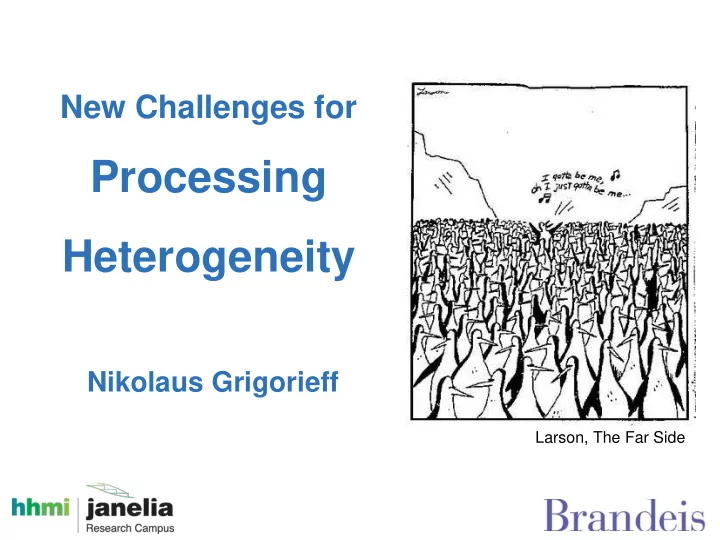
Larson, The Far Side
Processing Heterogeneity Nikolaus Grigorieff Larson, The Far Side - - PowerPoint PPT Presentation
New Challenges for Processing Heterogeneity Nikolaus Grigorieff Larson, The Far Side Heterogeneity and Biology Translocation, Brilot et al 2013 Glutamate receptor, Drr et al 2014 GroEL/GroES ATP cycle Kinesin power stroke Clare et al
Larson, The Far Side
Translocation, Brilot et al 2013 Kinesin power stroke Sindelar & Downing 2010 Spliceosome, Wahl et al 2009 GroEL/GroES ATP cycle Clare et al 2012 Glutamate receptor, Dürr et al 2014
Compositional Conformational discrete continuous General
Hierarchical ascendant classification K-means Supervised classification (MRA/multiparticle, ML2D/3D, ISAC) (MRA)
MSA
Classification
Align MRA
Maximization 𝐪(zi=k|Θ,X ,X) Expectation Seeds
Count Correlation difference
Larson, The Far Side
Brilot et al. 2013
pre post pre pre post 100 Å tRNA EF-G 250 Å
27% 3.5% 2.4% 13% 6.8% Dataset: 1.3 million particles 300 kV, Falcon I
Spliceosome
Anna Loveland, unpublished
50 nm
Lyumkis et al. 2013 ML2D, MRA, MSA, HAC Random conical tilt reconstructions
200 Å
Negative stain data 180 kDa Dataset: 68k particles, 12k final
250 kDa 49% 25% 26%
Bo Liang, Zongli Li, Simon Jenni, Tim Grant Steve Harrison, Sean Whelan, Tom Walz
43% 32% 25%
Frealign refinement & classification
50 Å
82278 particles 3.9 Å resolution 356211 particles F20, K2 EMAN2 initial model K-means classification
Larson, The Far Side
2.4% 3.3% 6.4%
Brilot et al. 2013
Hashem et al. 2013
26317 particles (one class out of 630k particles) 40k bootstrap volumes
misalignments
Liao et al. 2013
Frealign Refinement & classification 38326 particles (44%) Dataset: 88915 particles (300 kV, K2) Relion Refinement & classification 35645 particles (40%) Overlap: 23230 particles (~60%)
0.2 0.4 0.6 0.8 1 0.05 0.1 0.15 0.2 0.25 0.3 0.35 Frealign class Sum Intersection FSC Resolution [Å-1]
particles to the Frealign class slightly degrade resolution.
Relion class were misaligned by Frealign (and vice versa).
separate aligned form misaligned particles. Frealign class (38326 particles) Sum of Frealign and Relion classes (50755 particles) Intersection of Frealign and Relion classes (23216 particles)
Larson, The Far Side
Jin et al. 2014
Normal mode corresponding to ratcheting
70S ribosome (non-rotated) 70S ribosome + EF-G (rotated) Reconstruction from bins with* from bins with*
Model
FSC at 22 Å (σ = 0.016)
0.157 0.145
No deformation
0.107 0.108
c a a Q
c a c a c a 5
bound to auxilin and Hsc70
Fotin et al. 2004, Xing et al. 2010
Voorhees et al. 2014
60S ribosome + Sec61
Elena Zehr, Alexis Rohou, David Agard
CTF estimation (ctffind4) Motion correction (unblur) Frame selection Subframe motion (Frealix) 3.6 Å resolution
Software for helical processing
20 nm
Cryo-EM 3D filament tracking Structure refinement Deformation statistics Improved mechanical model
Software for helical processing
3nm Rohou & Grigorieff 2014
450 total, Frealix, 7.5 Å 188 straightest, Frealix, 7.1 Å 188 most curved, Frealix, 8.3 Å 188 most curved, Frealign, 8.9 Å
Rohou & Grigorieff 2014
– Search for weak/blurred density, calculate variance maps.
– Carful biochemistry, repeat analysis with many different starting conditions, check that the results make structural/biological sense.
– Biochemistry, classification, modeling, possibly 3D MSA of bootstrap volumes (Klaholz/Penczek).
and heterogeneous particle?
– Guess: 200 kDa particle with 20-50 kDa heterogeneity should be possible.
resolution reconstruction?
– Very likely, for example if a particle contains large unstructured domains.
Bottom line Better biochemistry, bigger datasets, bigger computers, better algorithms
Axel Brilot, Andrei A. Korostelev, Dmitri N. Ermolenko
Anna Loveland, Melissa Moore
Bo Liang, Zongli Li, Simon Jenni, Tim Grant, Steve Harrison, Sean Whelan, Tom Walz
Elena Zehr, Alexis Rohou, David Agard, Joe Pogliano
Alexis Rohou
Chen Xu (Brandeis), Zhiheng Yu (Janelia)
HHMI, NIH