Processes for Sustainability of Community-Managed Water Supply - - PowerPoint PPT Presentation

processes for sustainability of community managed water
SMART_READER_LITE
LIVE PREVIEW

Processes for Sustainability of Community-Managed Water Supply - - PowerPoint PPT Presentation

Processes for Sustainability of Community-Managed Water Supply Systems Understanding Processes for Sustainability in Tori Klug Community-Managed Water Systems Kate Shields Tori Klug July 19, 2016 Kate Shields July 19, 2016 Outline


slide-1
SLIDE 1

Processes for Sustainability of Community-Managed Water Supply Systems

Tori Klug Kate Shields July 19, 2016

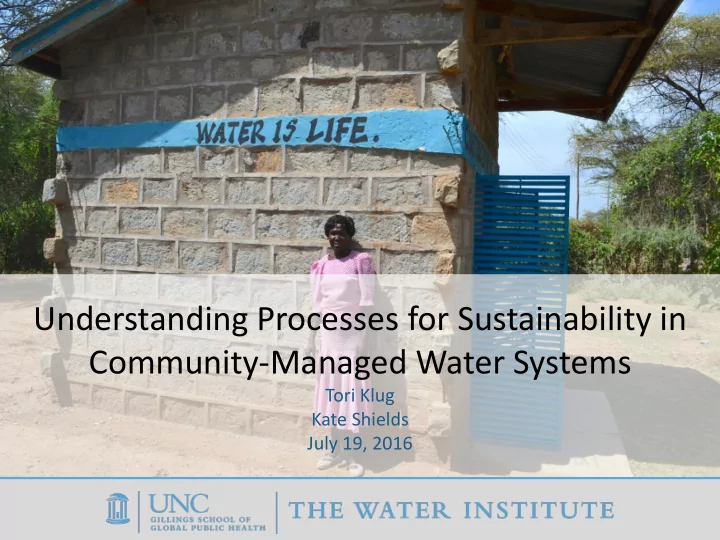
Understanding Processes for Sustainability in Community-Managed Water Systems

Tori Klug Kate Shields July 19, 2016
slide-2
SLIDE 2

Outline

  • Study goals
  • Methods
  • Results and recommendations
  • Questions and discussion

Background Methods Results and recommendations Questions

slide-3
SLIDE 3

Background Methods Results and recommendations Questions

Background: Study goals

  • Assess World Vision’s Community Engagement

Strategy

  • Explore how and why certain water systems

are functional

  • Inform best practices that facilitate successful

management

slide-4
SLIDE 4

Background Methods Results and recommendations Questions

Methods

  • 3 study countries – Ghana,

Kenya, and Zambia

  • Community selection

criteria:

– Water system implemented by World Vision (WV) – WaSH committee in existence – System functional at time

  • f baseline evaluation
slide-5
SLIDE 5

Background Methods Results and recommendations Questions

Methods

  • Qualitative
  • Inductive approach

– Hypothesis-building – Themes emerge from data – Framework not predetermined – Focus on perspective of study participants without forcing preconceptions

  • “Deep dive”

– Explore processes that are not captured in quantitative studies

slide-6
SLIDE 6

Background Methods Results and recommendations Questions

Methods

Activity Type Participant(s) Number of recordings Individual Interviews Water Committee Member 92 World Vision Staff 34 Community Member 69 Other Local Leader 49 Post-Construction Support Provider 23 Focus Group Discussions Water Committee Members 19 Community Members 20 Grand Tour and Community Mapping 18 Total Number of Recordings 324 Total Hours of Recordings 237 hours

slide-7
SLIDE 7

Background Methods Results and recommendations Questions

Results: Themes

  • Committee characteristics
  • Community engagement and

training

  • Participation and ownership
  • Resource mobilization
  • Social capital
  • Hardware and management

rehabilitation

slide-8
SLIDE 8

Background Methods Results and recommendations Questions

Results: Ownership and participation

Committee and community participation Financial contributions Physical labor Meetings and decision making

slide-9
SLIDE 9

Background Methods Results and recommendations Questions

Results: Ownership and participation

  • Balanced participatory approach by external

support actors

  • Includes:

– Encouraging a sense of ownership – Troubleshooting when challenges are above community capacity – Building regional water associations – Considering context including existing structures

slide-10
SLIDE 10

Background Methods Results and recommendations Questions

Recommendations: Ownership and participation

  • Maintain a context-specific balanced

participatory approach

  • Sensitize local leaders in the importance, role,

and autonomy of the water committee

  • Encourage local leaders to engage their

community members in management decision- making, particularly before construction

  • Support the formation of regional water

committee associations

slide-11
SLIDE 11

Background Methods Results and recommendations Questions

Results: Women and water management

  • Higher level of trust for female

treasurers

  • Women are sometimes

prevented from maintaining active and meaningful involvement in water management

  • Women are often the first to

recognize water system breakdowns

slide-12
SLIDE 12

Background Methods Results and recommendations Questions

Recommendations: Women and water management

  • Ensure that women are better represented

in water committee executive positions

  • Emphasize why women should be actively

involved in water management in water committee training sessions

  • Encourage active participation of female

committee and community members in water management decision-making

  • Train women to be able to recognize water

system breakdowns and on proper water system operation and preventing common causes of water system breakdown

slide-13
SLIDE 13

Background Methods Results and recommendations Questions

Results: Resource mobilization

Resource mobilization for water systems Water fee Proactive Regular fee Pay-as-you- go Fine Reactive Community contributions Loan Mobilization of personal assets Mobilization of community assets Mobilization of community institutions Mobilization

  • f community

labor

slide-14
SLIDE 14

Background Methods Results and recommendations Questions

Results: Resource mobilization

Resource mobilization for water systems Water fee Proactive Regular fee Pay-as-you- go Fine Reactive Community contributions Loan Mobilization of personal assets Mobilization of community assets Mobilization of community institutions Mobilization

  • f community

labor

slide-15
SLIDE 15

Background Methods Results and recommendations Questions

Recommendations: Resource mobilization

  • Adapt financial training for water committees

to be more inclusive of these alternative

  • ptions for resource mobilization to promote

sustainability and equity

  • Explicitly address equity issues in resource

mobilization training

  • Encourage communities to proactively (rather

than reactively) mobilize resources

slide-16
SLIDE 16

Water System Maintenance and Rehabilitation

  • Money available for repair and

rehabilitation

  • O&M and rehabilitation

activities

  • Knowledge pooling
  • Sense of ownership

Social Capital

  • Informal social networks
  • Formal community
  • rganizations
  • General sense of trust and

interdependency within community

Resource Mobilization

  • Financial and/or material

contribution during construction

  • Financial contributions towards
  • peration and maintenance
  • Assistance from other

community organizations

Collective Action

  • Communal labor during

system construction

  • Identification and training of

committee

  • Communal problem solving

and participation during rehabilitation process (hardware and management)

  • Committee participation in

system governance

slide-17
SLIDE 17

Background Methods Results and recommendations Questions

Overall recommendations

  • Actors who provide support to community-

managed water systems can enable communities to enter a cycle of success by:

– Using participatory approaches – Building capacity of committee members – Emphasizing community and committee

  • wnership

– Providing balanced support

slide-18
SLIDE 18

Acknowledgements

Project team Kate Shields, Tori Klug, Ryan Cronk, Nikki Behnke, Emma Kelly, Kristen Lee, Leah Everist, Julian Oliver Qualitative research guidance Peggy Bentley, Vidya Venkataramanan, Valerie Flax Funding sources AWWA Larson Aquatic Master’s Research Support UNC Master’s Merit Assistantship Jon Curtis Student Enrichment Fund UNC Class of 1938 scholarship Project support World Vision US: Greg Allgood, Jordan Smoke World Vision International: Ashley Labat World Vision Kenya: National and ADP offices World Vision Zambia: National and ADP offices World Vision Ghana: National and ADP offices

slide-19
SLIDE 19

Background Methods Results and recommendations Questions

Questions?