Problems with open approach History of popliteal aneurysm repair - - PowerPoint PPT Presentation

problems with open approach
SMART_READER_LITE
LIVE PREVIEW

Problems with open approach History of popliteal aneurysm repair - - PowerPoint PPT Presentation

4/3/2014 History of popliteal aneurysm repair Outcomes for Endovascular Treatment of Popliteal Aneurysms 2nd century AD, Antyllus, the Father of Aneurysm are Similar to Open Repair Surgery performed the first recorded aneurysm repair


slide-1
SLIDE 1

4/3/2014 1

Outcomes for Endovascular Treatment of Popliteal Aneurysms are Similar to Open Repair DISCLOSURES Grants: NIA, NHLBI, Aastrom Biosciences Other support: VA Nebraska-Western Iowa Health Care System

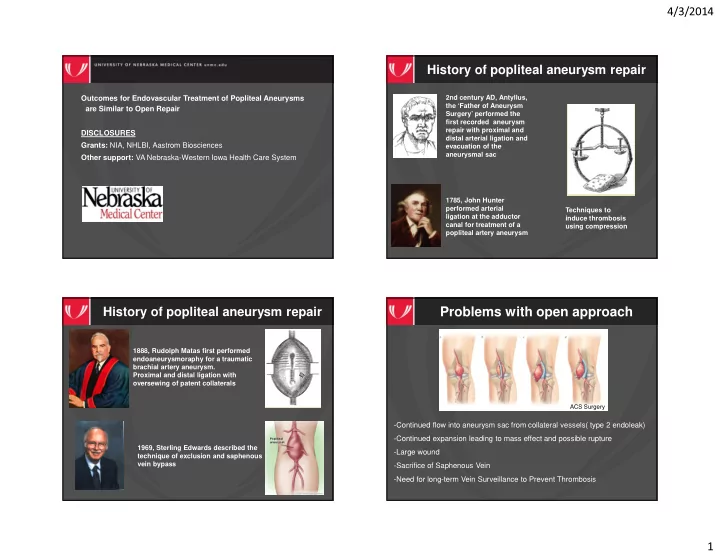
History of popliteal aneurysm repair

2nd century AD, Antyllus, the ‘Father of Aneurysm Surgery’ performed the first recorded aneurysm repair with proximal and distal arterial ligation and evacuation of the aneurysmal sac 1785, John Hunter performed arterial ligation at the adductor canal for treatment of a popliteal artery aneurysm Techniques to induce thrombosis using compression

History of popliteal aneurysm repair

1969, Sterling Edwards described the technique of exclusion and saphenous vein bypass 1888, Rudolph Matas first performed endoaneurysmoraphy for a traumatic brachial artery aneurysm. Proximal and distal ligation with

  • versewing of patent collaterals

Problems with open approach

  • Continued flow into aneurysm sac from collateral vessels( type 2 endoleak)
  • Continued expansion leading to mass effect and possible rupture
  • Large wound
  • Sacrifice of Saphenous Vein
  • Need for long-term Vein Surveillance to Prevent Thrombosis

ACS Surgery

slide-2
SLIDE 2

4/3/2014 2

Comparison of Open and Endovascular Repair

The latest three reviews of the literature: 1.Lovegrove RE, Javid M, Magee TR, Galland RB. Endovascular and open approaches to non-thrombosed popliteal aneurysm repair: a meta-analysis. Eur J Vasc Endovasc Surg. 2008 Jul;36(1):96-100

  • 2. Cina CS. Endovascular repair of popliteal aneurysms. J Vasc Surg. 2010 Apr;51(4):1056-60.
  • 3. Tsilimparis N, Dayama A, Ricotta JJ 2nd. Open and endovascular repair of popliteal artery aneurysms:

tabular review of the literature. Ann Vasc Surg. 2013 Feb;27(2):259-65.

Hybrid Repair 70 yo patient s/p AF2 repair presents with:

  • anastomotic pseudoaneurysm of the R limb of the

AF2 to the RCFA and

  • R popliteal aneurysm

Open repair

Open repair of the anastomotic pseudoaneurysm of the R limb of prior AF2 to the RCFA (14-7 knitted prosthetic graft)

Endovascular repair (8 x 15 Viabahn)

slide-3
SLIDE 3

4/3/2014 3

Large Femoropopliteal Aneurysm

RSFA-TP trunk bypass

Large Femoropopliteal Aneurysm

RSFA-TP trunk bypass

Demographics and Clinical Presentation

Tsilimparis N, et al. Ann Vasc Surg. 2013

Demographics and Clinical Presentation

Tsilimparis N, et al. Ann Vasc Surg. 2013

Clinical Presentation Average Asymptomatic 41% Symptomatic 59% Acute limb ischemia 25% Rupture 3% Claudication 31%

slide-4
SLIDE 4

4/3/2014 4

Anatomic Features

Tsilimparis N, et al. Ann Vasc Surg. 2013

Type of Treatment

Tsilimparis N, et al. Ann Vasc Surg. 2013

Early outcomes (<30 days)

Tsilimparis N, et al. Ann Vasc Surg. 2013

Late outcomes (>30 days)

Tsilimparis N, et al. Ann Vasc Surg. 2013

slide-5
SLIDE 5

4/3/2014 5

Outcomes

Lovegrove RE, et al. Eur J Vasc Endovasc Surg 2008

Three year patency

Cina CS, J Vasc Surg. 2010

Summary

Endovascular repair of popliteal artery aneurysms offers similar short and medium-term benefits as an open repair. However, short-term graft thrombosis and reintervention rates are significantly greater with endovascular repair. The choice between open repair, and endovascular repair, needs to be balanced on an individual basis based on anatomical and patient- related characteristics. Further studies are necessary to define indications, anatomical and prosthetic graft limitations, and the exact role of postoperative anticoagulation therapy.