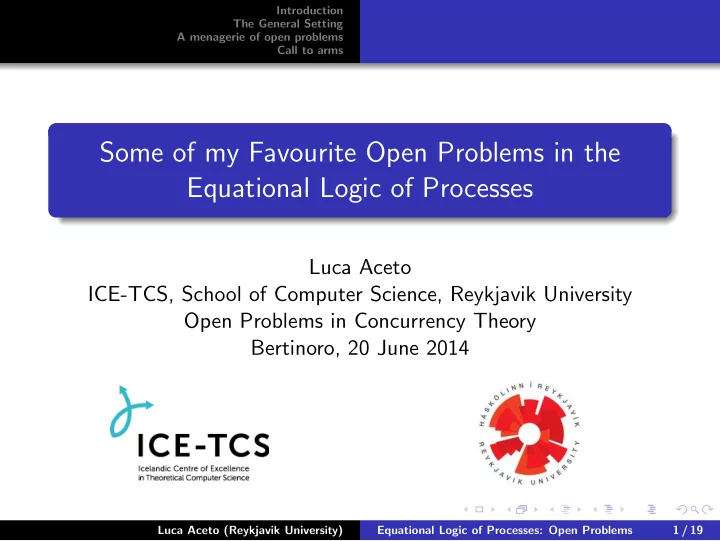
Some of my Favourite Open Problems in the Equational Logic of - - PowerPoint PPT Presentation

some of my favourite open problems in the equational
SMART_READER_LITE
LIVE PREVIEW

Some of my Favourite Open Problems in the Equational Logic of - - PowerPoint PPT Presentation

Introduction The General Setting A menagerie of open problems Call to arms Some of my Favourite Open Problems in the Equational Logic of Processes Luca Aceto ICE-TCS, School of Computer Science, Reykjavik University Open Problems in


slide-1
SLIDE 1

Introduction The General Setting A menagerie of open problems Call to arms

Some of my Favourite Open Problems in the Equational Logic of Processes

Luca Aceto ICE-TCS, School of Computer Science, Reykjavik University Open Problems in Concurrency Theory Bertinoro, 20 June 2014

Luca Aceto (Reykjavik University) Equational Logic of Processes: Open Problems 1 / 19

slide-2
SLIDE 2

Introduction The General Setting A menagerie of open problems Call to arms

Why This Talk at OPCT and in 2014?

Goal (Hope?) To rekindle interest in some questions that I hope will be solved before I sign off. To issue a call to arms (and to myself). What questions?

Luca Aceto (Reykjavik University) Equational Logic of Processes: Open Problems 2 / 19

slide-3
SLIDE 3

Introduction The General Setting A menagerie of open problems Call to arms

Why This Talk at OPCT and in 2014?

Goal (Hope?) To rekindle interest in some questions that I hope will be solved before I sign off. To issue a call to arms (and to myself). What questions?

Luca Aceto (Reykjavik University) Equational Logic of Processes: Open Problems 2 / 19

slide-4
SLIDE 4

Introduction The General Setting A menagerie of open problems Call to arms

Why This Talk at OPCT and in 2014?

Goal (Hope?) To rekindle interest in some questions that I hope will be solved before I sign off. To issue a call to arms (and to myself). What questions?

Luca Aceto (Reykjavik University) Equational Logic of Processes: Open Problems 2 / 19

slide-5
SLIDE 5

Introduction The General Setting A menagerie of open problems Call to arms Equalities Between Programs Abstracting the Problem: Finite Axiomatizations

The Role of Equational Logic in Process Algebra

Motto: In process algebra, we use formal languages to describe reactive systems and specifications of their expected behaviour. Fact of Life: We often need to know when two syntactically different descriptions are describing the “same thing”. Correctness: Is SPECification equivalent to IMPlementation? Tenet: Equational logic can be used to capture “valid”

  • equivalences. In process algebra, the equational characterization of

parallel composition is key.

Luca Aceto (Reykjavik University) Equational Logic of Processes: Open Problems 3 / 19

slide-6
SLIDE 6

Introduction The General Setting A menagerie of open problems Call to arms Equalities Between Programs Abstracting the Problem: Finite Axiomatizations

Finite, Complete Axiomatizations

The Challenge Given some algebraic signature Σ, and some congruence ∼ over (closed) terms Is there a finite set E of Σ-equations s = t such that t ∼ u ⇔ E ⊢ t = u for all (closed) Σ-terms t, u? E is called a sound and (ground-)complete axiomatization.

Luca Aceto (Reykjavik University) Equational Logic of Processes: Open Problems 4 / 19

slide-7
SLIDE 7

Introduction The General Setting A menagerie of open problems Call to arms Equalities Between Programs Abstracting the Problem: Finite Axiomatizations

Why is This an Interesting Game?

A non-answer I have always liked it! The official answer An equational axiomatization

1 tells ye all ye need to know about your notion of program

equivalence;

2 allows you to relate it to other types of program equivalence

by simply looking at laws;

3 may form the basis for program verification tools based on

theorem proving technology. (See J.F. Groote’s talk later today.)

Luca Aceto (Reykjavik University) Equational Logic of Processes: Open Problems 5 / 19

slide-8
SLIDE 8

Introduction The General Setting A menagerie of open problems Call to arms Equalities Between Programs Abstracting the Problem: Finite Axiomatizations

Why is This an Interesting Game?

A non-answer I have always liked it! The official answer An equational axiomatization

1 tells ye all ye need to know about your notion of program

equivalence;

2 allows you to relate it to other types of program equivalence

by simply looking at laws;

3 may form the basis for program verification tools based on

theorem proving technology. (See J.F. Groote’s talk later today.)

Luca Aceto (Reykjavik University) Equational Logic of Processes: Open Problems 5 / 19

slide-9
SLIDE 9

Introduction The General Setting A menagerie of open problems Call to arms Equalities Between Programs Abstracting the Problem: Finite Axiomatizations

Why is This an Interesting Game?

A non-answer I have always liked it! The official answer An equational axiomatization

1 tells ye all ye need to know about your notion of program

equivalence;

2 allows you to relate it to other types of program equivalence

by simply looking at laws;

3 may form the basis for program verification tools based on

theorem proving technology. (See J.F. Groote’s talk later today.)

Luca Aceto (Reykjavik University) Equational Logic of Processes: Open Problems 5 / 19

slide-10
SLIDE 10

Introduction The General Setting A menagerie of open problems Call to arms Equalities Between Programs Abstracting the Problem: Finite Axiomatizations

The Cold Shower

Empirically proven fact The life of a concurrency theorist is equationally hard. In many situations, the collection of valid equivalences cannot be “captured” by means of a finite collection of equations. This holds true even for very simple languages! There are still (natural) open problems in this area. Rest of the Talk Examples of problems I’d like to see solved. A suggestion.

Luca Aceto (Reykjavik University) Equational Logic of Processes: Open Problems 6 / 19

slide-11
SLIDE 11

Introduction The General Setting A menagerie of open problems Call to arms Equalities Between Programs Abstracting the Problem: Finite Axiomatizations

The Cold Shower

Empirically proven fact The life of a concurrency theorist is equationally hard. In many situations, the collection of valid equivalences cannot be “captured” by means of a finite collection of equations. This holds true even for very simple languages! There are still (natural) open problems in this area. Rest of the Talk Examples of problems I’d like to see solved. A suggestion.

Luca Aceto (Reykjavik University) Equational Logic of Processes: Open Problems 6 / 19

slide-12
SLIDE 12

Introduction The General Setting A menagerie of open problems Call to arms Open problems for strong bisimilarity Open problems for weak congruences Transferring negative results Other things I wish I could prove

A Core Language: CCS

The Language CCS nil 0 prefixing at variables x choice t + u parallel tu where a is an action drawn from a non-empty, finite set A. We assume A includes τ and complementary actions. Its (Operational) Semantics (Sample Rules) Given by transitions between terms of the form t

a

→ u. These associate a loop-free finite automaton with each term. How? ax

a

→ x x

a

→ x ′ x + y

a

→ x ′ x

a

→ x ′ xy

a

→ x ′y x

a

→ x ′, y

¯ a

→ y ′ xy

τ

→ x ′y ′

Luca Aceto (Reykjavik University) Equational Logic of Processes: Open Problems 7 / 19

slide-13
SLIDE 13

Introduction The General Setting A menagerie of open problems Call to arms Open problems for strong bisimilarity Open problems for weak congruences Transferring negative results Other things I wish I could prove

A Core Language: CCS

The Language CCS nil 0 prefixing at variables x choice t + u parallel tu where a is an action drawn from a non-empty, finite set A. We assume A includes τ and complementary actions. Its (Operational) Semantics (Sample Rules) Given by transitions between terms of the form t

a

→ u. These associate a loop-free finite automaton with each term. How? ax

a

→ x x

a

→ x ′ x + y

a

→ x ′ x

a

→ x ′ xy

a

→ x ′y x

a

→ x ′, y

¯ a

→ y ′ xy

τ

→ x ′y ′

Luca Aceto (Reykjavik University) Equational Logic of Processes: Open Problems 7 / 19

slide-14
SLIDE 14

Introduction The General Setting A menagerie of open problems Call to arms Open problems for strong bisimilarity Open problems for weak congruences Transferring negative results Other things I wish I could prove

Axiomatizing strong bisimilarity

Consider strong bisimilarity ↔. Fact: Strong bisimilarity is a congruence over CCS and all of its “reasonable extensions”. Motivating Question Is there a (finite) collection of equations (valid with respect to ↔) that allows us to prove all the valid (ground) equivalences modulo ↔ over CCS?

Luca Aceto (Reykjavik University) Equational Logic of Processes: Open Problems 8 / 19

slide-15
SLIDE 15

Introduction The General Setting A menagerie of open problems Call to arms Open problems for strong bisimilarity Open problems for weak congruences Transferring negative results Other things I wish I could prove

Axiomatizing strong bisimilarity

Consider strong bisimilarity ↔. Fact: Strong bisimilarity is a congruence over CCS and all of its “reasonable extensions”. Motivating Question Is there a (finite) collection of equations (valid with respect to ↔) that allows us to prove all the valid (ground) equivalences modulo ↔ over CCS?

Luca Aceto (Reykjavik University) Equational Logic of Processes: Open Problems 8 / 19

slide-16
SLIDE 16

Introduction The General Setting A menagerie of open problems Call to arms Open problems for strong bisimilarity Open problems for weak congruences Transferring negative results Other things I wish I could prove

An Axiom System E for Bisimilarity over CCS

x + y = y + x (x + y) + z = x + (y + z) x + x = x x + 0 = x

  • i∈I

aixi

  • j∈J

bjyj =

  • i∈I

ai(xi y) +

  • j∈J

bj(x yj) +

  • i∈I,j∈J,ai=bj

τ(xi yj)

Soundness & completeness (Hennessy and Milner, circa 1980): t ↔ u ⇔ E ⊢ t = u, for all ground CCS terms t, u. Groovy! But, can one obtain a finite axiomatization?

Luca Aceto (Reykjavik University) Equational Logic of Processes: Open Problems 9 / 19

slide-17
SLIDE 17

Introduction The General Setting A menagerie of open problems Call to arms Open problems for strong bisimilarity Open problems for weak congruences Transferring negative results Other things I wish I could prove

An Axiom System E for Bisimilarity over CCS

x + y = y + x (x + y) + z = x + (y + z) x + x = x x + 0 = x

  • i∈I

aixi

  • j∈J

bjyj =

  • i∈I

ai(xi y) +

  • j∈J

bj(x yj) +

  • i∈I,j∈J,ai=bj

τ(xi yj)

Soundness & completeness (Hennessy and Milner, circa 1980): t ↔ u ⇔ E ⊢ t = u, for all ground CCS terms t, u. Groovy! But, can one obtain a finite axiomatization?

Luca Aceto (Reykjavik University) Equational Logic of Processes: Open Problems 9 / 19

slide-18
SLIDE 18

Introduction The General Setting A menagerie of open problems Call to arms Open problems for strong bisimilarity Open problems for weak congruences Transferring negative results Other things I wish I could prove

Some classic results

Theorem (Bergstra and Klop 1984, yours truly et al. ICALP 2006) Bisimilarity affords a finite complete axiomatization over CCS with left and communication merge. Theorem (Moller) No “reasonable” congruence affords a finite equational axiomatization over CCS (without auxiliary operators). Bisimilarity is “reasonable”. Proof idea (for bisimilarity): No finite, sound axiom system E over CCS is powerful enough to prove the sound equation a

n

  • i=1

ai = a(

n

  • i=1

ai) +

n+1

  • i=2

ai (n > size(E)) .

Luca Aceto (Reykjavik University) Equational Logic of Processes: Open Problems 10 / 19

slide-19
SLIDE 19

Introduction The General Setting A menagerie of open problems Call to arms Open problems for strong bisimilarity Open problems for weak congruences Transferring negative results Other things I wish I could prove

Some classic results

Theorem (Bergstra and Klop 1984, yours truly et al. ICALP 2006) Bisimilarity affords a finite complete axiomatization over CCS with left and communication merge. Theorem (Moller) No “reasonable” congruence affords a finite equational axiomatization over CCS (without auxiliary operators). Bisimilarity is “reasonable”. Proof idea (for bisimilarity): No finite, sound axiom system E over CCS is powerful enough to prove the sound equation a

n

  • i=1

ai = a(

n

  • i=1

ai) +

n+1

  • i=2

ai (n > size(E)) .

Luca Aceto (Reykjavik University) Equational Logic of Processes: Open Problems 10 / 19

slide-20
SLIDE 20

Introduction The General Setting A menagerie of open problems Call to arms Open problems for strong bisimilarity Open problems for weak congruences Transferring negative results Other things I wish I could prove

Some classic results

Theorem (Bergstra and Klop 1984, yours truly et al. ICALP 2006) Bisimilarity affords a finite complete axiomatization over CCS with left and communication merge. Theorem (Moller) No “reasonable” congruence affords a finite equational axiomatization over CCS (without auxiliary operators). Bisimilarity is “reasonable”. Proof idea (for bisimilarity): No finite, sound axiom system E over CCS is powerful enough to prove the sound equation a

n

  • i=1

ai = a(

n

  • i=1

ai) +

n+1

  • i=2

ai (n > size(E)) .

Luca Aceto (Reykjavik University) Equational Logic of Processes: Open Problems 10 / 19

slide-21
SLIDE 21

Introduction The General Setting A menagerie of open problems Call to arms Open problems for strong bisimilarity Open problems for weak congruences Transferring negative results Other things I wish I could prove

Axiomatizing ↔ over full recursion-free CCS

We have known for ages how to give a ground-complete axiomatization ↔ over full recursion-free CCS (with left-merge and synchronization merge), but. . . Problem 1

1 Does bisimilarity afford a finite complete axiomatization over

recursion-free CCS (with left and communication merge)?

2 Give a complete axiomatization of bisimilarity over

recursion-free CCS (with left and communication merge). The following paper does not consider synchronization: Luca Aceto, Anna Ing´

  • lfsd´
  • ttir, Bas Luttik and Paul van Tilburg.

Finite Equational Bases for Fragments of CCS with Restriction and

  • Relabelling. IFIP TCS 2008: 317–332.

Luca Aceto (Reykjavik University) Equational Logic of Processes: Open Problems 11 / 19

slide-22
SLIDE 22

Introduction The General Setting A menagerie of open problems Call to arms Open problems for strong bisimilarity Open problems for weak congruences Transferring negative results Other things I wish I could prove

Axiomatizing ↔ over full recursion-free CCS

We have known for ages how to give a ground-complete axiomatization ↔ over full recursion-free CCS (with left-merge and synchronization merge), but. . . Problem 1

1 Does bisimilarity afford a finite complete axiomatization over

recursion-free CCS (with left and communication merge)?

2 Give a complete axiomatization of bisimilarity over

recursion-free CCS (with left and communication merge). The following paper does not consider synchronization: Luca Aceto, Anna Ing´

  • lfsd´
  • ttir, Bas Luttik and Paul van Tilburg.

Finite Equational Bases for Fragments of CCS with Restriction and

  • Relabelling. IFIP TCS 2008: 317–332.

Luca Aceto (Reykjavik University) Equational Logic of Processes: Open Problems 11 / 19

slide-23
SLIDE 23

Introduction The General Setting A menagerie of open problems Call to arms Open problems for strong bisimilarity Open problems for weak congruences Transferring negative results Other things I wish I could prove

Auxiliary operators

Bergstra and Klop taught us how to give a finite axiomatization of parallel composition, modulo ↔, using the left and communication merge operators. Problem 2 Is there a single auxiliary binary operator f that can be used to axiomatize bisimilarity over CCS as presented earlier? Conjecture:

  • No. Prove or disprove.

Simplifying assumptions from a 50-page draft from 2003 The behaviour of f is described by rules in de Simone format. For some J ⊆ {x, y}2, x y ↔

  • {f (z1, z2) | (z1, z2) ∈ J}.

Luca Aceto (Reykjavik University) Equational Logic of Processes: Open Problems 12 / 19

slide-24
SLIDE 24

Introduction The General Setting A menagerie of open problems Call to arms Open problems for strong bisimilarity Open problems for weak congruences Transferring negative results Other things I wish I could prove

Auxiliary operators

Bergstra and Klop taught us how to give a finite axiomatization of parallel composition, modulo ↔, using the left and communication merge operators. Problem 2 Is there a single auxiliary binary operator f that can be used to axiomatize bisimilarity over CCS as presented earlier? Conjecture:

  • No. Prove or disprove.

Simplifying assumptions from a 50-page draft from 2003 The behaviour of f is described by rules in de Simone format. For some J ⊆ {x, y}2, x y ↔

  • {f (z1, z2) | (z1, z2) ∈ J}.

Luca Aceto (Reykjavik University) Equational Logic of Processes: Open Problems 12 / 19

slide-25
SLIDE 25

Introduction The General Setting A menagerie of open problems Call to arms Open problems for strong bisimilarity Open problems for weak congruences Transferring negative results Other things I wish I could prove

Optimizing “Turning SOS rules into equations”

In 1992, Bloom, Vaandrager and I gave an algorithm for generating ground-complete axiomatizations of ↔ from GSOS languages. Problem 3

1 Optimize algorithms for the generation of ground-complete

axiomatizations from SOS specifications so that they generate axiom systems close to hand-crafted ones.

2 How about generating complete axiomatizations for some

classes of languages? Luca Aceto, Eugen-Ioan Goriac, Anna Ing´

  • lfsd´
  • ttir, Mohammad

Reza Mousavi, Michel A. Reniers. Exploiting Algebraic Laws to Improve Mechanized Axiomatizations. CALCO 2013: 36–50

Luca Aceto (Reykjavik University) Equational Logic of Processes: Open Problems 13 / 19

slide-26
SLIDE 26

Introduction The General Setting A menagerie of open problems Call to arms Open problems for strong bisimilarity Open problems for weak congruences Transferring negative results Other things I wish I could prove

Extending Moller’s result to τ-abstracting congruences

Problem 4

1 Do the congruences induced by weak bisimilarity and

branching bisimilarity afford a finite complete axiomatization

  • ver the fragment of CCS considered earlier?

2 Are there general techniques for lifting negative results from

strong to weak congruences? (See W. Fokkink’s talk later.) Luca Aceto, Wan Fokkink, Anna Ing´

  • lfsd´
  • ttir, Mohammad Reza
  • Mousavi. Lifting non-finite axiomatizability results to extensions of

process algebras. Acta Inf. 47(3):147–177 (2010)

Luca Aceto (Reykjavik University) Equational Logic of Processes: Open Problems 14 / 19

slide-27
SLIDE 27

Introduction The General Setting A menagerie of open problems Call to arms Open problems for strong bisimilarity Open problems for weak congruences Transferring negative results Other things I wish I could prove

Extending Moller’s result to τ-abstracting congruences

Problem 4

1 Do the congruences induced by weak bisimilarity and

branching bisimilarity afford a finite complete axiomatization

  • ver the fragment of CCS considered earlier?

2 Are there general techniques for lifting negative results from

strong to weak congruences? (See W. Fokkink’s talk later.) Luca Aceto, Wan Fokkink, Anna Ing´

  • lfsd´
  • ttir, Mohammad Reza
  • Mousavi. Lifting non-finite axiomatizability results to extensions of

process algebras. Acta Inf. 47(3):147–177 (2010)

Luca Aceto (Reykjavik University) Equational Logic of Processes: Open Problems 14 / 19

slide-28
SLIDE 28

Introduction The General Setting A menagerie of open problems Call to arms Open problems for strong bisimilarity Open problems for weak congruences Transferring negative results Other things I wish I could prove

What if we change the language slightly?

Problem 5 Are there general techniques for transferring negative results from

  • ne language to another? Concretely: How can one lift a negative

result proved for (an extension of) BCCSP, say, to (an extension

  • f) BPA? Or from strong to weak semantics?

Consider, for instance, Luca Aceto, Taolue Chen, Anna Ingolfsdottir, Bas Luttik and Jaco van de Pol. On the Axiomatizability of Priority II. Theoretical Computer Science 412(28):3035–3044, 2011.

Luca Aceto (Reykjavik University) Equational Logic of Processes: Open Problems 15 / 19

slide-29
SLIDE 29

Introduction The General Setting A menagerie of open problems Call to arms Open problems for strong bisimilarity Open problems for weak congruences Transferring negative results Other things I wish I could prove

Some other (more or less) wild thoughts

Completeness problem for bisimilarity over BPA∗

0,1 (Milner’s

axioms plus RSP/UFI). Non-existence of a finite equational axiomatization for BPA with Kleene star and the empty process (Corradini’s conjecture). Find general sufficient conditions ensuring finite axiomatizability of bisimilarity over process algebras. What about results for other semantic equivalences in the linear-time/branching-time spectrum? Add you own favourite problems!

Luca Aceto (Reykjavik University) Equational Logic of Processes: Open Problems 16 / 19

slide-30
SLIDE 30

Introduction The General Setting A menagerie of open problems Call to arms

A proposal

I believe that we should solve some of the problems mentioned

  • earlier. How?

Polyconc project? Could we follow the lead of the Polymath Projects and begin an on-line collaboration among interested concurrency theorists devoted to solving some of the above-mentioned problems? Proposal: Problems 2 or 4 could be the topic for Polyconc 1. On authorship No D.H.J. POLYCONC. In the spirit of the annual workshops in Probability, Combinatorics and Geometry (Barbados), everyone who feels they offered a sufficient contribution would be an author

  • f any resulting paper.

Luca Aceto (Reykjavik University) Equational Logic of Processes: Open Problems 17 / 19

slide-31
SLIDE 31

Introduction The General Setting A menagerie of open problems Call to arms

A proposal

I believe that we should solve some of the problems mentioned

  • earlier. How?

Polyconc project? Could we follow the lead of the Polymath Projects and begin an on-line collaboration among interested concurrency theorists devoted to solving some of the above-mentioned problems? Proposal: Problems 2 or 4 could be the topic for Polyconc 1. On authorship No D.H.J. POLYCONC. In the spirit of the annual workshops in Probability, Combinatorics and Geometry (Barbados), everyone who feels they offered a sufficient contribution would be an author

  • f any resulting paper.

Luca Aceto (Reykjavik University) Equational Logic of Processes: Open Problems 17 / 19

slide-32
SLIDE 32

Introduction The General Setting A menagerie of open problems Call to arms

A proposal

I believe that we should solve some of the problems mentioned

  • earlier. How?

Polyconc project? Could we follow the lead of the Polymath Projects and begin an on-line collaboration among interested concurrency theorists devoted to solving some of the above-mentioned problems? Proposal: Problems 2 or 4 could be the topic for Polyconc 1. On authorship No D.H.J. POLYCONC. In the spirit of the annual workshops in Probability, Combinatorics and Geometry (Barbados), everyone who feels they offered a sufficient contribution would be an author

  • f any resulting paper.

Luca Aceto (Reykjavik University) Equational Logic of Processes: Open Problems 17 / 19

slide-33
SLIDE 33

Introduction The General Setting A menagerie of open problems Call to arms

Conclusion

Drop me a line, if you are interested in Polyconc or any of the specific problems mentioned in this talk. A Pearl of Wisdom from Giorgio Parisi The attraction of a scientific field depends a lot on fashion and on the story-telling ability of its expositors. In reality, each field has its

  • wn interesting and difficult problems, which are an intellectual

challenge that may stimulate the interest of curious observers. (From La Chiave, La Luce e L’Ubriaco, p. 10, Di Renzo Editore)

Thank You! Any Questions?

Luca Aceto (Reykjavik University) Equational Logic of Processes: Open Problems 18 / 19

slide-34
SLIDE 34

Introduction The General Setting A menagerie of open problems Call to arms

Conclusion

Drop me a line, if you are interested in Polyconc or any of the specific problems mentioned in this talk. A Pearl of Wisdom from Giorgio Parisi The attraction of a scientific field depends a lot on fashion and on the story-telling ability of its expositors. In reality, each field has its

  • wn interesting and difficult problems, which are an intellectual

challenge that may stimulate the interest of curious observers. (From La Chiave, La Luce e L’Ubriaco, p. 10, Di Renzo Editore)

Thank You! Any Questions?

Luca Aceto (Reykjavik University) Equational Logic of Processes: Open Problems 18 / 19

slide-35
SLIDE 35

Introduction The General Setting A menagerie of open problems Call to arms

Subliminal message

Join the EATCS! The more, the merrier!

Luca Aceto (Reykjavik University) Equational Logic of Processes: Open Problems 19 / 19