Problem: Want to send a message with n packets. Channel: Lossy - - PowerPoint PPT Presentation

problem want to send a message with n packets channel
SMART_READER_LITE
LIVE PREVIEW

Problem: Want to send a message with n packets. Channel: Lossy - - PowerPoint PPT Presentation

Problem: Want to send a message with n packets. Channel: Lossy channel: loses k packets. Question: Can you send n + k packets and recover message? A degree n 1 polynomial determined by any n points! Erasure Coding Scheme: message = m 0 , m 2


slide-1
SLIDE 1

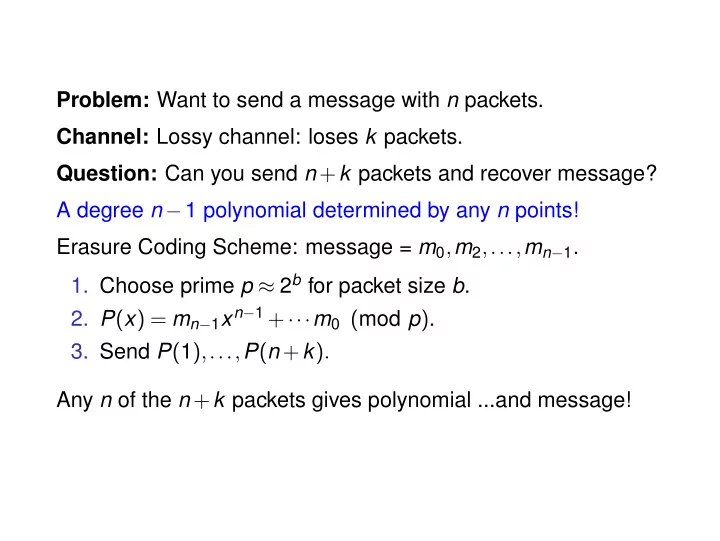
Problem: Want to send a message with n packets. Channel: Lossy channel: loses k packets. Question: Can you send n +k packets and recover message? A degree n −1 polynomial determined by any n points! Erasure Coding Scheme: message = m0,m2,...,mn−1.

  • 1. Choose prime p ≈ 2b for packet size b.
  • 2. P(x) = mn−1xn−1 +···m0 (mod p).
  • 3. Send P(1),...,P(n +k).

Any n of the n +k packets gives polynomial ...and message!

slide-2
SLIDE 2

Erasure Codes. Satellite GPS device

n packet message. So send n +k! Lose k packets. 1 2 ······ ··· n +k 1 2 ······ ··· n +k Any n packets is enough! n packet message. Optimal.

slide-3
SLIDE 3

Complexity Issues.

Size: Can choose a prime between 2b−1 and 2b. (Lose at most 1 bit per packet.) In practice, O(n) operations with almost the same redundancy.

slide-4
SLIDE 4

Polynomials.

◮ ..give Secret Sharing. ◮ ..give Erasure Codes.

Error Correction: Noisy Channel: corrupts k packets. (rather than loses.) Additional Challenge: Finding which packets are corrupt.

slide-5
SLIDE 5

Error Correction Satellite GPS device

3 packet message. Send 5. Corrupts 1 packets. A 1 B 2 C 3 D 1 E 2 A 1 C 3 D 1 E 2 B’ 2

slide-6
SLIDE 6

The Scheme.

Problem: Communicate n packets m1,...,mn

  • n noisy channel that corrupts ≤ k packets.

Reed-Solomon Code:

  • 1. Make a polynomial, P(x) of degree n −1,

that encodes message.

◮ P(1) = m1,...,P(n) = mn. ◮ Comment: could encode with packets as coefficients.

  • 2. Send P(1),...,P(n +2k).

After noisy channel: Recieve values R(1),...,R(n +2k). Property: P(i) = R(i) for at least n +k points i.

slide-7
SLIDE 7

Slow solution.

Brute Force: For each subset of n +k points fit degree n −1 polynomial to them.

◮ For subset of n +k pts where R(i) = P(i),

method will reconstruct P(x)!

◮ For any subset of n +k pts,

  • 1. at least n pts are correct since only k errors,
  • 2. P(x) is only degree n −1 polynomial that

contains the n correct points.!

Reconstructs P(x) and only P(x)!!

slide-8
SLIDE 8

Details..

P(x) = pn−1xn−1 +···p0 and receive R(1),...R(n +2k). pn−1 +···p0 ≡ R(1) (mod p) pn−12n−1 +···p0 ≡ R(2) (mod p) · pn−1in−1 +···p0 ≡ R(i) (mod p) · pn−1(n +2k)n−1 +···p0 ≡ R(n +2k) (mod p) Error!! .... Where??? Could be anwhere!!! ...so try everything. Runtime: n+2k

k

  • possibilitities.

Something like (n/k)k ...Exponential in k!.

slide-9
SLIDE 9

Reed Solomon codes of size n +2k can tolerate k errors! The scheme is information optimal: Must send n +2k packets to recover from k errors.

◮ Any two codewords must be different by 2k. ◮ Total information must equal original n packets,

plus which k packets are corrupted. n +2k packets, k garbage packets: n +k packets of information. Runtime is bad: exponential in k. Find the errors faster? ...on Wednesday.