Problem Formulation: Distributed Action Recognition Architecture - - PowerPoint PPT Presentation

problem formulation distributed action recognition
SMART_READER_LITE
LIVE PREVIEW

Problem Formulation: Distributed Action Recognition Architecture - - PowerPoint PPT Presentation

Introduction Distributed Pattern Recognition Conclusion Problem Formulation: Distributed Action Recognition Architecture Eight sensors on human body. Locations are given and fixed. Each sensor carries triaxial accelerometer and biaxial


slide-1
SLIDE 1

Introduction Distributed Pattern Recognition Conclusion

Problem Formulation: Distributed Action Recognition

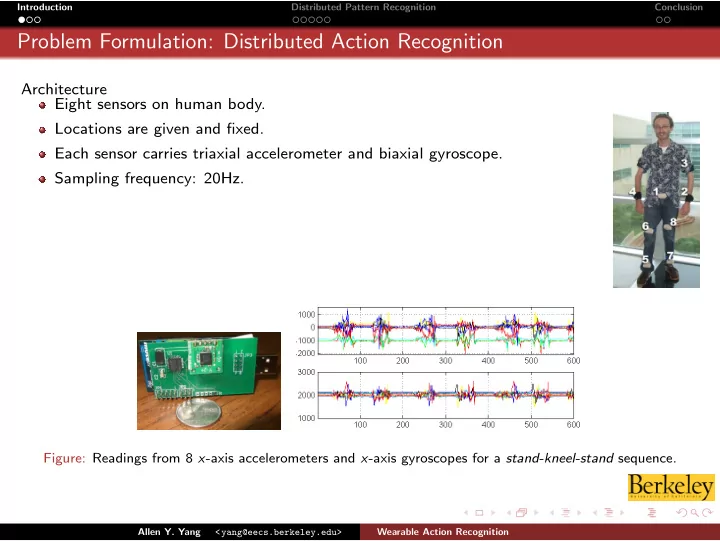
Architecture Eight sensors on human body. Locations are given and fixed. Each sensor carries triaxial accelerometer and biaxial gyroscope. Sampling frequency: 20Hz.

Figure: Readings from 8 x-axis accelerometers and x-axis gyroscopes for a stand-kneel-stand sequence.

Allen Y. Yang <yang@eecs.berkeley.edu> Wearable Action Recognition

slide-2
SLIDE 2

Introduction Distributed Pattern Recognition Conclusion

Challenges

1

Simultaneous segmentation and classification.

Allen Y. Yang <yang@eecs.berkeley.edu> Wearable Action Recognition

slide-3
SLIDE 3

Introduction Distributed Pattern Recognition Conclusion

Challenges

1

Simultaneous segmentation and classification.

2

Individual sensors not sufficient to classify full-body motions.

Single sensors on the upper body can not recognize lower body motions. Vice Versa.

Allen Y. Yang <yang@eecs.berkeley.edu> Wearable Action Recognition

slide-4
SLIDE 4

Introduction Distributed Pattern Recognition Conclusion

Challenges

1

Simultaneous segmentation and classification.

2

Individual sensors not sufficient to classify full-body motions.

Single sensors on the upper body can not recognize lower body motions. Vice Versa.

3

Simulate sensor failure and network congestion by different subsets of active sensors.

Allen Y. Yang <yang@eecs.berkeley.edu> Wearable Action Recognition

slide-5
SLIDE 5

Introduction Distributed Pattern Recognition Conclusion

Challenges

1

Simultaneous segmentation and classification.

2

Individual sensors not sufficient to classify full-body motions.

Single sensors on the upper body can not recognize lower body motions. Vice Versa.

3

Simulate sensor failure and network congestion by different subsets of active sensors.

4

Identity independence:

Figure: Same actions performed by two subjects.

Allen Y. Yang <yang@eecs.berkeley.edu> Wearable Action Recognition

slide-6
SLIDE 6

Introduction Distributed Pattern Recognition Conclusion

Challenges

1

Simultaneous segmentation and classification.

2

Individual sensors not sufficient to classify full-body motions.

Single sensors on the upper body can not recognize lower body motions. Vice Versa.

3

Simulate sensor failure and network congestion by different subsets of active sensors.

4

Identity independence:

Figure: Same actions performed by two subjects.

Proposed solutions:

1

10-D LDA feature space suffices to express 12 action classes on individual motes.

2

Individual sensor obtains limited classification ability. To save power, sensors become active only when certain events are locally detected.

3

Global classifier adapts to change of active sensors in network.

Allen Y. Yang <yang@eecs.berkeley.edu> Wearable Action Recognition

slide-7
SLIDE 7

Introduction Distributed Pattern Recognition Conclusion

Experiment Results

Precision vs Recall:

Sensors 2 7 2,7 1,2,7 1- 3, 7,8 1- 8 Prec [%] 89.8 94.6 94.4 92.8 94.6 98.8 Rec [%] 65 61.5 82.5 80.6 89.5 94.2

Allen Y. Yang <yang@eecs.berkeley.edu> Wearable Action Recognition

slide-8
SLIDE 8

Introduction Distributed Pattern Recognition Conclusion

Experiment Results

Precision vs Recall:

Sensors 2 7 2,7 1,2,7 1- 3, 7,8 1- 8 Prec [%] 89.8 94.6 94.4 92.8 94.6 98.8 Rec [%] 65 61.5 82.5 80.6 89.5 94.2

Segmentation results using all 8 sensors:

(a) Stand-Sit-Stand (b) Sit-Lie-Sit (c) Rotate-Left (d) Go-Downstairs

Allen Y. Yang <yang@eecs.berkeley.edu> Wearable Action Recognition

slide-9
SLIDE 9

Introduction Distributed Pattern Recognition Conclusion

Mixture Subspace Model for Distributed Action Recognition

1

Training samples: manually segment and normalize to duration h.

Allen Y. Yang <yang@eecs.berkeley.edu> Wearable Action Recognition

slide-10
SLIDE 10

Introduction Distributed Pattern Recognition Conclusion

Mixture Subspace Model for Distributed Action Recognition

1

Training samples: manually segment and normalize to duration h.

2

On each sensor node i, stack training actions into vector form vi = [x(1), · · · , x(h), y(1), · · · , y(h), z(1), · · · , z(h), θ(1), · · · , θ(h), ρ(1), · · · , ρ(h)]T ∈ R5h

Allen Y. Yang <yang@eecs.berkeley.edu> Wearable Action Recognition

slide-11
SLIDE 11

Introduction Distributed Pattern Recognition Conclusion

Mixture Subspace Model for Distributed Action Recognition

1

Training samples: manually segment and normalize to duration h.

2

On each sensor node i, stack training actions into vector form vi = [x(1), · · · , x(h), y(1), · · · , y(h), z(1), · · · , z(h), θ(1), · · · , θ(h), ρ(1), · · · , ρ(h)]T ∈ R5h

3

Full body motion Training sample: v = v1 . . .

v8

  • Test sample: y =

 

y1

. . .

y8

  ∈ R8·5h

Allen Y. Yang <yang@eecs.berkeley.edu> Wearable Action Recognition

slide-12
SLIDE 12

Introduction Distributed Pattern Recognition Conclusion

Mixture Subspace Model for Distributed Action Recognition

1

Training samples: manually segment and normalize to duration h.

2

On each sensor node i, stack training actions into vector form vi = [x(1), · · · , x(h), y(1), · · · , y(h), z(1), · · · , z(h), θ(1), · · · , θ(h), ρ(1), · · · , ρ(h)]T ∈ R5h

3

Full body motion Training sample: v = v1 . . .

v8

  • Test sample: y =

 

y1

. . .

y8

  ∈ R8·5h

4

Action subspace: If y is from Class i, y =  

y1

. . .

y8

  = αi,1 v1 . . .

v8

  • 1

+ · · · + αi,ni v1 . . .

v8

  • ni

= Aiαi.

Allen Y. Yang <yang@eecs.berkeley.edu> Wearable Action Recognition

slide-13
SLIDE 13

Introduction Distributed Pattern Recognition Conclusion

Sparse Representation

1

Nevertheless, label(y) = i is the unknown membership function to solve: Sparse Representation: y = A1 A2 · · · AK

    α1 α2 . . . αK      = Ax ∈ R8·5h.

Allen Y. Yang <yang@eecs.berkeley.edu> Wearable Action Recognition

slide-14
SLIDE 14

Introduction Distributed Pattern Recognition Conclusion

Sparse Representation

1

Nevertheless, label(y) = i is the unknown membership function to solve: Sparse Representation: y = A1 A2 · · · AK

    α1 α2 . . . αK      = Ax ∈ R8·5h.

2

One solution: x = [0, 0, · · · , αT

i , 0, · · · , 0]T .

Sparse representation encodes membership.

Allen Y. Yang <yang@eecs.berkeley.edu> Wearable Action Recognition

slide-15
SLIDE 15

Introduction Distributed Pattern Recognition Conclusion

Sparse Representation

1

Nevertheless, label(y) = i is the unknown membership function to solve: Sparse Representation: y = A1 A2 · · · AK

    α1 α2 . . . αK      = Ax ∈ R8·5h.

2

One solution: x = [0, 0, · · · , αT

i , 0, · · · , 0]T .

Sparse representation encodes membership.

3

Two problems:

Directly solving the linear system is intractable. Seeking the sparsest solution.

Allen Y. Yang <yang@eecs.berkeley.edu> Wearable Action Recognition

slide-16
SLIDE 16

Introduction Distributed Pattern Recognition Conclusion

Dimensionality Reduction

1

Construct Fisher/LDA features Ri ∈ R10×5h on each node: ˜ yi = Riyi = RiAix = ˜ Aix ∈ R10

Allen Y. Yang <yang@eecs.berkeley.edu> Wearable Action Recognition

slide-17
SLIDE 17

Introduction Distributed Pattern Recognition Conclusion

Dimensionality Reduction

1

Construct Fisher/LDA features Ri ∈ R10×5h on each node: ˜ yi = Riyi = RiAix = ˜ Aix ∈ R10

2

Globally  

˜ y1

. . .

˜ y8

  =  

R1 ···

. . . ... . . .

··· R8

   

y1

. . .

y8

  = RAx = ˜ Ax ∈ R8·10

Allen Y. Yang <yang@eecs.berkeley.edu> Wearable Action Recognition

slide-18
SLIDE 18

Introduction Distributed Pattern Recognition Conclusion

Dimensionality Reduction

1

Construct Fisher/LDA features Ri ∈ R10×5h on each node: ˜ yi = Riyi = RiAix = ˜ Aix ∈ R10

2

Globally  

˜ y1

. . .

˜ y8

  =  

R1 ···

. . . ... . . .

··· R8

   

y1

. . .

y8

  = RAx = ˜ Ax ∈ R8·10

3

During the transformation, the data matrix A and x remain unchanged.

Allen Y. Yang <yang@eecs.berkeley.edu> Wearable Action Recognition

slide-19
SLIDE 19

Introduction Distributed Pattern Recognition Conclusion

Seeking Sparsest Solution: ℓ1-Minimization

1

Ideal solution: ℓ0-minimization (P0) x∗ = arg min

x

x0 s.t. ˜ y = ˜ Ax. where · 0 simply counts the number of nonzero terms. However, such solution is generally NP-hard.

Allen Y. Yang <yang@eecs.berkeley.edu> Wearable Action Recognition

slide-20
SLIDE 20

Introduction Distributed Pattern Recognition Conclusion

Seeking Sparsest Solution: ℓ1-Minimization

1

Ideal solution: ℓ0-minimization (P0) x∗ = arg min

x

x0 s.t. ˜ y = ˜ Ax. where · 0 simply counts the number of nonzero terms. However, such solution is generally NP-hard.

2

Compressed sensing: under mild condition, equivalence relation (P1) x∗ = arg min

x

x1 s.t. ˜ y = ˜ Ax.

Allen Y. Yang <yang@eecs.berkeley.edu> Wearable Action Recognition

slide-21
SLIDE 21

Introduction Distributed Pattern Recognition Conclusion

Seeking Sparsest Solution: ℓ1-Minimization

1

Ideal solution: ℓ0-minimization (P0) x∗ = arg min

x

x0 s.t. ˜ y = ˜ Ax. where · 0 simply counts the number of nonzero terms. However, such solution is generally NP-hard.

2

Compressed sensing: under mild condition, equivalence relation (P1) x∗ = arg min

x

x1 s.t. ˜ y = ˜ Ax.

3

ℓ1-Ball

ℓ1-Minimization is convex. Solution equal to ℓ0-minimization.

Allen Y. Yang <yang@eecs.berkeley.edu> Wearable Action Recognition

slide-22
SLIDE 22

Introduction Distributed Pattern Recognition Conclusion

A Distributed Recognition Framework

1

Distributed Sparse Representation  

y1

. . .

y8

  =   v1 . . .

v8

  • 1

, · · · , v1 . . .

v8

  • n

  x ⇔     

y1=(v1,1,··· ,v1,n)x

. . .

y8=(v8,1,··· ,v8,n)x

Allen Y. Yang <yang@eecs.berkeley.edu> Wearable Action Recognition

slide-23
SLIDE 23

Introduction Distributed Pattern Recognition Conclusion

A Distributed Recognition Framework

1

Distributed Sparse Representation  

y1

. . .

y8

  =   v1 . . .

v8

  • 1

, · · · , v1 . . .

v8

  • n

  x ⇔     

y1=(v1,1,··· ,v1,n)x

. . .

y8=(v8,1,··· ,v8,n)x

2

The representation x and training matrix A remain invariant.

References: Distributed segmentation and classification of human actions using a wearable motion sensor

  • network. Berkeley Tech Report 2007.

Allen Y. Yang <yang@eecs.berkeley.edu> Wearable Action Recognition

slide-24
SLIDE 24

Introduction Distributed Pattern Recognition Conclusion

Conclusion

1

Mixture subspace model: 10-D action spaces suffice for data communication.

Allen Y. Yang <yang@eecs.berkeley.edu> Wearable Action Recognition

slide-25
SLIDE 25

Introduction Distributed Pattern Recognition Conclusion

Conclusion

1

Mixture subspace model: 10-D action spaces suffice for data communication.

2

State-of-the-art recognition via sparse representation

Full-body network: 99% accuracy with 95% recall. Keep one on upper body and one on lower body: 94% accuracy and 82% recall. Reduce to single sensors: 90% accuracy.

Allen Y. Yang <yang@eecs.berkeley.edu> Wearable Action Recognition

slide-26
SLIDE 26

Introduction Distributed Pattern Recognition Conclusion

Conclusion

1

Mixture subspace model: 10-D action spaces suffice for data communication.

2

State-of-the-art recognition via sparse representation

Full-body network: 99% accuracy with 95% recall. Keep one on upper body and one on lower body: 94% accuracy and 82% recall. Reduce to single sensors: 90% accuracy.

3

Applications

Beyond Wii controllers and iPhones.

Allen Y. Yang <yang@eecs.berkeley.edu> Wearable Action Recognition

slide-27
SLIDE 27

Introduction Distributed Pattern Recognition Conclusion

Conclusion

1

Mixture subspace model: 10-D action spaces suffice for data communication.

2

State-of-the-art recognition via sparse representation

Full-body network: 99% accuracy with 95% recall. Keep one on upper body and one on lower body: 94% accuracy and 82% recall. Reduce to single sensors: 90% accuracy.

3

Applications

Beyond Wii controllers and iPhones. Eldertech: falling detection, mobility monitoring.

Allen Y. Yang <yang@eecs.berkeley.edu> Wearable Action Recognition

slide-28
SLIDE 28

Introduction Distributed Pattern Recognition Conclusion

Conclusion

1

Mixture subspace model: 10-D action spaces suffice for data communication.

2

State-of-the-art recognition via sparse representation

Full-body network: 99% accuracy with 95% recall. Keep one on upper body and one on lower body: 94% accuracy and 82% recall. Reduce to single sensors: 90% accuracy.

3

Applications

Beyond Wii controllers and iPhones. Eldertech: falling detection, mobility monitoring. Energy Expenditure: lifestyle-related chronic diseases.

Allen Y. Yang <yang@eecs.berkeley.edu> Wearable Action Recognition

slide-29
SLIDE 29

Introduction Distributed Pattern Recognition Conclusion

Acknowledgments

Collaborators Berkeley: Ruzena Bajcsy, Shankar Sastry Cornell: Philip Kuryloski Vanderbilt: Yuan Xue UT-Dallas: Roozbeh Jafari Funding Support TRUST Center ARO MURI: Heterogeneous Sensor Networks (HSN)

Allen Y. Yang <yang@eecs.berkeley.edu> Wearable Action Recognition