Principles of Voter Registration and Biometric VR Workshop on BVR, - - PDF document

principles of voter registration and biometric vr
SMART_READER_LITE
LIVE PREVIEW

Principles of Voter Registration and Biometric VR Workshop on BVR, - - PDF document

20170827 Principles of Voter Registration and Biometric VR Workshop on BVR, Zimbabwe, August 2017 Intl Electoral Standards Agreed Practices Political Commitments Public International Law 20170827 ICCPR: Article 25 Every


slide-1
SLIDE 1

2017‐08‐27

Principles of Voter Registration and Biometric VR

Workshop on BVR, Zimbabwe, August 2017
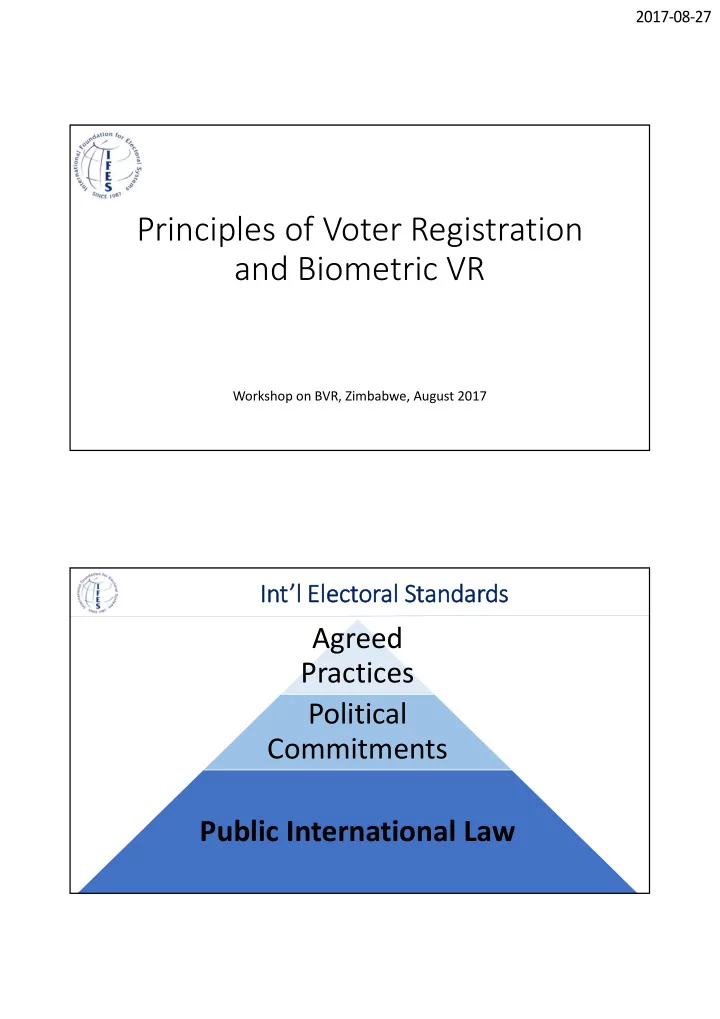
Int’l Electoral Standards

Agreed Practices Political Commitments Public International Law

slide-2
SLIDE 2

2017‐08‐27

ICCPR: Article 25

Every citizen shall have the right and the opportunity (…) without unreasonable restrictions: (a) to take part in the conduct of public affairs, directly or through freely chosen representatives (b) To vote and to be elected at genuine periodic elections which shall be by universal and equal suffrage and shall be held by secret ballot, guaranteeing the free expression of the will of the electors;

Convention on the Rights of People with Disabilities

slide-3
SLIDE 3

2017‐08‐27

CRPD

CRPD, Art. 5: (3) In order to promote equality and eliminate discrimination, States Parties shall take all appropriate steps to ensure that reasonable accommodation is provided. (4) Specific measures which are necessary to accelerate or achieve de facto equality of persons with disabilities shall not be considered discrimination under the terms of the present Convention.

CRPD

CRPD, Art. 29: ….Ensuring that voting procedures, facilities and materials are appropriate, accessible and easy to understand and use.

slide-4
SLIDE 4

2017‐08‐27

Int’l Electoral Standards

Agreed Practices Political Commitments Public International Law

Political Commitments

OAU/AU Declaration on the Principles Governing Democratic Elections in Africa ‐ AHG/Decl. 1 (XXXVIII) We commit our Governments to: establish where none exist, appropriate institutions where issues such as codes of conduct, citizenship, residency, age requirements for eligible voters, compilation of voters' registers, etc. would be addressed SOUTHERN AFRICAN DEVELOPMENT COMMUNITY Principles And Guidelines Governing Democratic Elections 2.1.1 Full participation of the citizens in the political process; 2.1.6 Equal opportunity to exercise the right to vote and be voted for; 2.1.8 Voter education.

slide-5
SLIDE 5

2017‐08‐27

Political Commitments

ECOWAS Protocol on Good Governance and Democracy 2001 Article 5: The voters' lists shall be prepared in a transparent and reliable manner, with the collaboration of the political parties and voters who may have access to them whenever the need arises.

Int’l Electoral Standards

Agreed Practices Political Commitments Public International Law

slide-6
SLIDE 6

2017‐08‐27

UN Human Rights Committee ‐ General Comment 25

PROHIBITED LIMITATIONS

Race, colour, sex, language, religion, political or other opinion, national or social origin, property, birth, physical disability, education, illiteracy, property, party membership, homeless

ALLOWED LIMITATIONS

Age, residency, members of particular public service positions, conviction

CONDITION for LIMITATION

Objective & reasonable criteria, established by the law

RESPONSIBILITY OF STATE

Effective measures, facilitation, no obstacles, voter and registration campaign

What Needs to Be Defined in the Law

  • types of citizenship and proof of age documentation;
  • types of residency documentation;
  • methods of voter registration;
  • processes for dealing with objections and appeals;
  • voter identification; and
  • documentation required by voters.
slide-7
SLIDE 7

2017‐08‐27

What Needs to Be Defined in the Law

  • types of citizenship and proof of age documentation;
  • types of residency documentation;
  • methods of voter registration;
  • processes for dealing with objections and appeals;
  • voter identification; and
  • documentation required by voters.

BIOMETRIC STANDARDS

UNIVERSAL BIOMETRIC STANDARDS PRIVACY & DATA PROTECTION STANDARDS

  • Convention for the Protection of Individuals with regard to Automatic Processing of Personal Data 1980
  • Organization for Economic Cooperation and Development Guidelines on the Protection of Privacy and Trans‐

border Flows of Personal Data 1980

  • Asia‐Pacific Economic Cooperation Privacy Framework 2004
  • The European Parliament and the Council of the European Union Directive 95/46/EC on the protection of

individuals with regard to the processing of personal data and on the free movement of such data

biometric vocabulary, testing methodology finger, signature and iris image data formats physical characteristics and test methods for ID‐cards jurisdictional and societal considerations for commercial applications security specifications user interfaces machine readable travel documents Cryptography and security mechanisms

slide-8
SLIDE 8

2017‐08‐27

PROPOSED BIOMETRIC PRINCIPLES

UNIVERSAL SUFFRAGE

  • Unless universally accessible, the system shall only be an additional and optional mean of

verification

  • The user interface should be understandable and easily usable
  • The systems should be designed, as far as is practicable, to maximize the opportunities for persons

with disabilities EQUAL SUFFRAGE

  • The system should prevent voters from having multiple records
  • The system should prevent multiple voter verifications

FREE SUFFRAGE

  • If biometric and paper‐based verification is conducted, there should be a procedure for reliable

aggregation of the data

  • The system shall indicate clearly to the voter if the verification was successful or not

SECRET SUFFRAGE

  • The system shall be so designed so it is impossible to link verification to the vote

PROPOSED BIOMETRIC SAFEGUARDS

TRANSPARENCY

  • The authorities shall take steps to ensure that voters understand the system
  • Information on the functioning of the system shall be made publicly available
  • Any observers, to the extent permitted by law, shall be able to observe the system

VERIFIABILITY AND ACCOUNTABILITY

  • components of the system shall be disclosed
  • independent body appointed by the electoral authorities, shall verify that the system

RELIABILITY AND SECURITY

  • The system shall contain measures to preserve the availability of its services during

processes and to mitigate malfunction and breakdowns

  • Only persons appointed by the electoral authority shall have access to the central

infrastructure and the voters’ data.

  • If stored or communicated outside controlled environments, the data shall be encrypted
slide-9
SLIDE 9

2017‐08‐27

PROPOSED BIOMETRIC SAFEGUARDS

TECHNICAL REQUIREMENTS

  • Users shall be involved in the design of the systems
  • Consideration shall be given, when developing new systems, to their

compatibility with existing ones

  • Open standards shall be used to ensure that the various technical

components inter‐operate

  • Those responsible for operating the equipment shall draw up a contingency

procedure

  • Systems shall generate reliable and sufficiently detailed observation data so

that election observation can be carried out

  • After the end of the registration, access to the biometric system should be

limited and allowed only for auditing purposes

  • The audit system shall be designed and implemented as part of the system

NDI Manual

At every point where electronic technologies are to be employed in election processes the following question must be asked by policy makers, election administrators, political contestants, nonpartisan election monitors, the media and the public: “Will it be possible to provide sufficient transparency in the application of this technology to allow problems to be identified and allow effective remedies to be provided?”