THE IAEAS INTERNET REACTOR THE IAEAS INTERNET REACTOR LABORATORY - - PowerPoint PPT Presentation

the iaea s internet reactor
SMART_READER_LITE
LIVE PREVIEW

THE IAEAS INTERNET REACTOR THE IAEAS INTERNET REACTOR LABORATORY - - PowerPoint PPT Presentation

THE IAEAS INTERNET REACTOR THE IAEAS INTERNET REACTOR LABORATORY PROJECT (IRL) LABORATORY PROJECT (IRL) F. FOULON 1 , A. BORIO-DI-TIGLIOLE 2 , J. VYSHNIAUSKAS-GOMEZ 3 , D. RIDIKAS 4 , P. CANTERO 5 1 National Institute for Nuclear science


slide-1
SLIDE 1

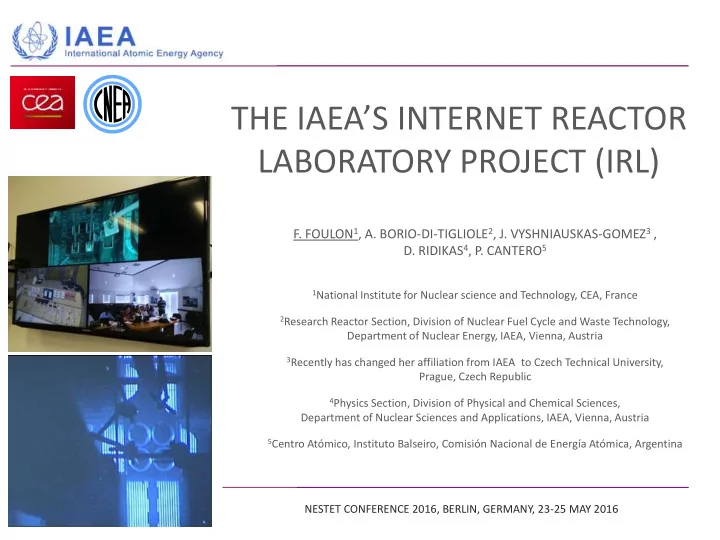
THE IAEA’S INTERNET REACTOR LABORATORY PROJECT (IRL)

  • F. FOULON1, A. BORIO-DI-TIGLIOLE2, J. VYSHNIAUSKAS-GOMEZ3 ,
  • D. RIDIKAS4, P. CANTERO5

1National Institute for Nuclear science and Technology, CEA, France 2Research Reactor Section, Division of Nuclear Fuel Cycle and Waste Technology,

Department of Nuclear Energy, IAEA, Vienna, Austria

3Recently has changed her affiliation from IAEA to Czech Technical University,

Prague, Czech Republic

4Physics Section, Division of Physical and Chemical Sciences,

Department of Nuclear Sciences and Applications, IAEA, Vienna, Austria

5Centro Atómico, Instituto Balseiro, Comisión Nacional de Energía Atómica, Argentina

THE IAEA’S INTERNET REACTOR LABORATORY PROJECT (IRL)

NESTET CONFERENCE 2016, BERLIN, GERMANY, 23-25 MAY 2016

slide-2
SLIDE 2

OUTLINE

  • 1. The Internet Reactor Laboratory (IRL)
  • 2. The IRL implementation in Europe
  • 3. The IRL implementation in Latin America
  • 4. Further IRL implementation in Africa and Asia-pacific
  • 5. Conclusion

| PAGE 2 NESTET CONFERENCE 2016, BERLIN, GERMANY, 23-25 MAY 2016

slide-3
SLIDE 3
  • 1. THE INTERNET REACTOR LABORATORY (IRL)

The Internet Reactor Laboratory project from the IAEA

  • The

concept

  • f

the IRL project was pioneered internationally in 2010 through a link from the PULSTAR research reactor of North Carolina State University to teaching classes at the Jordan University of Science and Technology.

| PAGE 3 NESTET CONFERENCE 2016, BERLIN, GERMANY, 23-25 MAY 2016

slide-4
SLIDE 4

The Internet Reactor Laboratory project from the IAEA

  • Project implemented and promoted by the IAEA.

Supported by extra budgetary funds from the US Department of State.

  • Aims at providing virtual access to research reactor (RR)

experiments, connecting an operating RR in a country (host reactor) with universities classes in other countries (gest institutions).

  • Intended to increase the global supply of nuclear education

based on the use of RRs.

  • Can benefit to countries engaged in educating human

capital for future nuclear programmes (power and non- power).

| PAGE 4

  • 1. THE INTERNET REACTOR LABORATORY (IRL)
slide-5
SLIDE 5

The Internet Reactor Laboratory project from the IAEA

  • Experiments are aimed at advanced undergraduate or

postgraduate level of nuclear engineering or nuclear physics students.

  • The IRL is under implementation in Europe and Latin

America with the ISIS reactor (France) and RA-6 reactor (Argentina): broadcasting of the experiments will start in 2016.

  • The IRL will be extended to Africa and Asia-Pacific :

broadcasting of the experiments is foreseen in 2017.

| PAGE 5

  • 1. THE INTERNET REACTOR LABORATORY (IRL)
slide-6
SLIDE 6
  • 2. EDUCATION AND TRAINING AT THE CEA/INSTN

The IRL is implemented with CEA - National Institute for Nuclear Science and Technology (INSTN)

  • Since 1956, the INSTN’s strategy has always been to

complement theoretical courses with practical courses on research reactors.

  • The ISIS reactor : 700 kW open core pool type reactor
  • The education and training (E&T) activity on the ISIS reactor:

400 on-site trainees/year, 400 hours dedicated to E&T

  • For the implementation of the IRL project in Europe, the

IAEA has been working with CEA since 2013.

  • In the period 2013-2014, CEA integrated an advanced

videoconference system on the reactor to carry out the IRL .

  • 2. THE IRL IMPLEMENTATION IN EUROPE
slide-7
SLIDE 7

The system implemented on the ISIS reactor

  • The reactor parameters (recorded and processed by the

supervision system), and the signals from 4 cameras installed on the facility can be broadcasted to trainees through the internet.

| PAGE 7

  • 2. THE IRL IMPLEMENTATION IN EUROPE
slide-8
SLIDE 8

| PAGE 8

  • Fuel Loading
  • Reactivity effect of devices
  • Rod calibration curve
  • Rod drop technique
  • Approach to criticality
  • Reactor start-up
  • Reactivity effects – reactor kinetics
  • Fast Transient
  • Temperature Effect – reactor dynamics
  • Operating Range of Detection Systems
  • Neutron Detection

LAB 1: LAB 2: LAB 3: LAB 4: LAB 5:

Five “Core experiments” to be broadcasted from the ISIS reactor

  • 2. THE IRL IMPLEMENTATION IN EUROPE
slide-9
SLIDE 9

| PAGE 9

The different steps of the project

  • Signature of the agreement between the IAEA and the host reactor,
  • Installation of the equipment on the reactor (in-kind contribution

from the INSTN to the project),

  • Development of a 25 min film in order to make a “walk through” of

the facility as an introduction to the IRL (IAEA under PUI funding).

  • Signature of an agreement between each guest institution and the

IAEA,

  • Procurement and installation of the equipment at each guest

institution (equipment funded by the IAEA),

  • Organization of two orientation workshops for the professors from

the guest institutions (during the 5 year project), first one in S3 2015,

  • Scheduling of the core experiment (should fit the academic program
  • f all guest institutions), and broadcasting the five core experiments
  • nce a year in parallel to up to six guest institutions.
  • 2. THE IRL IMPLEMENTATION IN EUROPE
slide-10
SLIDE 10

| PAGE 10

First workshop for the guest instructors (October 2015)

  • An orientation workshop for professors from the guest

institutions was organized in October 2015 at the host reactor.

  • The main objectives:
  • Train the guest professors,
  • Discuss technical and pedagogical aspects,
  • Provide practical demonstration,
  • Develop the broadcasting schedule for 2016.
  • Countries that participated to this first orientation workshop:

Belarus, Lithuania, Tanzania, and Tunisia.

  • 2. THE IRL IMPLEMENTATION IN EUROPE
slide-11
SLIDE 11

| PAGE 11

First workshop for the guest instructors (October 2015)

Workshop - In a videoconference room at the host reactor, to experience what will be the IRL at their guest institutions Workshop - In the control room

  • f the host reactor, to get familiar with

the reactor

  • 2. THE IRL IMPLEMENTATION IN EUROPE
slide-12
SLIDE 12

| PAGE 12

First workshop for the guest instructors

  • While being connected through internet to the host

reactor, the guest instructors were able to experience what will be the IRL as if they were at their own institute,

  • Their impression and feedback was very positive as they

felt that they had proper information about the reactor state and operation through the videoconference system. They were also able to interact with the host instructor and with the staff of the reactor.

  • Next step is to further develop the material

(lecture notes, documentation, protocols) so that the guest instructors can prepare the students for the experiments. This work is done in collaboration with the host reactor.

  • 2. THE IRL IMPLEMENTATION IN EUROPE
slide-13
SLIDE 13

| PAGE 13 NESTET CONFERENCE 2016, BERLIN, GERMANY, 23-25 MAY 2016

  • 3. THE IRL IMPLEMENTATION IN LATIN AMERICA

The IRL is implemented with CNEA – Balseiro Institute

  • The RA-6 reactor was designed and constructed as a school

reactor to support Nuclear Engineering career at the Balseiro Institute which was created in 1977.

  • The RA-6 reactor is a 1 MW MTR light water cooled and

moderated reactor. It was commissioned in 1982.

  • Teaching focuses on: (1) learning about experimental

reactors, (2) developing experiences focused on engineering aspects of reactors, (3) integrating specific knowledge of the different areas related to nuclear engineering.

  • For the implementation of the IRL project in Latin America,

the IAEA has been working with CNEA since 2013.

slide-14
SLIDE 14

| PAGE 14 NESTET CONFERENCE 2016, BERLIN, GERMANY, 23-25 MAY 2016

  • 3. THE IRL IMPLEMENTATION IN LATIN AMERICA

The system implemented on the RA-6 reactor

RA-6 operations signals Data Acquisition Data base recording Internet Connection Dedicated WEB platform

Modular and scalable system

slide-15
SLIDE 15

| PAGE 15 NESTET CONFERENCE 2016, BERLIN, GERMANY, 23-25 MAY 2016

  • 3. THE IRL IMPLEMENTATION IN LATIN AMERICA

The system implemented on the RA-6 reactor

Web Platform - Five Screens: 1. Welcome 2. Main menu 3. Laboratory interface 4. Historical data download 5. Bibliography Screens in the platform

  • Real Time Data
  • One Tab dedicated to each experiment
  • Control rod position always present
  • Last 3 minutes of operation data
  • Historical data with configurable time-

base and auto-range

slide-16
SLIDE 16

| PAGE 16 NESTET CONFERENCE 2016, BERLIN, GERMANY, 23-25 MAY 2016

  • 3. THE IRL IMPLEMENTATION IN LATIN AMERICA

Six “Core experiments” to be broadcasted from the RA-6 reactor 1 - Nuclear instrumentation

  • n a Research Reactor

2 - Critical approach 3 - Control rod calibration 4 - Control rod reactivity measurement (rod drop) 5 - Temperature reactivity coefficient 6 - Void coefficient calculation

slide-17
SLIDE 17

| PAGE 17 NESTET CONFERENCE 2016, BERLIN, GERMANY, 23-25 MAY 2016

  • 3. THE IRL IMPLEMENTATION IN LATIN AMERICA

The different steps of the project

  • Signature of the agreement between the IAEA and the host reactor,
  • CNEA: Develop and operate the platform,
  • CNEA: Develop the laboratory protocols adapted to the IRL,
  • CNEA: Prepare and conduct an orientation workshop for guest trainers,
  • Gest Institutions: Equip their facilities to receive the IRL,
  • Gest Institutions: Include the experiences within their curricula,
  • AIEA: Coordinate the project and support financially the procurement
  • f the equipment at the host reactor and guest institutions,
  • The guest institutions:

Universidad Mayor de San Andres (Bolivia) Escuela Politécnica Nacional de Ecuador Universidad Nacional de Colombia Instituto Superior de Tecnologías y Ciencias Aplicadas (Cuba), the Universidad Politecnica de Madrid (Spain) Universidad del Pais Vasco (Spain)

slide-18
SLIDE 18

| PAGE 18 NESTET CONFERENCE 2016, BERLIN, GERMANY, 23-25 MAY 2016

  • 3. THE IRL IMPLEMENTATION IN LATIN AMERICA

First workshop for the guest instructors (September 2015)

  • An orientation workshop for professors from the guest

institutions was organized at the host reactor.

  • The main objectives:
  • introduction to the RA-6 reactor as a machine
  • presentation of the six protocols developed for the IRL
  • host institution presented how they intend to include

the IRL activities into their curricula

  • two reactor experiments were conducted, acting as local

and remote instructors in order to show the guest instructors how should be the dynamic of the sessions

  • Develop the broadcasting schedule for 2016.
slide-19
SLIDE 19

| PAGE 19 NESTET CONFERENCE 2016, BERLIN, GERMANY, 23-25 MAY 2016

  • 3. THE IRL IMPLEMENTATION IN LATIN AMERICA

First workshop for the guest instructors (September 2015)

slide-20
SLIDE 20

| PAGE 20 NESTET CONFERENCE 2016, BERLIN, GERMANY, 23-25 MAY 2016

  • 4. FURTHER IRL IMPLEMENTATION IN AFRICA AND ASIA-PACIFIC

Implementation in Africa and Asia-pacific

  • Consultations and selection process has been started with a

number of research reactors in Africa and Asia-Pacific regions.

  • Expert missions to assess the research reactor capabilities and

suitability to host the IRL for the regional partners.

  • As a result of the assessment process, based on comparative

criteria, one host reactor will be selected in each region.

  • The procedure will result in signing contractual agreements

with these two host research reactor facilities.

  • In parallel, the IAEA is collecting information from the Member

States interested in receiving IRL courses through the internet. The contractual agreements also include the offer to receive the IRL classes at no cost for a limited period of time.

slide-21
SLIDE 21

| PAGE 21 NESTET CONFERENCE 2016, BERLIN, GERMANY, 23-25 MAY 2016

  • 5. CONCLUSION
  • IRL is a powerful tool for the development of the human

resources needed for national nuclear programmes.

  • Keeping in mind that IRL does not replace real hands-on

experimentation at a research reactor, it is seen as a cost-effective way to expand the nuclear education for students that would not normally have access to a research reactor during their educational curricula.

  • First IRL experiments will be broadcasted in Europe and Latin

America from the second semester 2016.

  • Expansion of the project in Africa and Asia-Pacific regions is also

undergoing.

  • This ensures that the IRL will contribute to the increase in the

global supply of nuclear education and training based on research reactors.

slide-22
SLIDE 22

Thank you for your attention