Principle of 10/09/2009 Lecture: 19 Effective stress Sub-topics - - PowerPoint PPT Presentation

principle of
SMART_READER_LITE
LIVE PREVIEW

Principle of 10/09/2009 Lecture: 19 Effective stress Sub-topics - - PowerPoint PPT Presentation

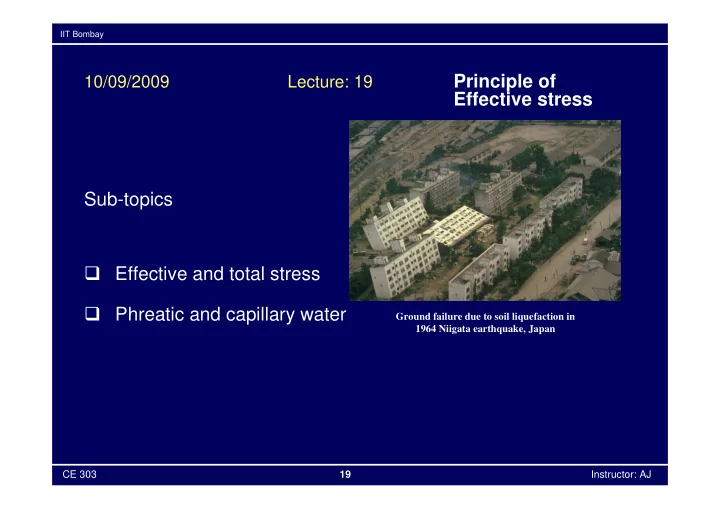
IIT Bombay Principle of 10/09/2009 Lecture: 19 Effective stress Sub-topics Effective and total stress Phreatic and capillary water Ground failure due to soil liquefaction in 1964 Niigata earthquake, Japan CE 303 19 Instructor: AJ


slide-1
SLIDE 1

IIT Bombay

CE 303 19 Instructor: AJ

10/09/2009 Lecture: 19

Principle of Effective stress Sub-topics Effective and total stress Phreatic and capillary water

Ground failure due to soil liquefaction in 1964 Niigata earthquake, Japan

slide-2
SLIDE 2

IIT Bombay

CE 303 19 Instructor: AJ

Physical interaction between soil particles and pore fluid

Inter-granular or effective stress σ’

u ' − σ = σ

Total vertical stress at depth z in soil mass Pore water pressure

z u

w

γ =

z γsat

z sat γ = σ

soil

slide-3
SLIDE 3

IIT Bombay

CE 303 19 Instructor: AJ

Is called neutral stress WHY?

  • Liquid has only normal stress which acts equally in all

directions; it has no shear component

  • σ and σ’ have normal and shear components
  • σ and u can be measured can also be estimated from

density and thickness of soil layers and location of GWT

Pore water pressure Effective stress cannot be measured can only be calculated by subtracting pore water pressure from total stress

slide-4
SLIDE 4

IIT Bombay

CE 303 19 Instructor: AJ

Total stress and pore pressure measuring instruments

slide-5
SLIDE 5

IIT Bombay

CE 303 19 Instructor: AJ

Mechanical behaviour of soil mass is linked with σ’ and not σ or u σ’ ↑ ? σ & u ↑ but dσ’ = 0 ?

Effective stress

σ’ is not the same as grain-to-grain contact stress ! Two soil particles in contact over area Ac Total/ gross area in plan = A PWP acts over area = A - Ac

( )u

A A P P

c '

− + =

( )u

A A A A P A P

c '

− + = u A A 1

c '

⎟ ⎠ ⎞ ⎜ ⎝ ⎛ − + σ = σ Or In granular materials contact area approach point area in other words Ac zero u

' +

σ = σ

slide-6
SLIDE 6

IIT Bombay

CE 303 19 Instructor: AJ

We have assumed that the plane passing through the two soil particles is horizontal (is this true? Or are we making an implicit assumption?)

Effective stress

True horizontal surface through soil at any depth would cut through many particles Horizontal plane is taken :

  • 1. For the sake of simplicity

2. Wavy plane is really indistinguishable from true horizontal plane because of small size of particles on mass scale wavy plane through points

  • f inter-particle contact
slide-7
SLIDE 7

IIT Bombay

CE 303 19 Instructor: AJ

Interparticle force-fields which contribute to effective stress are difficult to interpret Experimental evidence (Skempton 1960) has shown that principle of effective stress holds for ALL saturated soils

Effective stress principle can be applied to fine-grained soils

Mineral crystals are not in physical contact tightly bound film of water

NOTE: This principle does not hold for partially saturated soils or saturated rocks and concrete

slide-8
SLIDE 8

IIT Bombay

CE 303 19 Instructor: AJ

Ground water exists in 2 forms (i) Phreatic (pronounced free-attic)

  • r gravitational water

(ii) Capillary water Gravitational water

  • Completely saturates voids
  • Can be removed from soils by drainage
  • Upper surface is called ground water table or phreatic surface
  • Pore water pressure balances atmospheric pressure at GWT

Phreatic & capillarity water

slide-9
SLIDE 9

IIT Bombay

CE 303 19 Instructor: AJ

PWP at phreatic surface = zero ( “gauge” pressure? Absolute pressure? )

slide-10
SLIDE 10

IIT Bombay

CE 303 19 Instructor: AJ

Soils can be saturated up to some height above the phreatic surface and partially saturated up to some more height Recall: Surface tension – tendency of fluid to reduce its exposed surface to the smallest possible area Capillarity arises from adhesion and cohesion

  • ccurs at interface of water, mineral-grains, and

air Capillary water

slide-11
SLIDE 11

IIT Bombay

CE 303 19 Instructor: AJ

Tube represent voids between soil grains Meniscus formed is concave upward in water

Capillarity illustrated by small diameter glass tubes

Adhesion forces cause water to rise Molecular bonding tend to reduce surface area of water

=

slide-12
SLIDE 12

IIT Bombay

CE 303 19 Instructor: AJ

T = surface tension (force/ unit length) T acts along the perimeter at angle α to wall of tube Force ↓ = height of water column Force ↑ = vertical component of T around the circumference

α π = γ π cos dT 4 d h

w 2 c

Clean glass tube / pure water, α = 0 T is physical property of water and is about 73 mN/m; γw = 9.81kN/m3

d T 4 h

w c

γ = mm in is d if meters d 03 . hc= Patm Patm hc

α

W d T

slide-13
SLIDE 13

IIT Bombay

CE 303 19 Instructor: AJ

Below the surface: pressure is hydrostatic Above the surface: pressure is negative or less than zero gauge pressure d T 4 h u w c c − = γ − = Stress distribution in water: above & below phreatic surface

  • +

Pressure, u Compression Tension hc hydrostatic +z

  • z

zγw hcγw hc W d

slide-14
SLIDE 14

IIT Bombay

CE 303 19 Instructor: AJ

Capillary tube analogy helps explain capillary phenomenon observed in real soils

slide-15
SLIDE 15

IIT Bombay

CE 303 19 Instructor: AJ

Above the phreatic surface

  • lower part is fully saturated
  • water fills only narrowest

voids in upper part

Capillarity in soils

hc = maximum capillary rise Soil is completely saturated only up to hcs The zone between hcs and hc remains partially saturated

Regime of subsurface water divided into 4 zones

d T 4 h w c γ =

slide-16
SLIDE 16

IIT Bombay

CE 303 19 Instructor: AJ

> 10 Clay 1.5 to 12 Silt 0.3 to 3.5 Fine sand 0.12 to 1.1 Medium sand 0.03 to 0.15 Coarse sand Capillary rise (m) Soil

Capillary rise in different soils

slide-17
SLIDE 17

IIT Bombay

CE 303 19 Instructor: AJ

Empirical method Terzaghi and Peck (1967)

( )

10 c

eD C cm in h =

where D10 = effective grain size in cm C = empirical constant (between 0.1 and 0.5 cm2) Alternate theoretical height of capillary rise : replace d by 20% of effective grain size D10

mm in is d if meters d 03 . hc=