Pretty Fish in Cold Places The Ornamental Fish Trade as a Pathway - - PowerPoint PPT Presentation

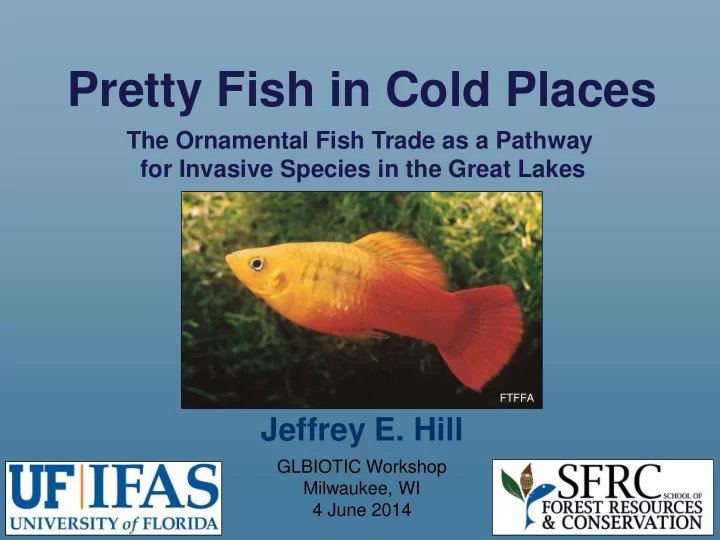
pretty fish in cold places
SMART_READER_LITE
LIVE PREVIEW

Pretty Fish in Cold Places The Ornamental Fish Trade as a Pathway - - PowerPoint PPT Presentation

Pretty Fish in Cold Places The Ornamental Fish Trade as a Pathway for Invasive Species in the Great Lakes FTFFA Jeffrey E. Hill GLBIOTIC Workshop Milwaukee, WI 4 June 2014 RISK?? RISK??? ? Questions? Questions? Historica Historical l


slide-1
SLIDE 1

Jeffrey E. Hill

GLBIOTIC Workshop Milwaukee, WI 4 June 2014

The Ornamental Fish Trade as a Pathway for Invasive Species in the Great Lakes

Pretty Fish in Cold Places

FTFFA
slide-2
SLIDE 2

RISK?? RISK??? ? Questions? Questions?

slide-3
SLIDE 3

Historica Historical l Perspec Perspective tive

  • 1848 First U.S. pet store
  • 1910 Importers/growers
  • 1980s Marine hobby
  • Currently

– 800+ varieties farmed in Florida – 2000+ species in trade (freshwater/marine)

  • 14.3 million U.S.

households with fish

  • 145 million pet fish

– APPMA 2014

slide-4
SLIDE 4

Top 25 Freshwater Top 25 Freshwater Varieties Varieties

  • Neon Tetra Paracheirodon innesi
  • Zebra Danio Danio rerio
  • Plecostomus Pterygoplichthys spp.
  • Feeder Guppy Poecilia reticulata
  • Male Betta Betta splendens
  • Comet Goldfish Carassius

auratus**

  • Ghost Shrimp Nantia sp.
  • Painted Glassfish Chanda ranga
  • Red Wag Platy Xiphophorus

maculatus

  • Black Molly Poecilia latipinna
  • Tiger Barb Puntius tetrazona
  • Mixed Fantail Goldfish

Carassius auratus**

  • Velvet Swordtail Xiphophorus hellerii
  • Black Neon Tetra Hyphessobrycon

herbertaxelrodi

  • Fancy Guppy Pair Poecilia reticulata
  • Algae Eater Gyrinocheilus aymonieri
  • Cherry Barb Puntius titteya
  • Black Skirt Tetra Gymnocorymbus

ternetzi

  • Bala Shark Balantiocheilus

melantopterus

  • Serpae Tetra Hyphessobrycon

callistus callistus

  • Velvet Wag Swordtail Xiphophorus

hellerii

  • Otocinclus Otocinclus affinis
  • Albino Aeneus Cory Corydoras

aeneus "albino"

  • Bloodfin Tetra Aphyocharax anisitsi

(** = temperate)

slide-5
SLIDE 5

Orname Ornamental ntal Fish Fish Intr Introdu

  • duction

ctions

  • Aquarium release
  • Water gardens
  • Others – bait, live food fish, ceremonial

release, aquaculture escape

  • Relatively little hitchhiking (SRAC Pub 3902)
  • How many released?
  • 10,104 fish/yr released in Montreal (95%

CI = 3,800-27,900; Gertzen et al. 2008)

slide-6
SLIDE 6

US Pathways US Pathways --

  • - USGS

USGS

slide-7
SLIDE 7

10 20 30 40 50 60 70 80 90 100 FL CA NV TX C0 AZ LA MA NY WA IL IN MT NC ID PA CT GA MO NE OH OR MN SC VA WI IA KY MD MI MS NJ OK TN WY AL SD UT VT AR KS ME NH NM RI ND WV DE

Number of Ornamental Species

Total Introduced Ornamentals

(48/48 U.S. States)

(43/48 U.S. States)

N = 135 species Range from 1 to 94 species Florida

(Hill, unpublished data)

slide-8
SLIDE 8

5 10 15 20 25 30 35 FL NV TX CA ID MT CO LA NC WY NY AZ GA IL MI NJ NM OR SD WA AL AR CT DE IN IA KS KY MD MA MN MS MO NE NH ND OH OK PA RI SC TN VA WI ME UT VT WV

Number of Ornamental Species

Established and Locally Established Ornamentals

Florida N = 44 species Range from 0 to 32

(Hill, unpublished data)

slide-9
SLIDE 9

2 4 6 8 10 12 14 16 18 20 FL IL MI NJ NY NC OH PA TX AL AZ AR CA CO CT DE GA ID IN IA KS KY LA ME MD MA MN MS MO MT NE NV NH NM ND OK OR RI SC SD TN UT VT VA WA WV WI WY

Number of Ornamental Species

Established Ornamentals

Florida N = 22 species Range from 0 to 19

(Hill, unpublished data)

slide-10
SLIDE 10

Non Non-natives natives in the in the Great Great Lakes Lakes

slide-11
SLIDE 11

Orname Ornamentals ntals in the in the GL GL

Goldfish Carassius auratus Oriental Weatherfish Misgurnus anguillicaudatus Rudd Scardinius erythrophthalmus Blue-spotted Sunfish Enneacanthus gloriosus

slide-12
SLIDE 12

Koi? or… Common Carp?

  • Common carp

widely established

  • Little published on

koi establishment

slide-13
SLIDE 13

Impact Impacts? s?

  • Goldfish can (at high

density):

– ↓ aquatic plant density

– ↑ turbidity

  • Oriental Weatherfish

– reduce invertebrate abundance – (vs. fish-less controls) …so???

slide-14
SLIDE 14

Risks of Risks of Orname Ornamental ntal Fishe Fishes

  • Risk

– Probability of establishment – Consequences of establishment

  • Few established
  • utside of warm spots

– FL, HI, CA, PR, TX, etc. – Geothermal springs

  • Few impacts overall
slide-15
SLIDE 15

Why Not Why Not the Rest the Rest of USA?

  • f USA?
  • Nearly all ornamental

species are tropical

– Low climate match

  • Require strong and

reliable thermal refuge

– Hot springs – Power plants

  • Winter kills in Florida
  • Loss of tropical species

in TX cooling reservoirs

slide-16
SLIDE 16

Limits Limits on Success:

  • n Success: Florida

Florida

  • Cold winter

temperatures

– Most in south Florida

  • Biotic resistance

– Predators – Aggressive competitors

  • Chance?
slide-17
SLIDE 17

(Tuckett et al. unpublished data)

Established Fishes in Florida

slide-18
SLIDE 18
slide-19
SLIDE 19

GL Percent Ice GL Percent Ice Cover Cover

slide-20
SLIDE 20

Month Avg. High Avg. Low Mean Record High Record Low Jan 74°F 50°F 62°F 87°F (1967) 16°F (1977) May 89°F 66°F 78°F 100°F (2006) 49°F (1992)

  • Avg. low air temp in January in

Okeechobee is warmer than most GL surface temps in late May 30s°F 40s°F 50s°F 60s°F

slide-21
SLIDE 21

A warm winter…

slide-22
SLIDE 22

GL Studies GL Studies

  • “…only seven recorded species could potentially survive

winter temperatures in the Great Lakes.” Rixon et al. 2005

  • Excluded “…tropical fish, which have high diversity but

pose a negligible invasion risk to the Great Lakes.” Keller and

Lodge 2007

  • “…the establishment of most aquarium species is limited

in this region owing to environmental tolerances…” Gertzen et

  • al. 2008
  • “There are currently very few common aquarium fish

species considered to be significant AIS threats to Canadian waters, primarily because most of the species

  • riginate from tropical climates and cannot tolerate the

cold northern winter temperatures.” Marson et al. 2009

slide-23
SLIDE 23

Fish I Fish Invasiv nvasiveness Screening eness Screening Kit Kit (FI (FISK) SK)

  • Adapted from Australian Weed Risk

Assessment (WRA)- Pheloung et al. (1999) by Copp et al. (2005)

  • FISK v2 (Lawson et al. 2013)
  • Semi-quantitative

– Scores -11 to 57: Low risk < 1, High risk >19 – Adapted to multiple environments and taxa

  • Biogeography, introduction/invasion history

(including impacts), and biology/ecology

  • Widely used outside the United States
slide-24
SLIDE 24

FISK FISK v2 v2

  • FISK: 49 questions (each with

guidance notes)

– Biogeography/History

  • Domestication/cultivation (3)
  • Climate and distribution (5)
  • Invasive elsewhere (5)

– Biology and ecology

  • Undesirable traits (12)
  • Feeding guild (4)
  • Reproduction (7)
  • Dispersal (8)
  • Persistence (5)

http://www.cefas.defra.gov.uk/our- science/ecosystems-and- biodiversity/non-native- species/decision-support-tools.aspx

slide-25
SLIDE 25
  • 10
  • 5

5 10 15 20 25 30 35 40

Mean FISK Score Florida Fishes

LOW RISK

Lawson 2014

slide-26
SLIDE 26

FISK FISK Assessment Assessment of

  • f GloFish

GloFish

  • USA
  • Low risk

– Climate match only in warm regions – Little invasive history – Few traits of concern

  • Hill et al. 2014 TAFS

143:817-829 Common Name Scientific Name FISK v2 Score Black Tetra Gymnocorymbus ternetzi

  • 3.5

Tiger Barb Systomus tetrazona

  • 2.5

Zebra Danio Danio rerio

  • 0.5
slide-27
SLIDE 27

Bottom Bottom Line Line

  • Most species in the ornamental fish

trade are tropical and have a low climate match for most regions

  • The Great Lakes region has a lot of

problems with invasives, but the aquarium fish trade is a minor risk

slide-28
SLIDE 28

Recommend Recommendations ations

  • Evaluate the overall ornamental trade

(i.e., plants, invertebrates, fish, & other vertebrates):

– Species capable of surviving the cold climate and establishing permanent populations – Species likely to cause noticeable impacts if they establish

  • Use risk-based approaches to inform

management

slide-29
SLIDE 29

Acknowledgme Acknowledgments nts

  • Tim Campbell and Doug Jensen
  • Funding sources:

– Florida Department of Agriculture and Consumer Services – Florida Fish and Wildlife Conservation Commission – US Department of Agriculture – US Fish and Wildlife Service

  • Pam Fuller (US Geological

Survey)

  • Quenton Tuckett, Larry Lawson,

Craig Watson (UF-TAL)

  • Marshall Meyers (PIJAC)
  • Courtenay and Meffe 1989